Hypercar Maker Czinger Reveals “World’s First” 3D Printed Gearbox Case

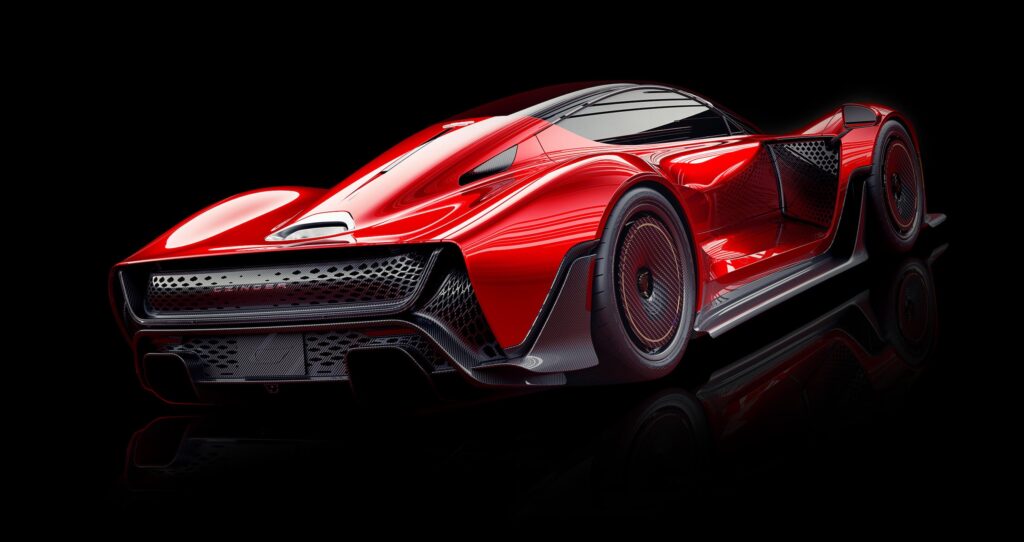
Czinger Vehicles, the maker of electric hypercars built on the Divergent Adaptive Production System (DAPS) assembly line, announced what the company claims is the first 3D printed automotive gearbox case. Partnering with UK automotive engineering firm Xtrac, Czinger used topology optimization software to design the gearbox case, which was printed in a proprietary aluminum alloy.
Topology optimization software is often used in additive manufacturing (AM), and is increasingly combined with AI-driven generative design. Those who favor the technique use it to speed up the design phase and maximize certain engineering attributes, especially structural efficiency. Divergent Technologies, the parent company of Czinger, developed its own in-house topology optimization software, one of the integral components to the DAPS platform.
Xtrac specializes in designing gearboxes for race cars, making the company a logical choice of partner for a manufacturer of fuel-efficient luxury hypercars. In addition to the gearbox case’s reduction in mass and its complex geometry, the main advantage to 3D printing the part is that it doesn’t require the use of tooling, which adds to the savings in lead time.
In a press release about the first 3D printed gearbox case, Lukas Czinger, the co-founder and senior VP of operations at Czinger Vehicles, commented, “We are proud to team Czinger’s world-class engineers with those at Xtrac; together, we have developed an incredible, industry first, gearbox that is truly at the pinnacle of performance. We can’t wait to shatter more track records as we utilize this system in the 21C.” The CEO of Xtrac, Adrian Moore, said, “What our Xtrac engineers have accomplished in tandem with Czinger and Divergent is groundbreaking. Xtrac is pleased to be at the forefront of cutting-edge gearbox manufacturing by creating these 3D printed casings. It has been extremely interesting and very stimulating for our engineers working closely together to bring this cutting edge innovation to life.”

Also speaking to the importance of software at Czinger is the fact that Divergent Technologies received a $100 million investment at the end of last year from Swedish software giant, Hexagon AB. Divergent has been extremely well-funded over the years. Prior to the investment from Hexagon, Divergent had already received a combined $240 million in financing and investments in 2022 alone — not a year when investors were generally very risk-friendly.
I think Divergent’s tech will have value regardless of how Czinger Vehicles does. That will remain a question until feedback comes in on the first Czinger cars to be delivered, which is expected to happen in late 2023. Even if they’re popular, moreover, the continued scale-up of production for a business model like Divergent’s/Czinger’s requires a constant steady increase of funding.
Luxury brands did very well in 2022, so there is reason to think that even if financing continues to be tough for risky ventures in 2023, Czinger will keep defying odds. Additionally, speaking of defying odds, if the broader market continues to be more resilient than expected, and there is a sudden resurgence of SPACs and IPOs, Czinger seems like the type of company that could do well by going public under the right circumstances.
Subscribe to Our Email Newsletter
Stay up-to-date on all the latest news from the 3D printing industry and receive information and offers from third party vendors.
Print Services
Upload your 3D Models and get them printed quickly and efficiently.













You May Also Like
The Manufacturing Race Behind the Drone Revolution
We are in the middle of a major manufacturing shift focused on the production speed and payload capacity of uncrewed aerial systems (UAS), or drones. A recent Manufacturing Dive article...
ADDMAN to Buy Up to $10.8M in Nickel 718 Powder from 6K Additive Over 30 Months
After years of buildup, we’re finally starting to see what the US metal additive manufacturing (AM) market could look like at scale. To be sure, it’s still not quite there,...
Metal AM in a Multipolar World, Part 2: How PBF and DED Could Change by 2035
The first decades of PBF development were heavily shaped by machine capability: more power, more lasers, larger build volumes, better recoating, and improved process monitoring. These developments will continue, but...
Advanced Manufacturing at IMTS 2026: 3D Printing and AI and Drones, Oh My!
Last week’s International Manufacturing Technology Snow (IMTS) in Chicago welcomed over 90,000 attendees to the jungle that is McCormick Place. With over 1.17 million square feet of exhibit space, and...