EOS Buys Metalpine, but What’s Behind the Move?


EOS has bought Austrian powder manufacturer Metalpine. EOS doesn’t buy companies often. And with increased competition from China & SLM, profligate spending doesn’t seem like it would be a good idea right now. So the Metalpine purchase should be a key to EOS’ future.
The company’s CTO, Joachim Zettler, said,
“For many years, Metalpine has been a strong and innovative partner to EOS. By integrating Metalpine into EOS, we are taking the next logical step in our collaboration, strengthening our metal materials supply and accelerating innovation, particularly in titanium, where we see significant and sustained market demand.”
Meanwhile, Metalpine CEO Gerald Pöllmann stated,
“During the past few years, we have built a rock-solid foundation with EOS. Becoming part of EOS is a natural progression of this partnership, enabling us to further develop our technologies and scale our capabilities while continuing to reliably serve customers worldwide.”
And Metalpine CTO Dr. Martin Dopler added,
“Our patented process stands for exceptional powder quality and consistency. As part of EOS, we will further advance material innovation and support the growing requirements of industrial additive manufacturing, while continuing to provide our products to a broad market.”

Metalpine facility in Austria. Image courtesy of EOS.
Options?
OK, so let’s get the problematic stuff out of the way first. EOS could have bought AP&C, a metal powder business within GE Aerospace’s additive group, Colibrium Additive, or whatever is left of Carpenter’s additive manufacturing materials business. Could it have maybe done something with GKN, too? SLM and EOS work extensively with all powder manufacturers in some capacity or another. Perhaps choosing one powder company could make the others more reticent to do business with EOS? Perhaps, as well, the other powder companies would be less inclined to share their latest research with EOS. This is not a riskless purchase; there very well will be knock-on effects from this.
If EOS wanted to double down on super special powders, then maybe Elementum 3D would have been a more defense-centric play. Reportedly, that firm’s products are doing well in the US defense establishment. If you want something special with significant growth potential, it could be hilarious to buy CP1 from Constellium. Both the CP1 and Elementum materials are also used significantly in F1 and have a lot of growth potential.
A World Beyond LPBF
I think I would have rather bought Norsk Titanium and then entered into the aerospace DED business, really. That would have been really cool because then you can use your experience to let people make big parts well, and also the smaller, more detailed parts. DED has a lot of potential in repair, cladding, armor, and aerostructures. A broader adoption could see the technology gain widespread adoption in industrial and automotive settings. I think that a well-capitalized Norsk would be able to leverage a lot of growth in defense in the US and within the aerospace and new space supply chain. That company is an underappreciated gem.
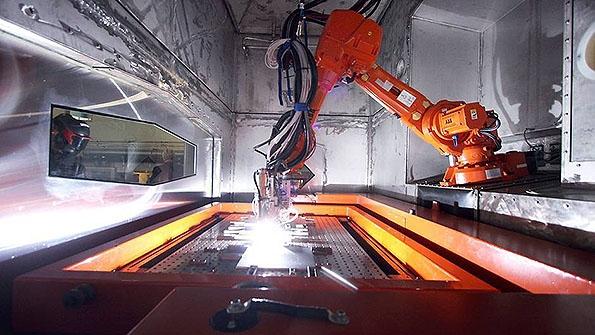
Norsk Titanium’s Direct Metal Deposition (DMD) technology. Image courtesy of Norsk Titanium.
ATO
Now, if you wanted to double down on responsible manufacturing, an atomizer company like ATO or similar would be a nice play. Imagine offering a way to turn metal scrap into powder for car firms? Imagine you build a complete chain to turn your scrap into powder using EOS equipment. That would be an interesting solution for a lot of industrials. You could try buying MetalPowderWorks or something and make your own “6K for everyone” play. That to me would have been truly interesting. And at high volume, this would make a real impact. It could be a valuable business line for EOS, allowing them to double down on their laboratory and research customers. You could also be a key environmental solution for large European firms while being a key enabler of the manufacturing resilience through-fest going on in the US. If I were in it for the money, the growth, or the environment, that’s what I would have done.

ATO atomizers use ultrasonic vibrations to break molten metal into droplets. Image courtesy of ATO.
Explanation?
Therefore, I think the most logical explanation is that Metalpine was either struggling to raise cash to fund growth and turned to EOS, or that a large EOS customer implementation relied on Metalpine powder, so the company bought the firm. That could be either because it wanted to own the entire process chain (Apple, aerospace, medical) or because it had to guarantee the solution’s availability for a long time. Another alternative was that the application demanded such scale that EOS had to buy Metalpine to ensure it could grow towards it in tandem. Or perhaps the customer needed certain assurances to dominate, own, or control the entire process chain, and a sale was the only way to get it off the ground. That could very well be the reason, and it would make sense. GE, for example, found it necessary to buy the OEM and the powder company to scale its application, for example. EOS was a shareholder, so a Metalpine buy could have been opportunistic or something more active than an asset sale. Could EOS have seen that the firm could achieve better results with its machines using Metalpine and wanted to capitalize on that? Perhaps, but why do you need to do this then?
How EOS Explains It
The firm says that it is a part of a partnership and lets EOS,
“expand access to high-quality titanium powders produced through Metalpine’s patented atomization process, known for its consistency and performance in demanding industrial applications.”
EOS also states that,
“The acquisition strengthens EOS’ ability to deliver tightly integrated materials, parameters, and process expertise — helping manufacturers for fast and effective qualification, improve process stability, and scale additive manufacturing into serial production with greater confidence. Those industries and applications reliant on titanium (aerospace, medical, and high‑performance industrial applications) now garner greater access to high‑quality powders engineered for consistent performance in serial additive manufacturing environments.”
Furthermore, the company says that Metalpine will be an independent business. EOS also states that it “underlines EOS’ commitment to an open ecosystem and continued collaboration with a wide range of partners across the additive manufacturing industry.”
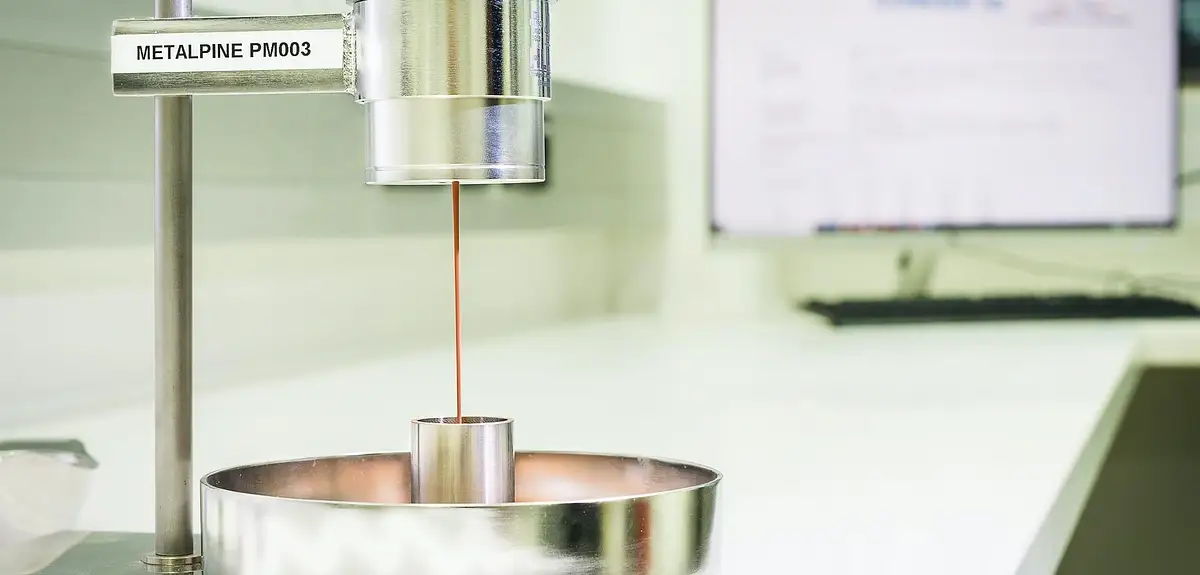
Metalpine’s metal powder production. Image courtesy of Metalpine.
Now, Metalpine is capable of making highly spherical, reduced final porosity powders. This very well may be advantageous. To move ot the next stage of production, owning that particular process could give EOS customers advantages over others. Better dialed-in, better powders could make a difference. Especially if people wish to deploy large-scale systems and manufacturing lines, this may matter. This could also let EOS give moe guarantees in large-scale implementations and perhaps find ways to offset supplier risks (e.g., if we go bankrupt, you get all the recipes, kind of stuff).
And there is a logic here in what EOS said. I would have much rather bought ATO and turned it into an alloy discovery and recycling system for large customers. That, to me, is a true product extension that would dramatically lower costs and make more production possible. Now, the thing is, Joachim Zettler is much, much smarter than I am. Marie is much, much smarter than I am. So the two of them, plus a board member or two, should be super way smarter than me. So, what is going on here? The most logical thing still is that there is a huge customer implementation somewhere that is so key to EOS that they had to do this. Or EOS is doing this to appease a potential buyer. There are not many companies that could afford the ticket and provide a sufficiently glorious future for the firm.
Could it make sense for Apple to buy EOS to gain an edge in making thinner, more hardware-packed cases from recycled materials while using less material overall? Less porosity and thinner walls really add up if you make hundreds of millions of things. Maybe in the Appleverse, a lot of things make sense that don’t for other companies. Something similar could really give Apple an edge in the consumer devices market. Whatever the answer, this is a thought-provoking move by EOS.
Subscribe to Our Email Newsletter
Stay up-to-date on all the latest news from the 3D printing industry and receive information and offers from third party vendors.
Print Services
Upload your 3D Models and get them printed quickly and efficiently.













You May Also Like
AM Pulse Asia: Consumer Metal AM, Nuclear Parts and Rockets Push New Ground
The second half of August produced financing milestones, facility openings, and qualification results across Asia-Pacific additive manufacturing. Rongsu Technology closed a CNY 100 million Series A+ and launched a consumer...
HeyGears G1 Passes $14M on Kickstarter with Full-Color 3D Printing
HeyGears was started in 2015 and has been making value-driven Vat Polymerization systems for dental and home use. The company is marketing savvy and very driven. Now the firm has...
One Machine, Three Worlds of Creation: Inside the HeyGears G1 Series
Turning a digital idea into a finished full-color physical product often requires several machines, multiple software tools, manual coloring, repeated positioning, and outsourced production. For creators and small businesses, this...
AMPulse Asia: India’s Orbital Launch Headlines a Busy Second Half of July
The second half of July brought major developments across Asia’s additive manufacturing sector. Highlights included India’s first private orbital launch powered by 3D printed engines, a billion-yuan ownership change at...