
UnionTech Takes $31M to Grow SLA 3D Printing

Shanghai-based 3D printer manufacturer UnionTech has announced a significant funding round worth 200 million Yuan (USD$31 million). The series D financing was led by Dening Capital, with participation from Money Capital, Yingke Private Equity, Dragonrise Capital, Evonik Equity Capital GmbH and more. This substantial influx of cash will likely see the firm grow rapidly alongside other major Chinese manufacturers like Farsoon and INTAMSYS.
Founded in 2000, UnionTech is primarily focused on stereolithography (SLA), claiming to maintain the largest market share for SLA in China. This includes standard laser-based SLA machines and digital light processing (DLP) UV projector-based 3D printers, from small medical and dental systems like the S110 to large-scale production printers like the D800. Additionally, UnionTech has developed its own software suite, which includes pre-print software Polydevs, print management tool RSCON/DSCON, and cloud-based fleet control software UnionFab—in other words, a complete software ecosystem.
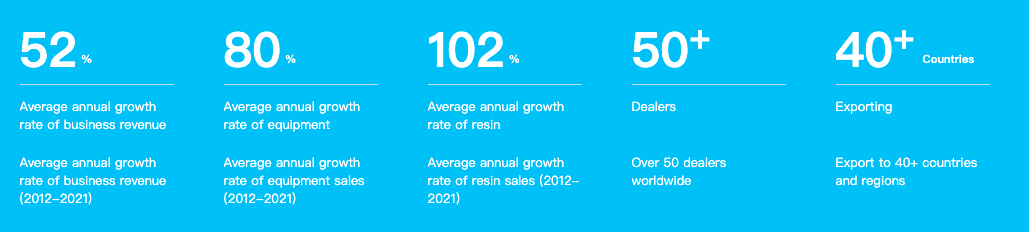
Image courtesy of UnionTech.
Among other things, the company suggests it has over 2,000 customers globally, 137 patents, some 5,500 pieces of equipment installed around the world, and a 52 percent revenue growth rate from 2012 to 2021. UnionTech also says that it spent more than 100 million Yuan (USD$16 million) on research and development over the past three years.
Interestingly, UnionTech sells resins made formerly by DSM, now Covestro, for its machines, but Evonik, previously focused on polymer sintering powders, has been investing in the Chinese firm since at least 2020 when it acquired a minority stake. Evonik, which developed the first synthetic powder for selective laser sintering (SLS) in 1996, began breaking into other polymer formats in 2020 with a poly ether ether ketone (PEEK) filament for extrusion.
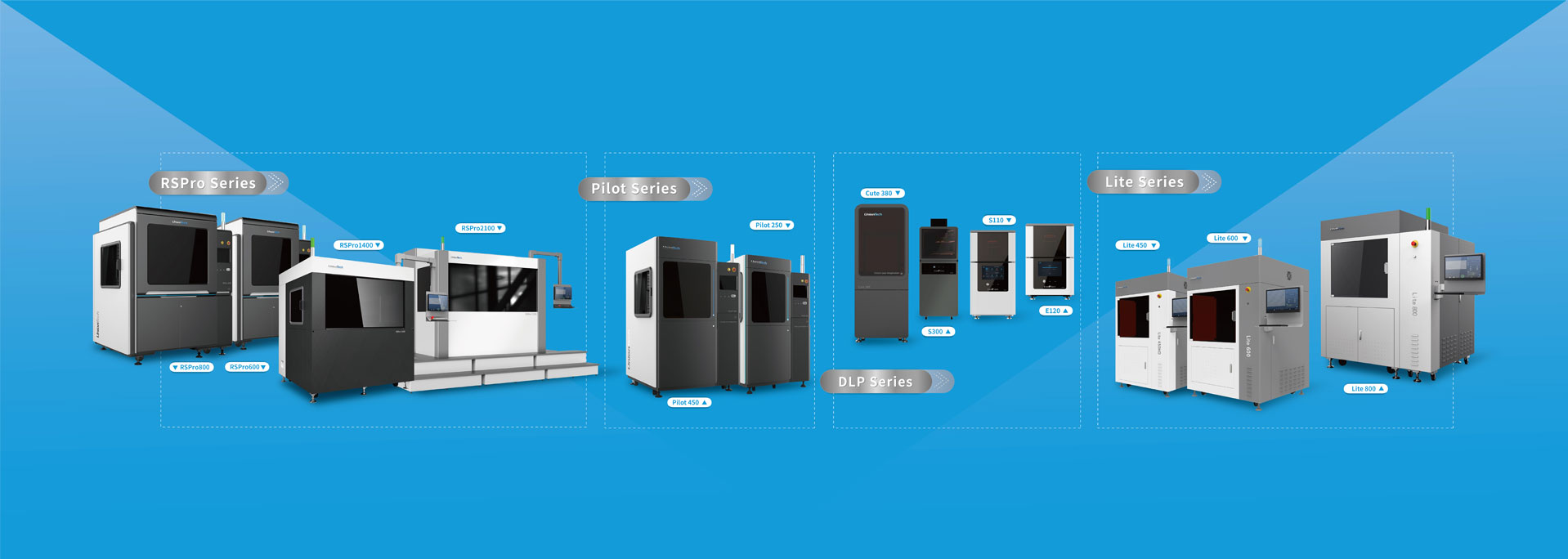
UnionTech’s various lines of 3D printers. Image courtesy of UnionTech.
Backing UnionTech not only gets the materials firm into photopolymers, but also the rapidly growing Chinese market, where Farsoon dominates in SLS and metal powder bed fusion and INTAMSYS is the current leader in industrial material extrusion. Both of those companies are expanding quickly, as Farsoon reported record sales in Q3 and INTAMSYS received an investment from Porsche. Meanwhile, desktop systems from China now dominate the low-cost sector. This includes Creality, Elegoo, and nearly countless others.
Perhaps UnionTech will use this funding to broaden into SLS and extrusion with the support of Evonik. Otherwise, we can imagine it continuing to add to its already robust portfolio of SLA and DLP machines, maybe venturing into large-scale continuous DLP similar to Azul 3D in the U.S. Or maybe it will simply add to its international teams.
Subscribe to Our Email Newsletter
Stay up-to-date on all the latest news from the 3D printing industry and receive information and offers from third party vendors.
Print Services
Upload your 3D Models and get them printed quickly and efficiently.













You May Also Like
The Manufacturing Race Behind the Drone Revolution
We are in the middle of a major manufacturing shift focused on the production speed and payload capacity of uncrewed aerial systems (UAS), or drones. A recent Manufacturing Dive article...
ADDMAN to Buy Up to $10.8M in Nickel 718 Powder from 6K Additive Over 30 Months
After years of buildup, we’re finally starting to see what the US metal additive manufacturing (AM) market could look like at scale. To be sure, it’s still not quite there,...
Metal AM in a Multipolar World, Part 2: How PBF and DED Could Change by 2035
The first decades of PBF development were heavily shaped by machine capability: more power, more lasers, larger build volumes, better recoating, and improved process monitoring. These developments will continue, but...
Advanced Manufacturing at IMTS 2026: 3D Printing and AI and Drones, Oh My!
Last week’s International Manufacturing Technology Snow (IMTS) in Chicago welcomed over 90,000 attendees to the jungle that is McCormick Place. With over 1.17 million square feet of exhibit space, and...

























































