Micro 3D Printing Startup BMF Announces Partnership with Materialise

Materialise (Nasdaq: MTLS) has long been developing build processors and software for systems in the 3D printing industry, ranging from desktop extrusion 3D printers to industrial scale machines. Now, Materialise is going tiny with Boston Micro Fabrication (BMF). BMF announced that it will offer 3D printing software powered by Materialise, who has developed a Magics Build Processor for BMF’s Projection Micro Stereolithography (PμSL) technology.
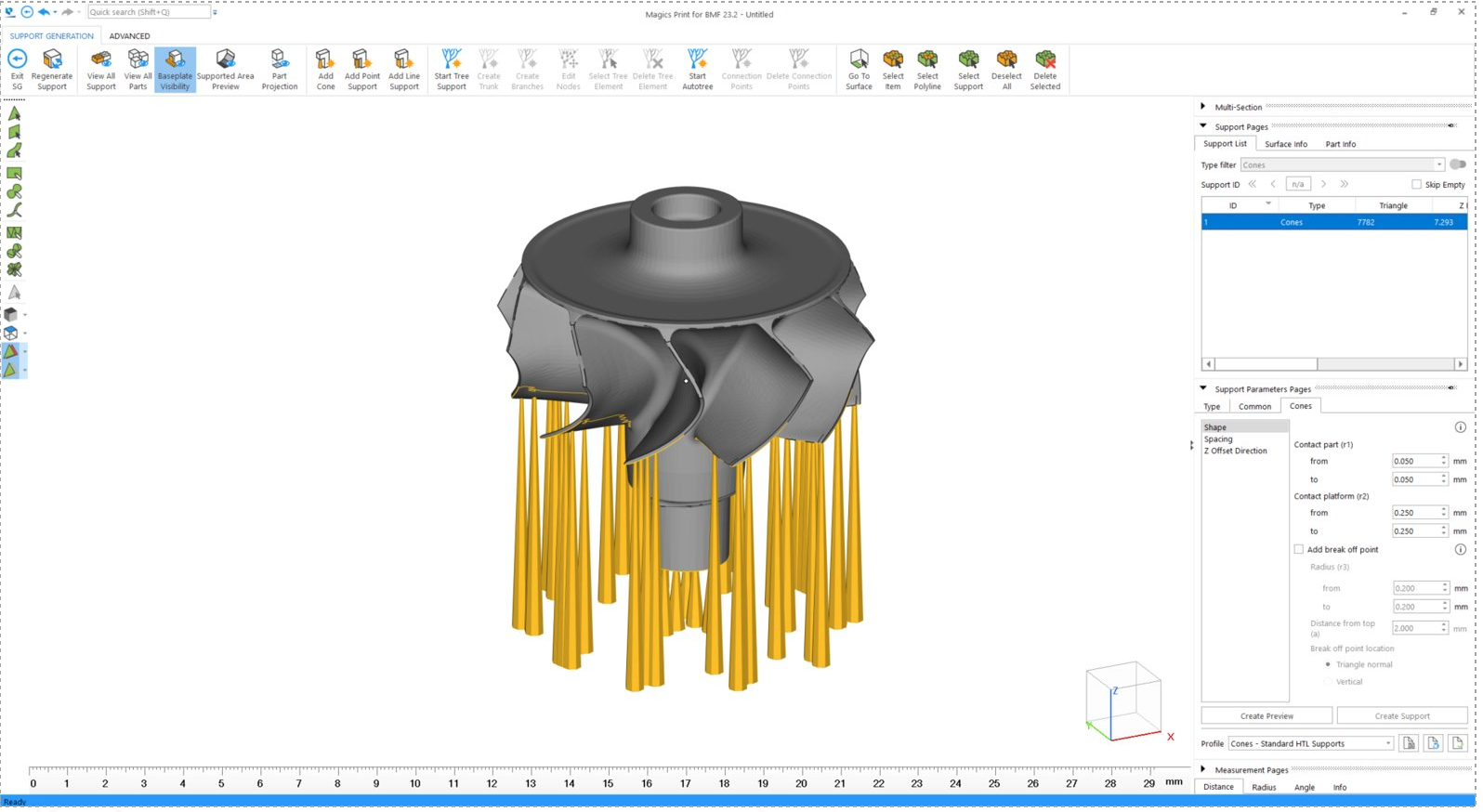
Automated support generation using Magics Print for BMF. Image courtesy of BMF.
In February 2020, BMF debuted its flagship microArch 3D printer series, capable of printing objects 100 times smaller than a human hair. Available in a variety of sizes, the microArch is able to print at a resolution as fine as 2 microns with tolerances of ±10µm /±25µm and at volumes cost competitive with injection molding. It can also print with tough, elastic, casting, biocompatible and high-temperature resins. Example objects printing with the technology include a terahertz lens.

Magics Print for BMF enables detailed part information. Image courtesy of BMF.
Now, with Magics Print for BMF, those deploying the use of microscale 3D printing can setup builds and prepare data using Materialise software. The software offers improved support structure generation, with support structure types and styles that can be customized to a user’s specific geometries. In turn, the company claims, users are able to achieve improved build success and accuracy, as well as a cut in preprocessing times. The software offers the following capabilities:
- STL File import
- Translate, Rotate, Scale parts
- Duplicate parts with arrays and orient parts using automatic placement
- Support structure generation with customizable profiles for Point, Line, Block, Cone and Tree support structures
- Creation of high-resolution build data (slices / layers) using the Magics Build Processor
“Today’s agreement will combine the strengths of our leading 3D file editing software with BMF’s powerful PµSL 3D printing technology,” says Karel Brans, Sr. Market Director at Materialise. “This will help BMF’s customers achieve the highest level of precision and accuracy available on the market today.”
Visit the Materialise “OEM Solutions” page on the company’s website and you’ll find a vast array of diverse businesses in the industry. Even this author was surprised at the variety, having been unaware of just some of Materialise’s newest partnerships. In addition to industry stalwarts, like EOS, SLM Solutions, 3D Systems, and Arcam/Concept Laser/GE Additive, as well as Software leaders like Siemens and PTC, there are the newer entrants that have proven their own prowess, such as Additive Industries, HP, and AddUp. And then there are exciting startups, such as Desktop Metal and Essentium.

Materialise’s many partners.
Many of these partnerships involve the integration of Materialise’s Magics Build Processor, which enables communication between 3D printing software and the machine itself. Apparently, so many of these businesses, large and small, new and old, have found that the company’s Build Processor is so capable at this key task that they have integrated it into their equipment. Either that or the rest of Materialise’s software that works with the Build Processor, such as Magics Print, is so ubiquitous that it might be easier to have the Build Processor installed in their equipment so as to streamline communication.
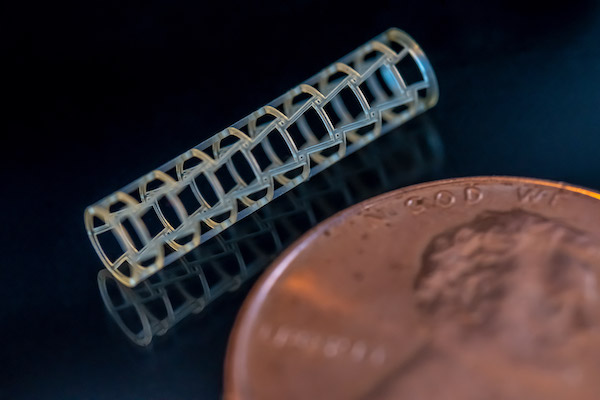
A 3D printed cardiovascular stent made using BMF technology. Image courtesy of BMF.
The partnership with BMF expands Materialise into the niche sector of microprinting. In other words, Materialise has established itself within every nook and cranny of the 3D printing sector. And because this sector is growing rapidly, as manufacturing giants adopt the technology, Materialise is rising with it, as demonstrated by its 2018 investment from BASF. Is there a new 3D printing technology on the market? You can probably guess that Materialise will find itself involved.
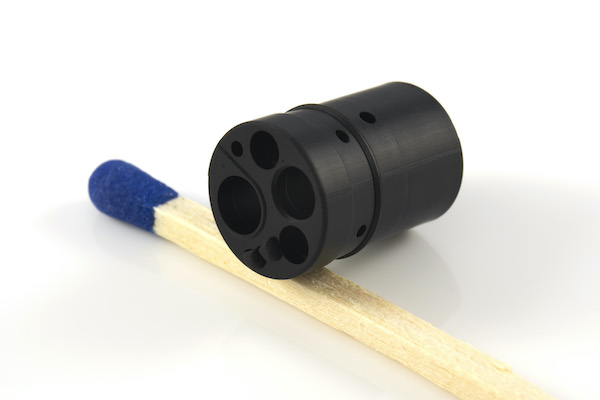
A 3D printed endoscope shell made with BMF technology. Image courtesy of BMF.
In a recent article, 3DPrint.com Executive Editor Joris Peels argued for more niche 3D printing services, including microscale production. While we now see BMF teaming with Materialise on the software front, when will we see a similar partnership on the microscale service front? After all, the ability to 3D print tiny cardiovascular stents and endoscope parts seems like it might be a nice synergy for Materialise’s vast experience in medical 3D printing.
Subscribe to Our Email Newsletter
Stay up-to-date on all the latest news from the 3D printing industry and receive information and offers from third party vendors.
Print Services
Upload your 3D Models and get them printed quickly and efficiently.













You May Also Like
UniFormation S10 Heads to Kickstarter with an Integrated Resin Printing and Post-Processing System
UniFormation will launch its S10 desktop resin 3D printer on Kickstarter on October 22, 2026, with pledges starting at $999. The S10 integrates printing, washing, and drying, allowing a print...
Creality Goes Pro with Sermoon P1S 3D Scanner
From making millions of value-engineered Prusa clones, Creality really has aggressively pivoted to more complex machines. The company has made strides forward in software, and the Ender’s of yore is...
Stratasys Showcases 3D Printed Automotive Applications & New Printer at IMTS 2026
Just ahead of last week’s International Manufacturing Technology Show (IMTS) in Chicago, Stratasys launched the F870, a new large-format, production-grade FDM 3D printing platform designed to drive industrial manufacturing at...
Creality Launches SPARKX i8 on Indiegogo, Bringing Fastest, No-Purge-Waste Printing
Creality announces the launch of the multi-color 3D printer SPARKX i8 on Indiegogo, at an early-bird price of $309 (MSRP $399) starting from Sept. 21. Designed for ultimate user experience,...