Juggerbot 3D and ORNL Collaborate on 3D Printing of Thermosets and Thermoplastics


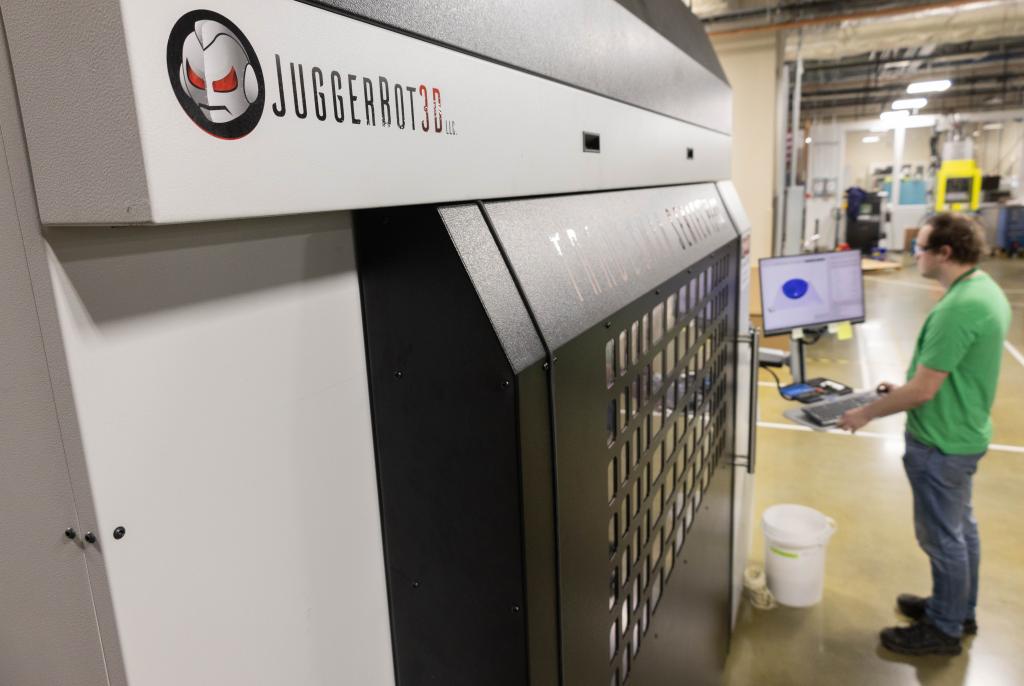
Youngstown-based JuggerBot 3D makes medium-format pellet printers. The firm is also doing some exciting defense work with a combination of Direct Ink Write, thermosets and pellet printing, and received a $4 million grant for large-format 3D printed parts for the US Air Force. At the same time, the company is also 3D printing with PVC, which is about the worst idea in 3D printing, because several toxic substances can remain behind in the nozzle, the printer mechanics, on parts, and in people, even with venting and filtration.
Now, the company is going to work once again with ORNL and its Manufacturing Demonstration Facility (MDF). As part of the Technical Collaboration Program, they will both look at thermoset materials, as they want to develop printers that can print both thermoset and thermoplastic materials. That could mean, for example, that you print a thermoplastic quickly for cost and then add a thermoset coating or outer layer for smoothness. But, through mixing the best of both worlds with these materials, a lot more could be possible. You could have a mostly recycled object, but only use thermosets for the properties you need, or you could quickly add smoothness and chemical resistance to a large, cheap part.
This is clearly a continuation of the earlier DoD award, whereby JuggerBot looked at functionally graded thermoset and thermoplastic printing. This is a frontier that I’m super excited about. Previously, JuggerBot worked with ORNL on improving pellet printing. Now, they want to look at better slicing software with the ORNL Slicer 2. They also increased deposition accuracy by better measuring deposition kinetics and the mass of the bead laid down. The two also added “critical process parameters for hundreds of thousands of materials” to the JuggerBot printer. That would eliminate a lot of the guesswork for 3D printing with the JuggerBot system, and make it easier to adopt; a JuggerBot Material Card system for the rest of our industry, that would save hundreds of millions.
MDF Director Ryan Dehoff stated,
“Creating innovative solutions with industry partners is what the MDF does best. Our strengths in digital, materials and additive manufacturing, combined with the expertise and interesting challenges industry brings, allow us to advance U.S. competitiveness.”
The partners are thinking of epoxies, vinyl esters, and polyurethane. Now that, of course, totally explains the PVC printer, because PU is also dangerous, and these vinyl esters are not to be messed with either. Now I’m going to go out on a limb here and say that they’re looking at high temperature-resistant composite materials for hypersonics or missiles more generally. In this rare public article by a Chinese team, they look at Bismaleimide resin matrix composite materials and polyimide composites. A holy grail thing the team could be in part looking at is the production of phenolic ablation structures or TPS. Thermal protection systems and additive are a match made in heaven. TPS tiles for spacecraft are a bottleneck for space exploration and space forces worldwide. Solving it would sustain US dominance in space. The smartest Chinese lady in the world is working on this, or maybe cracking the free WiFi at Washington Dulles International Airport. The PU 3D printing, in turn, could point to the need to 3D print FRSI or flexible reusable surface insulation material that could be in Nomex or PU. Being able to do one of those things well would set the company up for life. If they did a few of the above well, I’ll quit my job and move to Youngstown to be their new in-house massage therapist.
JuggerBot 3D co-founder Zachary DiVencenzo said,
“When our company first transitioned to pellet-fed 3D printing, we faced a big risk because there were no available slicers that could do what we envisioned. That is, until we met the ORNL team. Their existing slicer software was the foundation we needed to grow. Now, the updated open-source Slicer 2 showcases how ORNL innovates for all advanced manufacturing. We’re far from the only company that will benefit from it.”
Alex Roschli, one of ORNL’s R&D staffers, said,
“Operators only need to know which machine they’ll be using. They can slice the CAD design once, then the system pulls in the Material Card data and does the rest, They won’t need to run the entire calibration process each time they change materials. This can save days or weeks. That adds up for a company.”
For their next joint step, ORNL and JuggerBot hope to improve the slicer so that it can slice both thermoset and thermoplastic tool paths and do joint tool pathing. They also hope to have more Material Cards. This development is one of the most exciting things happening in additive. The ability to make gradient composites on demand and make metamaterials of both thermoplastic and thermoset materials could really expand the makeable with 3D printing. From better chemical resistance, strength, or just being able to print quickly and not have to machine everything for two weeks, this would represent a huge leap forward for our industry.
Subscribe to Our Email Newsletter
Stay up-to-date on all the latest news from the 3D printing industry and receive information and offers from third party vendors.
Print Services
Upload your 3D Models and get them printed quickly and efficiently.













You May Also Like
3D Printing News Briefs, September 12, 2026: Rebranding, Cybersecurity, Project Call, & More
We’ve got a lot of business news from ATLIX to start off this weekend’s 3D Printing News Briefs, with a new identify for its additive manufacturing (AM) portfolio and some...
Apple’s 3D Printed Hinge Cover & the Inauguration of the Ternus Era
Marc Andreessen notwithstanding, it turns out that hardware is, in fact, eating the world. Perhaps after being starved for so long, the hardware side of tech innovation is now overcompensating,...
3D Printing News Briefs, September 10, 2026: Tax Credits, Polymer Research, Microneedles, & More
We’re starting off this week’s 3D Printing News Briefs with a little business from Axtra3D and Beehive Industries, before moving on to a scientific collaboration agreement between Roboze and a...
IperionX Gets $11.5M Army Boost to Make Titanium Fasteners in the U.S.
IperionX is going to get another $11.5 million, potentially up to $25.4 million, of an existing SBIR Phase III with the Army (Task Order W911QX26FA097). The award covers low-cost titanium...