Velo3D Secures Further $12M in Funding for Metal 3D Printing

After already securing $28 million in a series-D round of investment just this April, Velo3D has announced an additional $12 million in funding for the series. This brings the total raised by the startup so far to $150 million, a probable testament to the capabilities of the company’s metal 3D printing technology.
Velo3D CEO and Founder Benny Buller made the announcement on LinkedIn:
“I am proud to announce that we have successfully completed fundraising with the addition of new strategic investors. We are very excited to see this level of interest from multiple industry leaders that use our solution to overcome complex challenges for their businesses and will be announcing more about this in the coming weeks,” Buller said. “In this unprecedented time of uncertainty, this raise enables us to grow our product portfolio with new machines and alloys and to continue providing world-class support to our customers.”
Buller said that the funding would be used to help the company expand and reach profitability. Given the company’s technology and customers so far, it seems as though that goal may not be far off.

VELO3D’s Assure™ quality control dashboard enables engineers to track the quality and progress of Sapphire® machines in real-time.
What sets Velo3D’s metal laser powder bed fusion (PBF) process apart from other metal PBF technologies is the high degree of control achieved, from pre-print to actual fabrication. Before printing even begins, Velo3D’s Assure software is able to simulate the task, accounting and compensating for any potential stresses or deformations that might occur. Within the print chamber, the atmosphere is also highly managed and closed-loop feedback corrects for possible errors during the build.
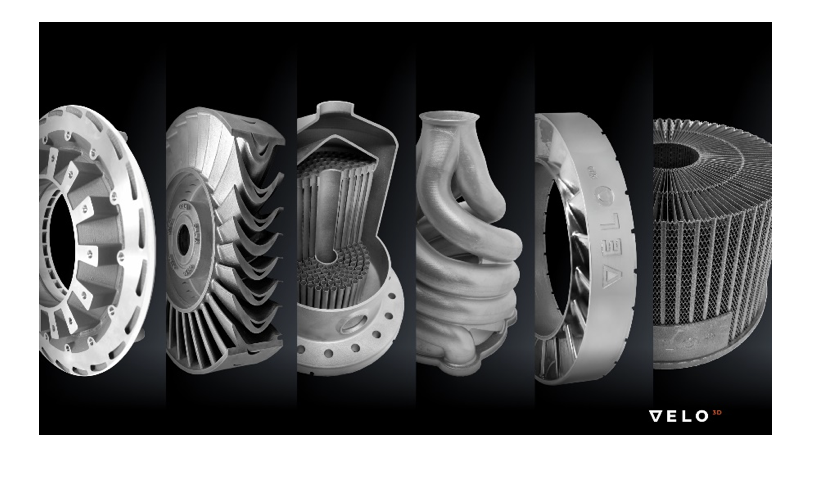
All of this not only enables a great deal of precision and detail, but also support-free overhangs that are impossible with other metal PBF systems. Moreover, this makes it easier to achieve the proper part with the first print and then repeatability with subsequent prints. Altogether, the process presents the possibility of overcoming the legacy issues associated with metal PBF technology: first-time printability, consistency, support structure optimization, thermal stress and associated problems, such as cracking and deformation.
With these capabilities, it’s not surprising that companies such as Stratasys, Honeywell, SpaceX, Knust-Godwin and Boom Supersonic have begun working with the technology. It’s also no surprise that Carl Bass is the chairman of the startup’s board of directors, which is made up of numerous tech investors.
As the company continues its growth, it will surely face competition. If other metal PBF manufacturers, including GE Additive, can hone in their technologies from the quality control side and adopt simulation tools being offered by firms like ANSYS and Hexagon or develop their own in-house, it’s possible they may be able to achieve the same capabilities. For that reason, Velo3D will need to stay ahead of the curve until it is potentially acquired by such a competitor in the future.
Subscribe to Our Email Newsletter
Stay up-to-date on all the latest news from the 3D printing industry and receive information and offers from third party vendors.
Print Services
Upload your 3D Models and get them printed quickly and efficiently.













You May Also Like
3D Printing News Briefs, August 22, 2026: Polymers for CubeSats, Animal Mobility Devices, & More
We’re starting with defense news in this weekend’s 3D Printing News Briefs, before moving on to polymers for CubeSats and 3D printed prosthetics. We’ll end with a story about engineering...
Pusan National University & ORNL Develop Elastomeric Liquid Crystal Actuators
Researchers from Korea’s Pusan National University and Oak Ridge National Laboratory (ORNL) have developed 3D printed elastomeric actuators. In a paper published in Nature, the team used elastomeric liquid crystal...
Scientists Use BMF to 3D Print Seal Whiskers That Track Prey Long After It’s Gone
Seals use their whiskers to hunt. Not Navy Seals, although they may in some way also, but this article is about lowercase seals. Not Seal the musician either; as far...
Harvard’s Jennifer Lewis Lab Is 3D Printing Artificial Muscles That Twist and Bend on Demand
Researchers at Harvard John A. Paulson School of Engineering and Applied Sciences (SEAS) have developed a new way to 3D print materials that can move on their own, bending, twisting,...