4DTexture: Holistic Computational Design for 3D Surfaces


Researchers from both the US and China are taking digital fabrication and texture in materials to the next level, releasing the findings of their study in the recently published ‘4D Texture: A Shape-Changing Fabrication Method for 3D Surfaces with Texture.’
4D printing is growing as an area of interest for many researchers, but like 3D printing—and even more so—there is still enormously uncharted territory. Users are able to move beyond the constraints of 3D printing to meet pressing needs for more complex projects like creating new metastructures, surfaces, and new materials and techniques. 4D printing offers more to users innovating beyond the 3D, seeking to fabricate more complex geometries too.
In this study, the authors introduce a new design approach called 4DTexture which they describe as a ‘holistic computational design and fabrication method, leveraging the state-of-the-art 4D printing process to make 3D surfaces with texture.’
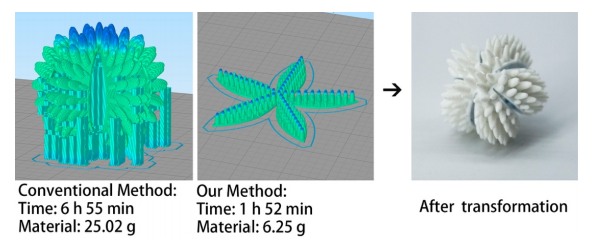
Time and material consumption comparison between conventional printing and 4DTexture method.

Shape-changing principle: the textured structure can be printed without a support structure, which can transform into a 3D textured shape after heat triggering.
While the benefits of 3D printing are and continue to be vast for industrial users, 4D printing opens up new areas for fabrication that usually cannot be explored through conventional technology either. The new technique created in this study allows for actuators to be made with vertical texture structures—later to be turned into more complicated forms. The system runs on Rhino with Grasshopper, comprised of the following for preview and customization:
- Texture element
- Arrangement
- Tendency and transformation type
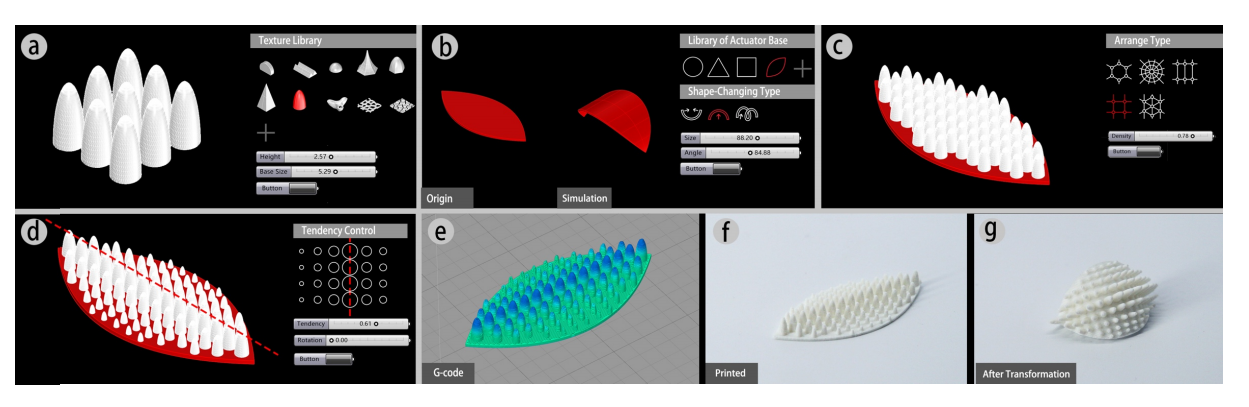
The workflow: users can (a) design the element of texture and (b) the shape of actuator, define the transformation type and (c) the arrange type of the texture, (d) set the tendency of the texture, then (e) generate the g-code file which can be printed by an FDM printer, finally users can obtain (f) the printed flat piece which can be heat triggered into (g) the target 3D shape.
Experiments were performed on textured structures as the researchers built up a ‘library’ consisting of shapes like hemispheres, pyramids, and hemicylinders. The program offers tools so that parameters can be customized; for example, designers can use offered 4D morphing mechanisms from previous projects or modify the settings if needed. Once the actuator shapes are set, textures can be arranged. Height and size can be chosen, and users can also move textures.
PLA was used with a MakerBot Replicator 2X as the researchers printed sample textures using the defaults for the hardware, producing self-rising, self-coiling, and self-bending objects.
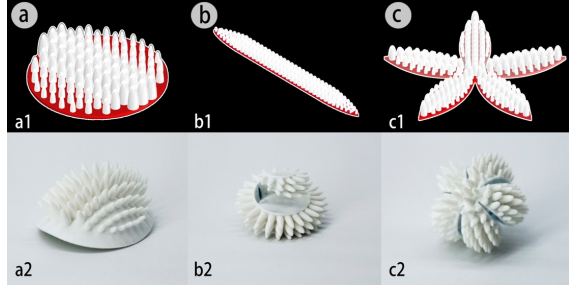
Transformation types: (a) self-rise (b) self-coil and (c) self-bend.
“The transformation mechanism can be controlled by the printing direction, which has been embedded into our system to simulate the behavior,” stated the researchers.
Just as 3D printing has allowed for a variety of different forays into fashion, 4D printing has too, bringing all the benefits of materials that can morph and shift as needed. In this study, the researchers fabricated fashion accessories, a modular toy, a haptic handle, and 3D fasteners.
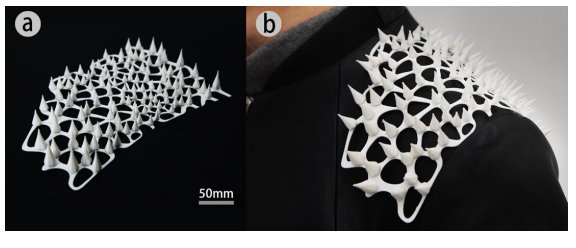
Fashion design: (a) The flat printed piece; (b) The decorative scenario.
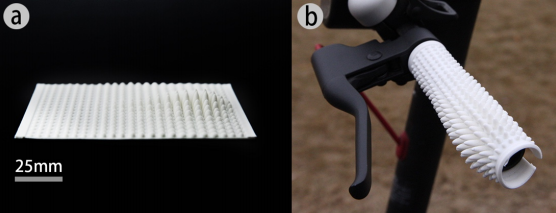
Customized haptic handle: (a) The flat printed piece; (b) The usage scenario.

3D fasteners: (a) The flat printed piece; (b, c) The usage scenario.
“We hope such a system can expand the design opportunity of 4D printing technology with a hobbyist FDM printer,” concluded the researchers. “In the future, we plan to implement a systematic material experiment for improving transformation accuracy and fine-tune the parametric setting with Grasshopper to make the design tool more user-friendly. We also found that the texture structure can serve as a constrained layer which needs further investigation.”
What do you think of this news? Let us know your thoughts! Join the discussion of this and other 3D printing topics at 3DPrintBoard.com.
Subscribe to Our Email Newsletter
Stay up-to-date on all the latest news from the 3D printing industry and receive information and offers from third party vendors.
Print Services
Upload your 3D Models and get them printed quickly and efficiently.












You May Also Like
Beyond the Prototype: How TPM3D Is Putting Industrial SLS to Work on the Factory Floor
A structural component for an autonomous police patrol vehicle in Dubai went from weighing 27 kilograms to just four. Delivery time dropped from seven days to two. The component was...
AMPulse Asia: The Push to Scale Up 3D Printing
China’s latest metal AM investments, Japan’s new hybrid manufacturing systems, and Australia’s defense-related projects lead this edition of AMPulse Asia. The 12 stories also cover advances in single-crystal 3D printing,...
Kratos Buys an AMCM M 8K to Increase Its AM Capacity in Indiana
As is true concerning the growth of any market, increasing AM adoption happens primarily through industrial clusters, hubs of economic activity which harness and accelerate innovation. While Indiana may not...
Aurora Labs Raises A$6M to Scale 3D Printed Turbojet Production
Australian metal 3D printing company Aurora Labs (ASX: A3D) is raising A$6 million ($4.2 million) to expand production of its small turbojet engines for defense and aerospace customers. The financing...