Beyond the Prototype: How TPM3D Is Putting Industrial SLS to Work on the Factory Floor



A structural component for an autonomous police patrol vehicle in Dubai went from weighing 27 kilograms to just four. Delivery time dropped from seven days to two.
The component was produced using the S600DL, an industrial selective laser sintering (SLS) system developed by TPM3D.
But lightweight vehicle parts are only one piece of the story. In Spain, the same SLS platform is being used to manufacture customized medical orthotics, while a German additive manufacturing service provider has adopted TPM3D technology to expand its automotive production capacity.
These are very different manufacturing challenges, but they point to a common question facing the 3D printing industry: How do you move beyond what’s technically possible and make additive manufacturing work in everyday production?
What Happens When SLS Moves Beyond Prototyping?
For Dubai-based MicroPolis Robotics, the challenge was developing structural components for autonomous police vehicles while reducing weight and shortening production lead times.
Using TPM3D’s S600DL, the company adopted SLS to manufacture complex polymer components without dedicated tooling. The project illustrates how changes in part design and manufacturing methods can deliver practical advantages beyond simply replacing one production process with another.

MicroPolis autonomous patrol robot. Image courtesy of Micropolis.
In Spain, medical orthotics company Edser has been using TPM3D’s large-format dual-laser SLS technology to manufacture customized orthotic products. As demand grows, increasing production capacity while maintaining short delivery times has become an important priority. Equipped with two 140 W CO₂ lasers, the S600DL helps improve printing efficiency, while its large build volume allows multiple customized products to be produced in a single build.
Orthotics are a particularly interesting application because every patient can require a different shape, size, or fit. With SLS, manufacturers can produce personalized designs without creating separate molds for each patient.
For the Spanish manufacturer, the challenge was producing more customized products while keeping delivery times short. Its products include insoles, sandals, braces, and other customized orthotics. To increase capacity, it selected TPM3D’s S600DL, a dual-laser printer with a 600 × 600 × 800 mm build volume that can accommodate multiple products in one build.
TPM3D states the custom-fit insoles can be delivered in as little as four days, using a process that begins with a digital foot scan and ends with 3D printing and post-processing. The large build volume also allows complex orthotic designs to be manufactured in one piece.
Materials were another important consideration. The company uses TPM3D’s PP Pro polypropylene powder, which offers properties similar to the conventional polypropylene already used in its products. As Edser explained, “PP Pro is quite similar to traditional polypropylene used for making insoles and customers like it.”
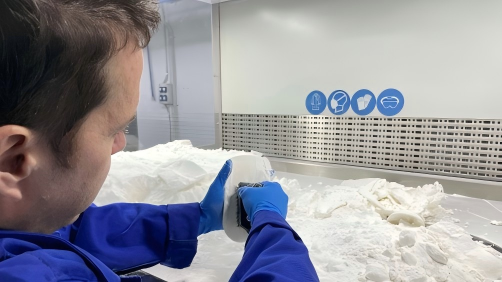
Edser technician cleaning an SLS-printed insole at a TPM3D powder-processing station. Image courtesy of Edser.
Although SLS requires specialized knowledge and training, the manufacturer said the workflow becomes smooth once operators are familiar with the equipment. Its S600DL is also paired with a powder-processing station to support material handling and recovery.
Meanwhile, in Germany, additive manufacturing service provider cirp added TPM3D’s S480 printer to increase its capacity to produce polymer parts for automotive customers.
Based in Stuttgart, cirp has decades of experience manufacturing prototypes and production parts. As demand for small-batch automotive components increased, the company needed additional SLS capacity while maintaining consistent quality and keeping production costs under control.
Before selecting the S480, cirp evaluated several factors, including equipment performance, production capacity, material compatibility, and operating efficiency. The printer has a 480 × 480 × 600 mm build volume and can produce up to 20 kilograms of finished polymer parts per build, depending on their geometry and arrangement, as well as material type.
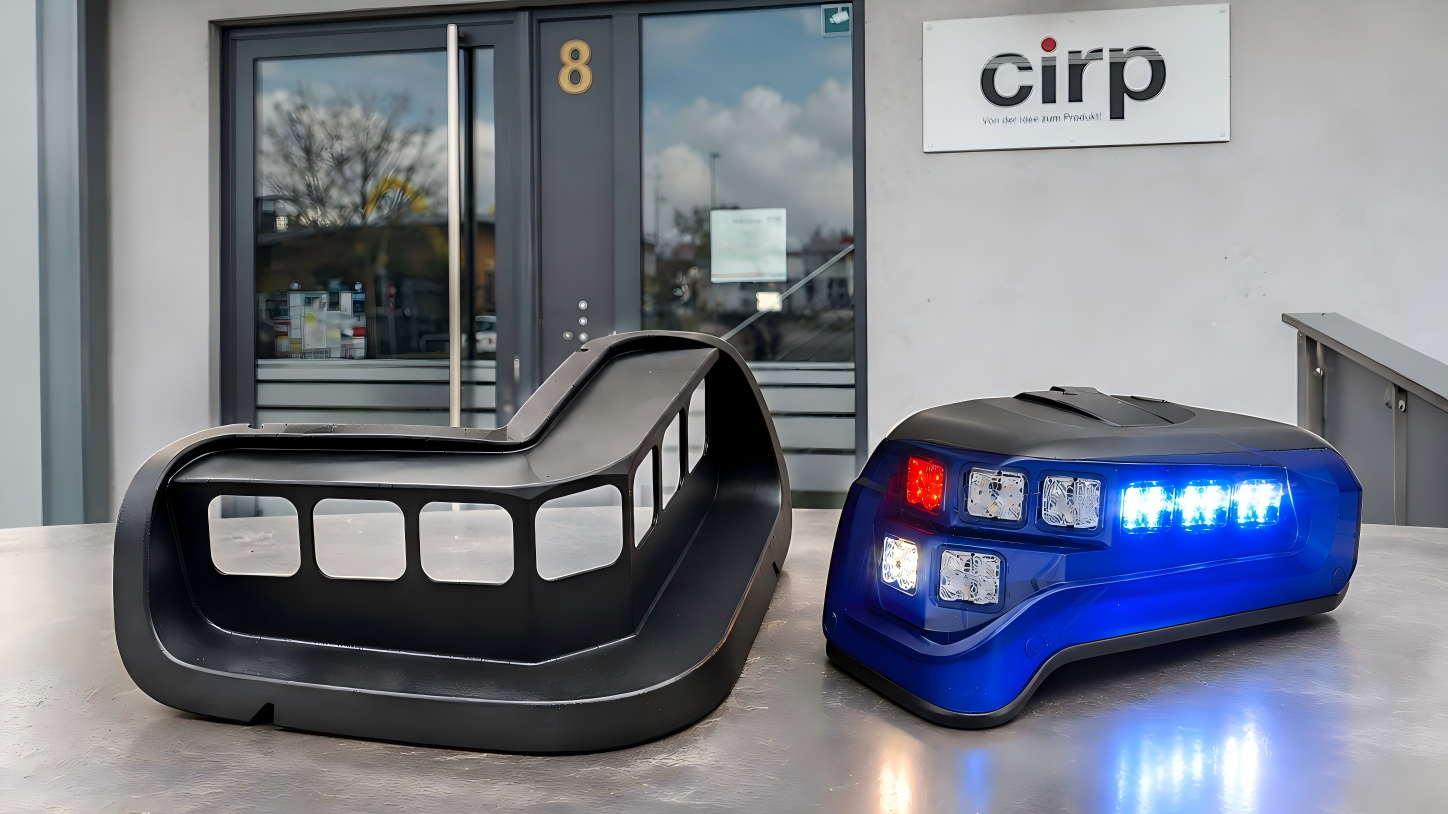
SLS 3D printed ambulance emergency light housing by cirp. Image courtesy of cirp.
The system is being used to manufacture automotive-related components, including emergency vehicle warning-light housings, fuel-system sealing components, and customized lighting parts. It also supports PA11 processing, using temperature control and powder recoating to help maintain consistent results.
Cirp uses TPM3D’s powder-processing station alongside the printer to manage powder recovery, mixing, and supply. For a service provider handling different customer orders, these steps are important because material use, production time, and repeatability all affect manufacturing costs.
The SLS Technology Behind the Applications
Behind these different applications is a company that has spent more than two decades developing polymer SLS technology.
TPM3D’s roots go back to 1999, when its original team began working in 3D printing services and research in China. By 2007, the team had developed its own industrial SLS system, laying the groundwork for a business that would eventually grow into an international equipment manufacturer.
Today, TPM3D specializes in polymer SLS, a process that uses a laser to fuse thin layers of plastic powder into solid parts. Unlike many conventional manufacturing methods, it doesn’t require molds
or dedicated tooling. It also allows manufacturers to create complex shapes and produce multiple components in a single build. That flexibility helps manufacturers develop new products or produce smaller batches, where designs and production needs can change frequently.
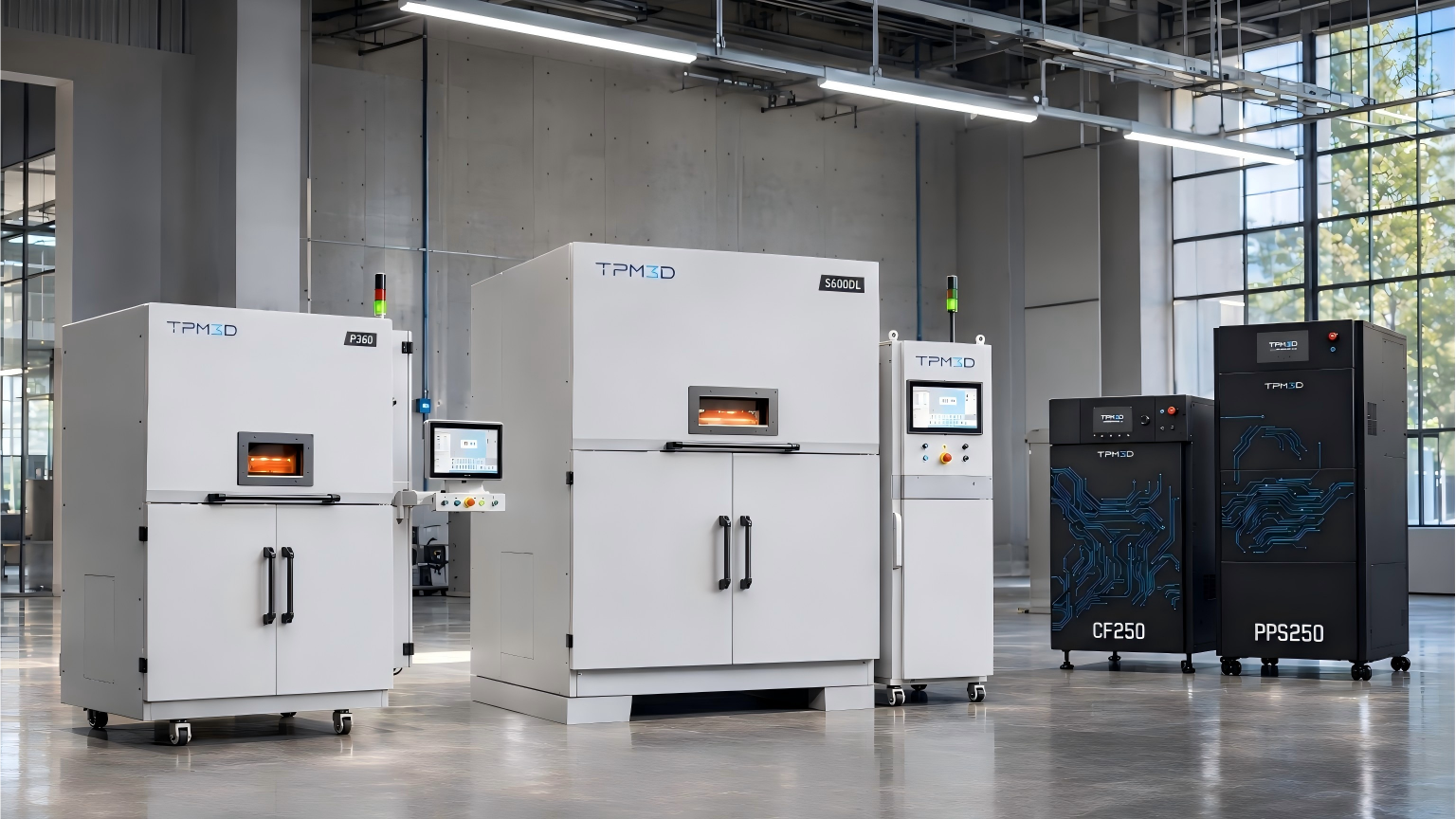
TPM3D’s industrial and professional SLS 3D printer lineup, featuring the P360, S600DL, and CF250. Image courtesy of TPM3D.
TPM3D has built its portfolio around these capabilities, offering systems for both large industrial components and smaller production runs. Its S and P series serve industrial customers, while its newer C series is intended to bring SLS technology to smaller businesses and other users that may not need a large industrial installation.
That expansion reflects a broader strategy. Rather than moving into metal printing or other 3D printing processes, TPM3D continues to concentrate on polymer SLS, developing equipment and materials for more industries and uses, including 3D printed footwear.
Selling Printers Is Only Part of the Business
A major part of TPM3D’s approach involves helping customers manage more than the printing stage itself. Manufacturers need to select the right materials, prepare and handle powder, clean finished parts, and reuse material where possible. To support these steps, TPM3D develops its own powder materials and offers powder-handling and post-processing equipment alongside its printers.
The Edser and cirp installations show how these systems can work together. Both companies use TPM3D printers with powder-processing equipment, helping them manage materials and reduce manual handling. For customers producing parts regularly, these operations can have a significant effect on productivity and manufacturing costs.
Supporting Customers Around the World
TPM3D works with overseas resellers and partners to serve manufacturers across Europe, the Americas, the Middle East, Australia, and other regions. The network supports customers with equipment installation, operator training, technical assistance, and after-sales service.
That support is especially important for businesses introducing SLS into their operations. Beyond installing a printer, manufacturers need to understand how to select materials, prepare builds, manage powder, and maintain equipment. TPM3D also provides application guidance to help customers develop processes suited to their production needs.
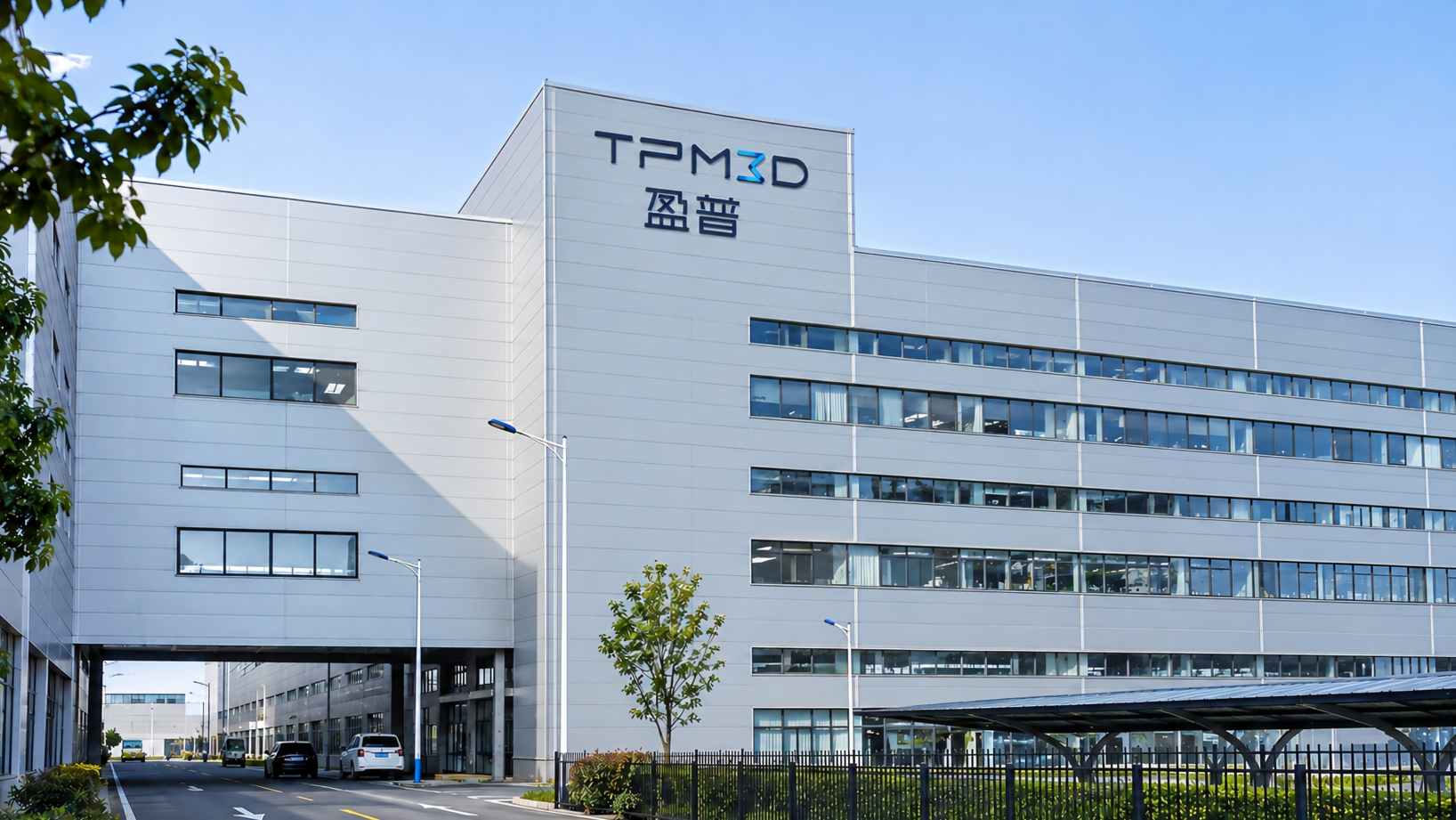
TPM3D’s 9,800-square-meter manufacturing facility in Hefei, China. Image courtesy of TPM3D.
The company has invested in its manufacturing capacity as well. In 2025, it completed a new 9,800-square-meter facility in Hefei, China, expanding its ability to manufacture equipment and support customers internationally.
Together, its manufacturing operations and partner network allow TPM3D to work with a broad range of customers, from established industrial manufacturers to smaller businesses adopting SLS for the first time.
What’s Next for TPM3D?
As TPM3D prepares for Formnext 2026 in Frankfurt, the company plans to make the international debut of its CF250+PPS250 compact professional SLS system. Launched in China earlier this year, the combination pairs a smaller-format printer with a dedicated powder-processing station, bringing TPM3D’s production approach to customers that may not need a full-size industrial installation.
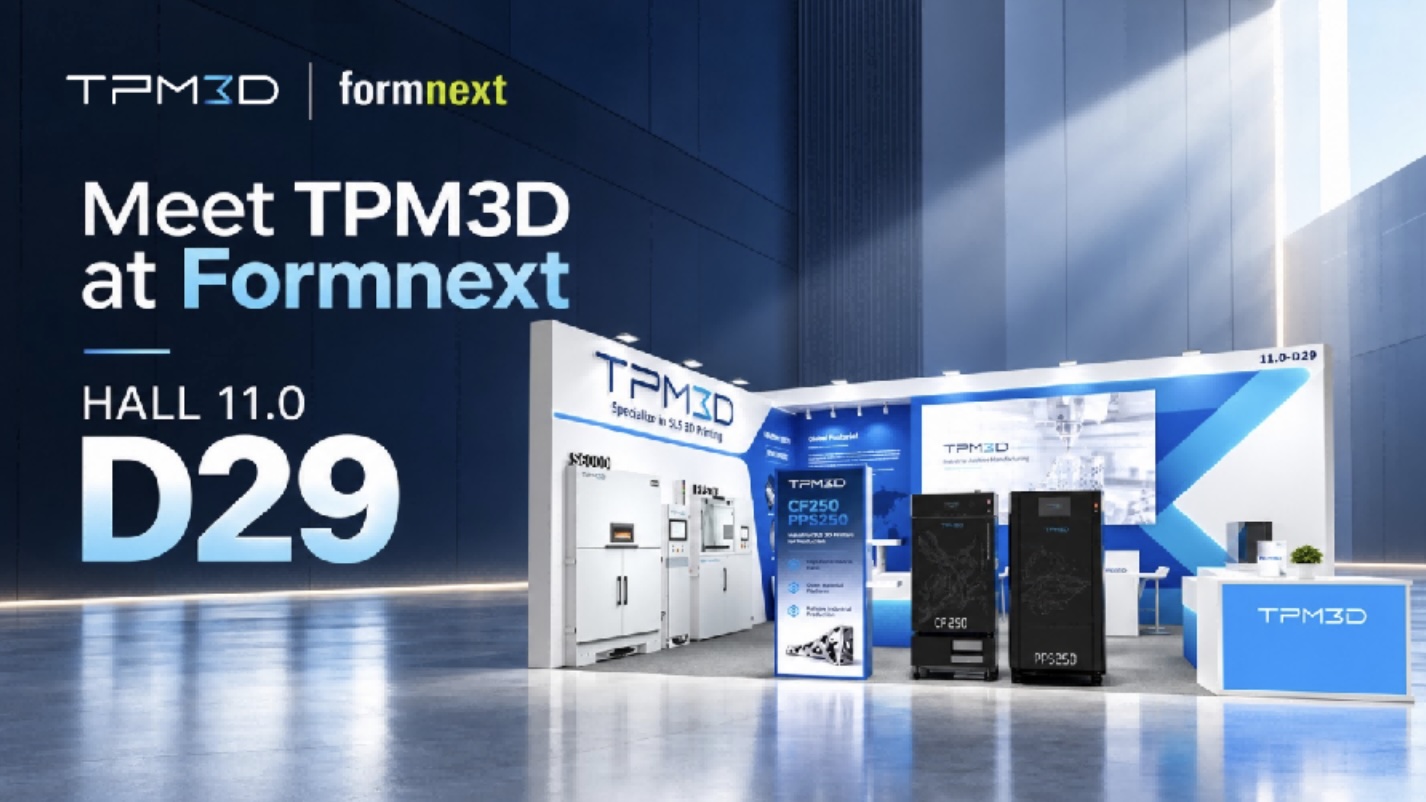
Meet TPM3D at Formnext. Image courtesy of TPM3D.
The system will be among the technologies TPM3D showcases at the November 17–20 event, alongside applications in robotics, footwear, automotive manufacturing, and medical rehabilitation. For TPM3D, the goal remains the same across its product range: helping more manufacturers put polymer SLS to work in everyday production.
Subscribe to Our Email Newsletter
Stay up-to-date on all the latest news from the 3D printing industry and receive information and offers from third party vendors.
Print Services
Upload your 3D Models and get them printed quickly and efficiently.











You May Also Like
Two Days Until AM Investment Strategies 2026: What Will Industry Leaders Have to Say?
AM Investment Strategies 2026 Nov. 5 · 12 p.m. ET · Free online event RESERVE YOUR SPOT ↗ With Formnext 2026 just around the corner, the 3D printing industry has...
Formnext 2026 Preview: Ceramics 3D Printing, Post-Processing, & More
In just a few weeks, it will be time for the biggest trade show extravaganza in the additive manufacturing (AM) industry. Soon, we’ll all be hopping planes bound for Frankfurt...
AM Investment Strategies 2026 Sets the Stage for AMS 2027
AM Investment Strategies 2026 Nov. 5 · 12 p.m. ET · Free online event RESERVE YOUR SPOT ↗ A one-hour online discussion featuring some of the biggest names in 3D...
Several New Engineering and Dental 3D Printing Materials Recommended
In 3D printing, the printer determines how a part is made — the material determines what can be made. Rather than another general-purpose material, the new ANTINSKY lineup answers specific...