CELLINK in France: Expanding Their Portfolio in 2020

Seeking to strengthen their presence in Europe, 3D bioprinter provider and pioneer bioink company CELLINK, opened their new offices in Lyon, France, last October. Begining new partnerships and collaborations with universities, hospitals, pharmaceutical companies and more, is a big part of the core mission of CELLINK, as they combine their technology with research innovation everywhere. The city of Lyon offers a booming scene for bioprinting, with companies heavily focusing on microtumors and taking advantage of an established network that has collected more than 2000 tumors from patients in collaboration with 11 major cancer hospitals in the country via the IMODI initiative–a French consortium to develop new experimental models of cancer–which preserves and archives all tissue and cell samples developed by the consortium partners during the project.
3DPrint.com spoke to CELLINK’s Sales Director for France and Southern Europe, Edouard Zorn, who envisions a greater expansion this year, new partnerships and research collaborations: “We hope to really expand our portfolio this year in France.”
“Cellink is amazing at building bridges between a product and researchers from different backgrounds and cultures. The company has a team-oriented mindset, looking to work with people from different nationalities,” sad Zorn, a biotechnology engineer with vast experience in scientific sales management.
Zorn and his five-people work team at the Lyon offices have their agenda full, with 30 customers in France, bioprinter installations, and training sessions for new CELLINK users, Zorn can’t help but highlight how fast the field of bioprinting is moving in Europe.
“There are many researchers focusing on skin and cancer, that’s really big here, but lately I have also been in contact with companies working on biopharma, vaccines and some even trying to replace animal testing assays,” he stated.
Since January 2018, CELLINK has been working with another major player in Lyon, CTI Biotech, using bioprinting to develop microtumors. CTI Biotech uses CELLINK technology exclusively for their work and now have three bioprinters at their lab, which is also located in Lyon. CELLINK and CTI Biotech had even signed a deal to 3D print customized cancer cells, with CELLINK assisting CTI in the production of patient-specific cancer tumor replicas, which will be 3D printed by combining CTI’s bioink with a sample of patients’ own cancer cells, promising to deliver personalized treatments for cancer on a custom, patient-by-patient basis.
“The aim of our collaboration is to give researchers an advantage in treating specific cancer types, and in the long term, take a serious step forward in the fight to cure cancer. CTI is moving really fast to develop models and commercialize them, and they choose our machines for their versatility, intuitiveness, and easily modifiable parameters. CTI Biotech is one of the customers we most grow with, and I believe it was a very good decision for both companies to work together,” explained Zorn.
So far, they have already commercialized CELLINK skin for drug and cosmetic testing, which they have also been working to improve, and Zorn thinks that soon they will be working on introducing some human cells to the skin, as well as perhaps vascularizing the tissue.
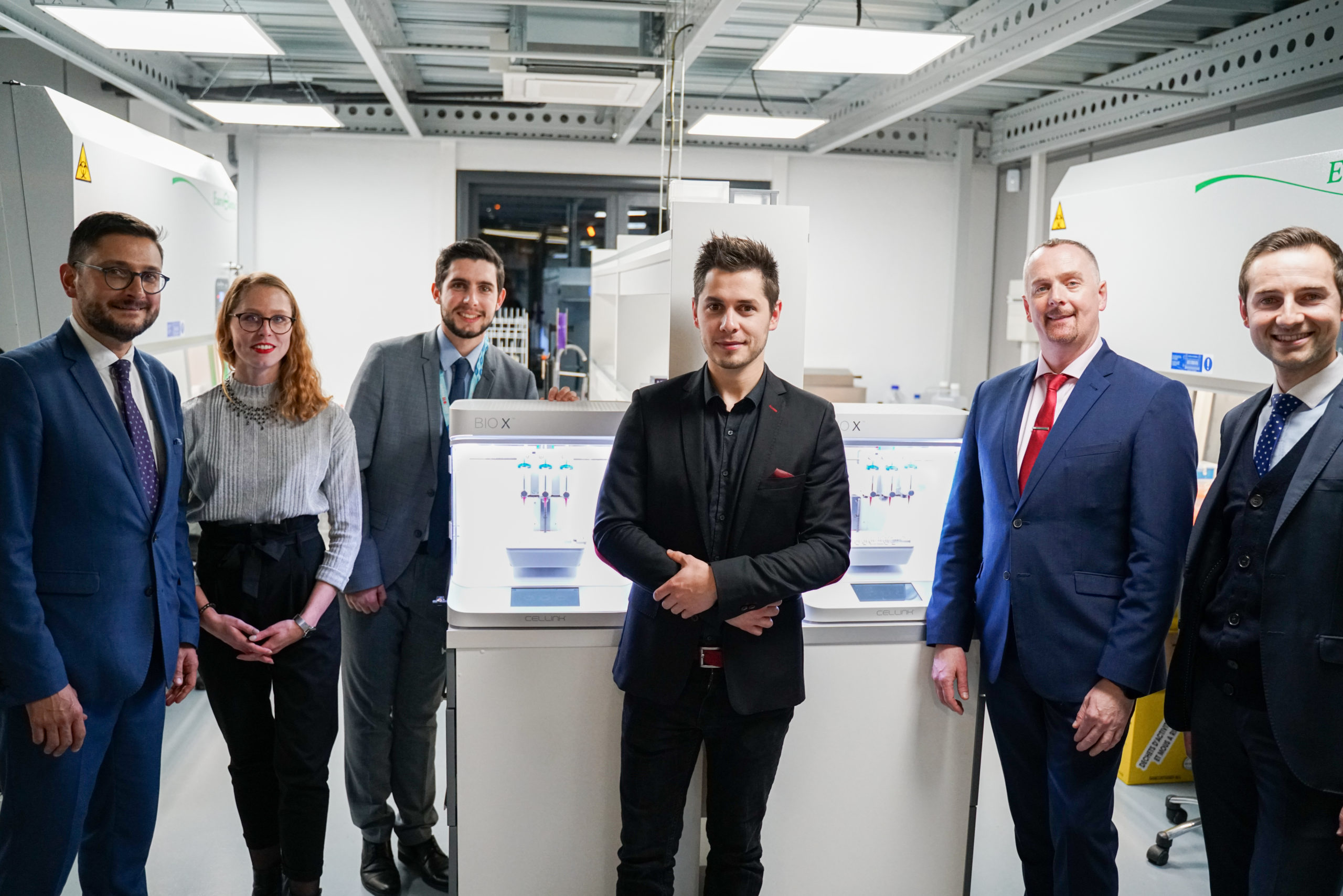
Edouard Zorn (far right) and CELLINK bioprinters at the CTI Biotech labs
The CELLINK office in Lyon is selling their machines to central Europe, working along the french-speaking part of Switzerland and Belgium, as well as in Spanish and Portuguese markets.

Edouard Zorn at CELLINK France
“We work with a lot of universities in France. For example, at the Medicine University of Montpellier, Xavier Garric, uses the INKREDIBLE+ bioprinter to teach master students how to design and print implantable medical devices and scaffolds for tissue engineering; and Alexandra Fuchs from the Hôpital St Louis employs a BIO X for tissue engineering.”
At the University of Grenoble, Vincent Haguet is generating skin, cornea and pancreas organoids for the modeling of organogenesis (organ formation) and pathogenesis (disease development), with a BIO X. Among these applications, organoids are used to screen and test new drugs. Also wielding the power of the BIO X is Anthony Treizèbre, from the University of Lille, for the bioprinting of Tumor-On-Chip and Blood-Vessels-on-Chip for the development of multicellular microfluidic biomimicry-based devices for the study of metastasis. Their idea is to reproduce blood vessels using human umbilical vein endothelial cells (HUVEC) and modulating the surrounding extracellular matrix.
The University of Nantes‘ Pierre Weiss also works with BIO X to print calcium phosphate-based personalized medical devices for maxillo-facial bone regeneration, as well as enzyme-based hydrogel formulation for the complex systems in bone regeneration.
Zorn believes that “there is a big demand from patients that expect the medical and bioengineering field to adapt treatments to patients. There is a lot of expectation for personalized medicine, especially with regard to microtumors for drug testing. Moreover, lately, we have seen researchers focusing heavily on immunotherapy, so I see a great future in that regard and consider that CTI Biotech is trying to position itself in that field.”
Fortunately, he suggests that there is collaboration in Europe. The European Union (EU) is financing joint collaboration projects with the objective to develop medical devices and applications with therapeutic solutions, and CELLINK wants to be a part of that. Zorn emphasized the importance of the Silk Fusion Project, which unites scientists in the development of a technology that uses silk, a natural biocompatible and sustainable material, to produce a bioink and 3D print platelet production instrumentation, attempting to solve the limited supply of human platelets. Other projects which have CELLINK as a collaborator seek to solve problems for joint articulation, bone, and even bioprinting parts of the tendon and cartilage.
“We need people who understand cell biology, chemistry, hardware, electronics, and software, as well as a good comprehension and understanding the needs inherent to each country’s culture, that is the way in which we expand,” concluded Zorn.

Edouard Zorn at the new CELLINK offices in France
The French branch of the company joins the other six worldwide offices of CELLINK, in Boston, Gothenburg, Freiburg, Blacksburg, Kyoto, and Stuttgart. Zorn hopes that the sales force along with the experienced network of professionals around the world working for CELLINK will result in a stronger presence of the company in central Europe as well as more joint efforts that could bring the future of bioprinting technology closer to our present.
Join the discussion of this and other 3D printing topics at 3DPrintBoard.com.
[Image credits: CELLINK]Subscribe to Our Email Newsletter
Stay up-to-date on all the latest news from the 3D printing industry and receive information and offers from third party vendors.
Print Services
Upload your 3D Models and get them printed quickly and efficiently.












You May Also Like
AM Investment Strategies 2026 Sets the Stage for AMS 2027
AM Investment Strategies 2026 Nov. 5 · 12 p.m. ET · Free online event RESERVE YOUR SPOT ↗ A one-hour online discussion featuring some of the biggest names in 3D...
With Its Latest $200M Round, ICON May Be Running Away With the 3D Printed Construction Market
I used to view ICON, the Austin-based additive construction (AC) firm, as one of a handful of companies that could realistically consider itself the leader of the 3D printed construction...
Deals, Dollars and 3D Printing: What’s Moving in AM
There’s been plenty of business activity in additive manufacturing (AM) lately, with new deals, partnerships and investments in production. One of the bigger moves comes from Sweden, where investment firm...
Oerlikon Adds ATLIX’s xBUILD 5000, Plans More for 2027
Oerlikon has installed a new ATLIX xBUILD 5000 metal 3D printer at its facility in Huntersville, North Carolina, marking the first production deployment of the system worldwide. The machine will...