U.S. Congress Calls Out 3D Printing in Proposal for Commercial Reserve Manufacturing Network

Last week, the U.S. House of Representatives’ Appropriations Committee moved the FY 2026 defense bill forward to the House floor. Included in the legislation is a $131 million proposal for what the committee is calling the “Commercial Reserve Manufacturing Network,” which would enable the Department of Defense (DoD) to demand that companies in the network shift their output from commercial products to defense hardware when the Pentagon deems it necessary.
References to additive manufacturing (AM) — in particular, the combination of AM and AI — featured heavily in the report surrounding the proposed legislation:
“Action is needed to immediately accelerate the Department’s adoption of commercially available [AI]-driven [AM] factories to preserve America’s military advantage. The Department has an exceptional opportunity to scale advanced manufacturing technologies in a way that bolsters the defense industrial base and the broader American industrial base.”
DefenseNews reporter Courtney Albon, in an article on the proposal, noted that one of the authors of the report, Nathan Diller, formerly the director of Air Force technology accelerator AFWERX, gave written testimony to the Senate Armed Services Committee back in February, which “highlighted [the Commercial Reserve Manufacturing Network] and called the offshoring of defense manufacturing a crisis.”
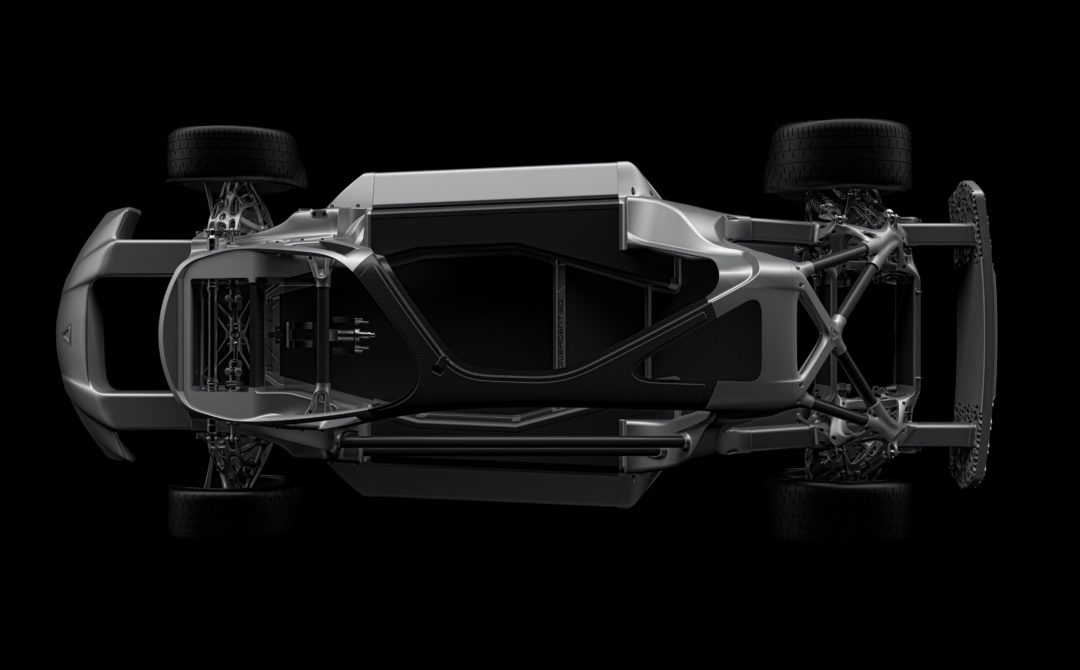
Divergent’s Blade supercar chassis, an example of the company’s commercial work that complements its defense manufacturing capabilities. Image courtesy of Divergent
Diller seemed to allude to Southern California’s Divergent Technologies, a heavily funded contract manufacturing startup with deep Pentagon ties and an emphasis on AI-backed AM, in his testimony:
”Right now, we literally are printing hyper car frames in the morning and cruise missiles in the afternoon. We are in agreements with most of the defense primes and many startups, delivering capabilities for air, land, sea, and space during all phases of the life cycle.”
As Albon also noted in her article, multiple branches of the U.S. military already maintain their own programs that resemble what’s being proposed with the Commercial Reserve Manufacturing Network. For instance, the Air Force Civil Reserve Air Fleet enables DoD to tap into qualifying commercial airline operators for surge airlift capacity, and the Department of Transportation maintains around 100 inactive, Government-owned vessels that comprise the National Defense Reserve Fleet, which can support the Navy when necessary.
However, aside from the temporary calls for increased production of certain raw materials and goods embodied in Defense Production Act (DPA) executive orders, this would seem to be one of the first instances since World War Two in which the U.S. government is aiming to cultivate an ecosystem of civilian manufacturing enterprises specifically dedicated to shifting their production from commercial to defense goods in response to surge demand.
The plan is very much in line with the call for “fungible manufacturing capacity” from Seurat’s Chief Product Officer, Michael Kenworthy, who wrote about the concept in a blog post published a few months ago. Relevantly, prior to working for Seurat, Kenworthy was the CTO of Divergent, illustrating how the themes underlying the Commercial Reserve Manufacturing Network have been percolating in certain U.S. deep tech circles for quite some time.

Seurat’s Area Printing technology. Image courtesy of Seurat
Along those lines, it is worth mentioning here that Divergent was recently made a part of the U.S. Air Force’s $46 billion Enterprise-Wide Agile Acquisition Contract (EWAAC), a ten-year, Indefinite Delivery, Indefinite Quantity (IDIQ) program that began in 2021, aiming to accelerate the acquisition of “innovative weapons systems”. The EWAAC vendors list currently includes almost 300 names.
In a post I recently wrote about the addition of metal powders supplier Elementum 3D to the EWAAC portal, I noted:
“…as big as it is, in-and-of-itself, the EWAAC contract should have long-term implications far beyond its own boundaries. Given how quickly the DoD’s procurement needs are changing nowadays, IDIQ could ultimately become the routine way the agency does business, and that is a state-of-affairs that would require a digital acquisition ecosystem to be the foundation around which the rest of the future defense industrial base is built. 3D printed drones and rocket engines are an ideal starting point for testing the validity of that concept. Eventually, the EWAAC can serve as a mechanism to gradually incorporate the concept into the workings of the DoD at large.”
Thus, the Commercial Reserve Manufacturing Network could realistically be used as a pilot program for just such an implementation of certain elements from the EWAAC across the DoD as a whole. As I’ve also been tracking lately in posts about the U.S. Army’s increasingly public declaration of its intentions to ramp up organic DoD drone production, as well as other DoD AM funding projects, the Pentagon seems to be more determined than ever to speed up the use of AM to create distributed manufacturing capabilities.
Subscribe to Our Email Newsletter
Stay up-to-date on all the latest news from the 3D printing industry and receive information and offers from third party vendors.
Print Services
Upload your 3D Models and get them printed quickly and efficiently.













You May Also Like
How Should Businesses Build New Business? Dirk Simon Weighs In — Part 1
Dirk Simon had deep experience in materials and chemistry before joining the 3D printing industry. Instrumental in BASF and Farsoon’s market introduction, Dirk has spent a lot of time thinking...
The Frankenservice Part 2: Have Your Cake and Eat it Too
This series of articles delves into a thought experiment. What if we let go of using a few machines very optimally, but instead use lots of different machines to meet...
The Additive Chicken Coop, Part IV: Lemmings
If we look at our past, we can see how making custom machines, incessantly watching ourselves, and our inability to rescope shaped our industry. We have also looked at the...
The Additive Chicken Coop, Part III: Bananas
A friend of mine, Ed Davis, once pointed out the level of strategic replication in additive. I wasn’t aware of it before and haven’t been able to unsee it since....