Korea: Researchers Unlock the Potential of 3D Printed Casts for Mallet Fingers

Korean researchers are examining better ways to customize casts for patients with bone fractures and other issues in ‘Mallet Finger Lattice Casts Using 3D Printing.’ Here, the team offers a perfect example of patient-specific treatment, offering patients a more viable option for mallet finger—a condition that occurs due to tendon damage or deformity.
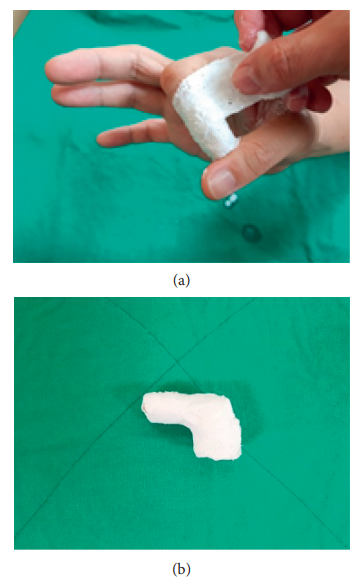
Plaster of Paris casts traditionally used to treat mallet finger in clinical practice. (a) Procedure for creating cast. (b) Removed plaster of Paris cast.
Historically, many casts have been made using plaster. And while that can be extremely effective, plaster of Paris can cause severe irritation to the skin, along with other problems such as edema, discoloration, infection, necrosis, and more. With so many materials available in 3D printing today, casts can be made quickly and affordably.
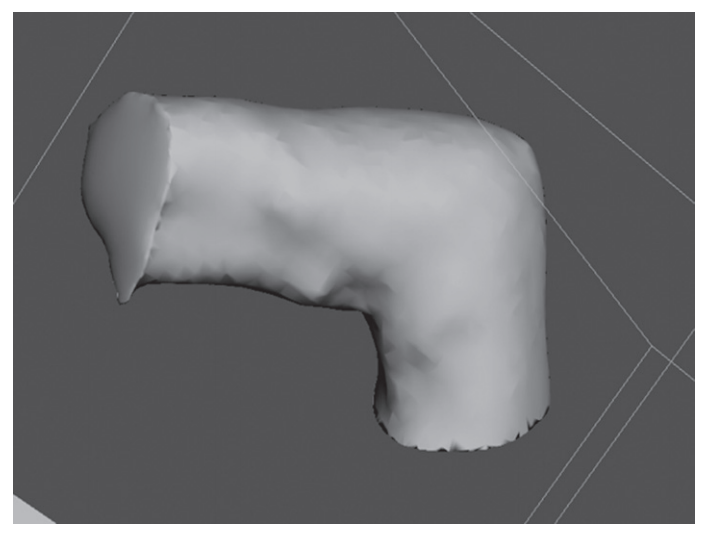
STL file of the mallet finger generated by the 3D Systems sense scanner.
For this study, random subjects, all suffering from mallet finger, were chosen. Some were given casts fabricated with MediACE 3D software, while others were given traditional plaster casts. In producing the 3D printed casts, the fingers were scanned and then 3D printed with PLA on a 3D Edison printer.
“Among the 45 cases of surgical treatment, 53% experienced complications and 76% of complications developed during the average monitoring period of 38 months. Six cases that involved surgical treatment after splinting (for a minimum of six weeks) were counted in both groups,” stated the researchers. “Major complications experienced by surgically treated patients were deep infection (4%), total joint incongruity (18%), and nail deformity (18%). Seven patients (16%) required reoperation, and all had unsatisfactory results [13] except for one whose result was unknown.”
Satisfaction evaluation and wearability evaluations of the lattice casts were performed, with both ratings held to the Likert scale from one to five (the positive end). The study showed that overall the patients were either ‘very satisfied’ or ‘satisfied’ with the 3D printed casts in terms of:
- Dimensions
- Weight
- Adjustment
- Ease of Use
- Comfort
Upon reviewing all the results, the researchers decided that 3D printed lattice casts should be worn to treat mallet finger, especially considering the many customizations that can be offered.
“The ability of 3D-printed casts to overcome the disadvantages of traditional plaster of Paris casts makes them beneficial for clinical application,” concluded the researchers.
“Development of 3D-printed lattice casts is meaningful because they have the potential to help many patients if produced in clinical practice using 3D printers. Improvements in body scanning technology and product design software are expected to bring benefits to clinical practice. Future research should investigate the production of orthoses with various structures using the processes developed in this study.”
3D printing has impacted the medical realm in countless ways, but has offered many different advantages in the specific area of bones—whether for healing, regeneration, or using 3D printed models to repair fractures. What do you think of this news? Let us know your thoughts! Join the discussion of this and other 3D printing topics at 3DPrintBoard.com.
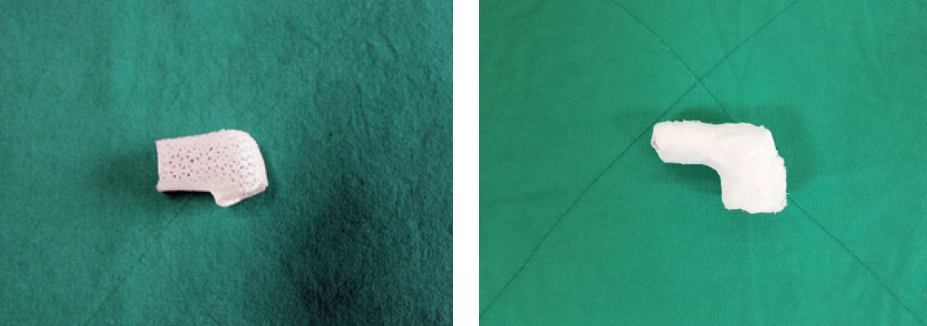
Comparison of removed mallet finger casts. (a) 3D-printed lattice cast. (b) Plaster of Paris cast.
Subscribe to Our Email Newsletter
Stay up-to-date on all the latest news from the 3D printing industry and receive information and offers from third party vendors.
Print Services
Upload your 3D Models and get them printed quickly and efficiently.













You May Also Like
3D Printing News Briefs, October 10, 2026: Drones, WAAM, Ceramics, & More
We have a packed 3D Printing News Briefs for you this weekend! First, America Makes celebrated the recent National Manufacturing Day with 3D printed drones, and then it’s on to...
10 Years of Multi Jet Fusion: Onsite at HP’s Vancouver, Washington Facility
At this year’s RAPID event in Boston, HP Additive Manufacturing Solutions celebrated ten years in the additive manufacturing (AM) market. The company ushered in the milestone with several innovations, including...
PharmaTher Plans U.S. Network to 3D Print Medicines on Demand
3D printing medicines has often been tied to the idea of personalization, basically making a pill in the right dose, shape, or drug combination for a patient. PharmaTher is now...
3D Printing News Briefs, September 17, 2026: 3D Printed Boat, UAS Development, & More
We’ll start with maritime manufacturing in this week’s 3D Printing News Briefs, and continue on to defense 3D printing. We’ll end with funding for Tripo AI. Read on for all...