Will 3D Printed Baked Goods With Probiotics Make Their Way to Your Table?

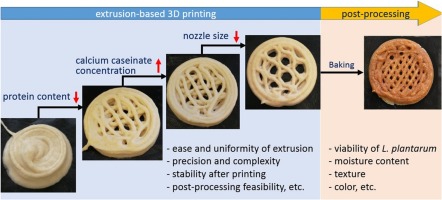
3D printed food is still something of a novelty, but researchers have begun looking into using it as a means to create specialized foods for people with dietary needs, such as gluten intolerance. In a paper entitled “3D printing of cereal-based food structures containing probiotics,” a group of researchers 3D printed several different types of dough, evaluating their rheological properties, microstructures and printability. The dough samples contained different water content, wheat flour type and amounts of calcium caseinate.
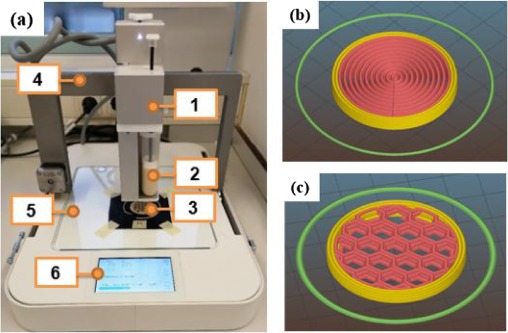
The dough, which contained probiotics, was baked into two different structures: a honeycomb and a concentric design. The 3D printed dough was baked at temperatures of 145, 175 and 205 °C. The survival of the probiotics was not significantly different in the two structures after baking them for the same time; however, increasing the surface-to-volume ratio of the structures accelerated the baking process.
“Thus, the viable counts of probiotics in the ‘honeycomb’ structure exceeded 106 CFU/g when the end point of baking (at 145 °C) was set as the time required to reach a 6% moisture content reduction, which was 2 log higher than that in the ‘concentric’ structure,” the researchers state. “The results reported in this study may benefit the development of innovative food products containing functional ingredients.”
The overall purpose of the study was to see if 3D printing was an effective way of incorporating probiotics into baked goods. Probiotics, the researchers point out, can impart health benefits when consumed in moderate amounts; in particular, they can boost intestinal health. Most probiotic foods are dairy-based, which is problematic as many people have allergies or lactose intolerance. Therefore, the researchers wanted to see if bakery products could be used to impart the same benefits.
This has been a challenge in the past, as probiotics are highly sensitive to heat, so it’s difficult to maintain their content during the baking process. The survival of probiotics during baking is influenced by baking temperature, baking time and moisture content. Studies have shown that probiotic bacteria are more stable when embedded in a food matrix with lower moisture content.
“Thus, increasing the drying rate during baking may favour the survival of probiotic because a lower moisture content of the food matrix can be reached in shorter time,” the researchers explain. “The convective baking process of the food structure can be accelerated by increasing its surface-to-volume ratio.”
Structure with a high surface-to-volume ratio can be achieved with 3D printing. The researchers 3D printed their dough structures with a byFlow 3D printer, then baked them at the different temperatures and immediately refrigerated them. Microbiological and statistical analyses were performed on the samples.
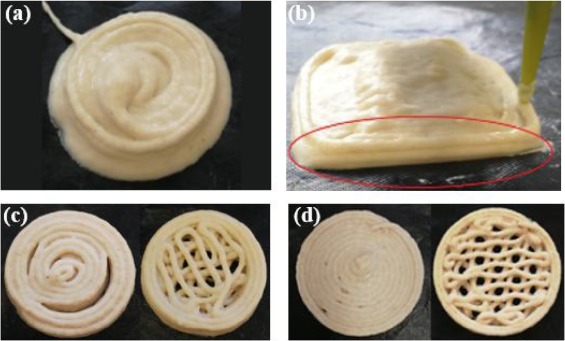
The researchers hypothesized that the survival of the probiotics could be improved by increasing the surface-to-volume ratio of the structures, and their experiments confirmed their hypothesis under specific conditions.
“The baking process of the structure with higher surface area was accelerated as the drying rate was increased,” the researchers conclude. “The viability of probiotics in the ‘honeycomb’ structure after baking for 6 min at 145 ○C met the definition of probiotic foods (e.g. viable counts of bacteria > 106 CFU/g). Future studies should focus on further increasing the survival by reducing baking intensity.”
Authors of the paper include Lu Zhang, Yimin Lou and Maarten A.I. Schutyser.
Discuss this and other 3D printing topics at 3DPrintBoard.com or share your thoughts below.
Subscribe to Our Email Newsletter
Stay up-to-date on all the latest news from the 3D printing industry and receive information and offers from third party vendors.
Print Services
Upload your 3D Models and get them printed quickly and efficiently.











You May Also Like
Ceramitec 2026 3D Printing Wrap Up
I was surprised by just how many 3D printing companies and 3D printing projects there were at Ceramitec this year. I came away from the show convinced that the ceramics...
RusselSmith Brings Additive to Ghana’s Maritime Sector
Nigerian firm RusselSmith is in talks with Ghana’s Maritime Authority (GMA) to bring 3D printing to Ghana’s maritime sector. The Commonwealth Enterprise and Investment Council (CWEIC) helped make the discussion...
The Blueprint for Industrial Serial Production
Lithoz is kicking off the 2026 trade fair season with a powerful showcase of real-world applications of ceramic AM serial production capabilities alongside new material upgrades. The company is stepping...
Fraunhofer ILT Tests 3D Printed Titanium Reactors to Generate Hydrogen Onboard Heavy Vehicles
The Aachen-based Fraunhofer Institute for Laser Technology (Fraunhofer ILT) is to research titanium aluminide hydrogen reactors and heat exchangers. The hope is that lightweight, better-performing 3D printed components will make...