DTU 3D Prints New Fuel Cell Design With 5x Power Boost

Technical University of Denmark (DTU) researchers have used Lithoz ceramics 3D printing to make more efficient hydrogen fuel cells. With a part made from Lithoz Yttria Fully Stabilized Zirconia (8YSZ), a thin-walled component saw a 500% increase in power-to-weight ratio. The part in question is a Solid Oxide Fuel Cell. Conveniently hobbled by the wondrously easy-to-pronounce acronym SOFC (because we’re sofc’ed if we don’t do this?), turn hydrogen into electricity. SOFC typically has multiple layers, including a porous cathode and a dense electrolyte. When heated to temperatures above 500 °C, oxygen ions are created and migrate through the electrolyte. At the anode, the fuel is oxidized, giving off water and electrons. Given the immense amount of heat and stress, ceramics are the go-to materials for these devices.
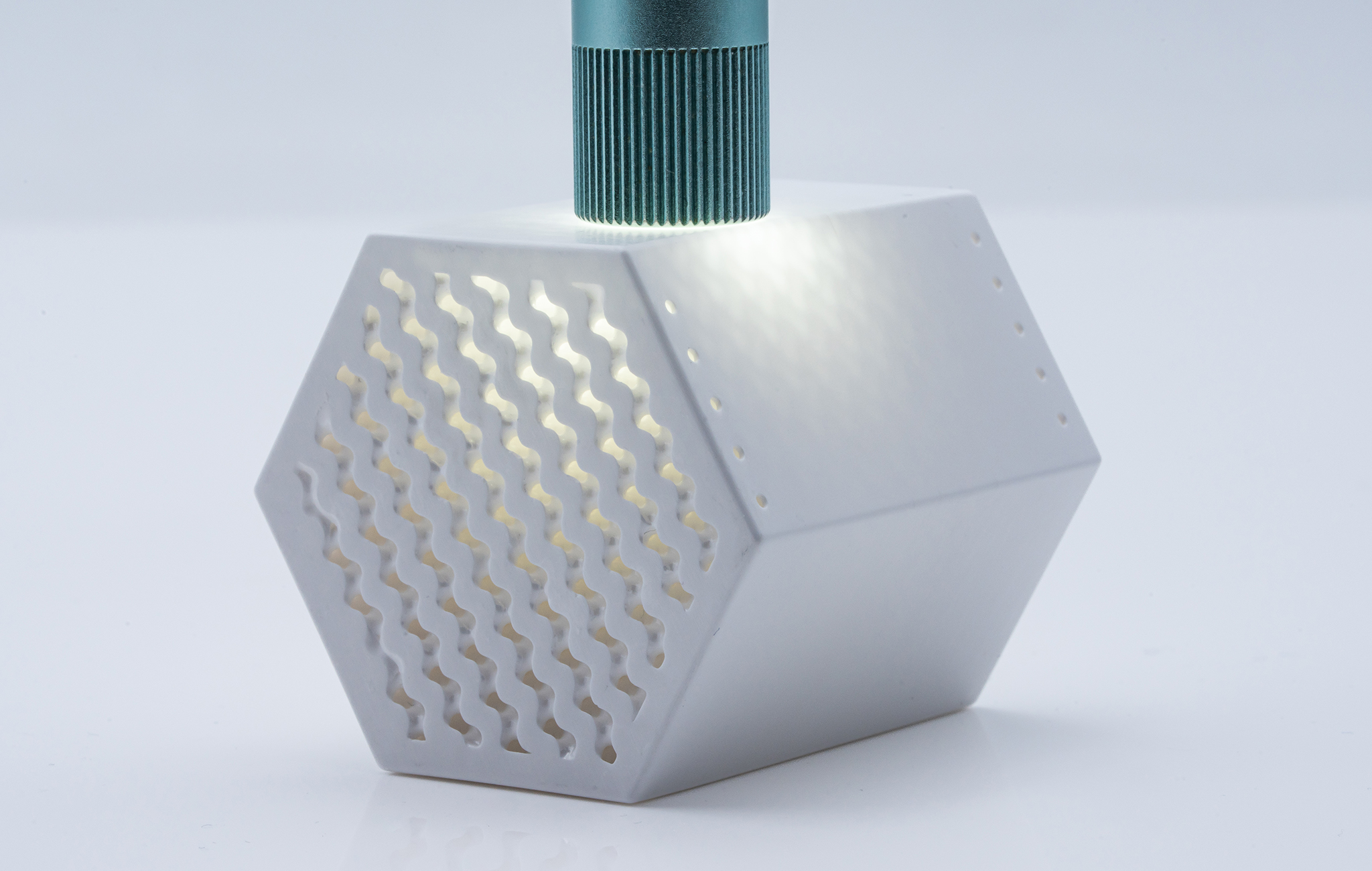
DTU SOFC.
Porosity, geometry, and flow are critical in this application, making it ideal for additive manufacturing. In this case, the team used LCM, Lithoz’s DLP-based doped resin 3D printing technology.was used to make the units. Used in home and industrial heating, with potential applications in future transport, this could be an important milestone for Lithoz and the DTU.
The research project by the Department of Energy Conversion and Storage at DTU Energy, led by Professor Vincenzo Esposito, is called “Escape Flatland.” Instead of the usual stacked setup, a single monolithic fuel cell was made. The team wishes to scale up production for this gyroid-shaped cell, saying that the unit “demonstrates power-to-weight ratios approaching around 1 W g−1, compared to around 0.2 W g−1 typical of conventional planar SOFC architectures.”
Professor Esposito says that,
“This innovation is a real paradigm shift from planar stacking to monolithic architectures.”
The design allows for a far more efficient shape, with the “combination of thin inner walls and elimination of interconnects and sealants resulting in a drastic loss of weight, reduced thermal mismatch and mechanical stress, all while significantly improving the utilization of the available volume.”
This is essentially the same case as we have seen in thermal management applications such as heat exchangers. With better performance, this could be a viable application. The team thinks that this type of SOFC will most likely be used in transport applications.
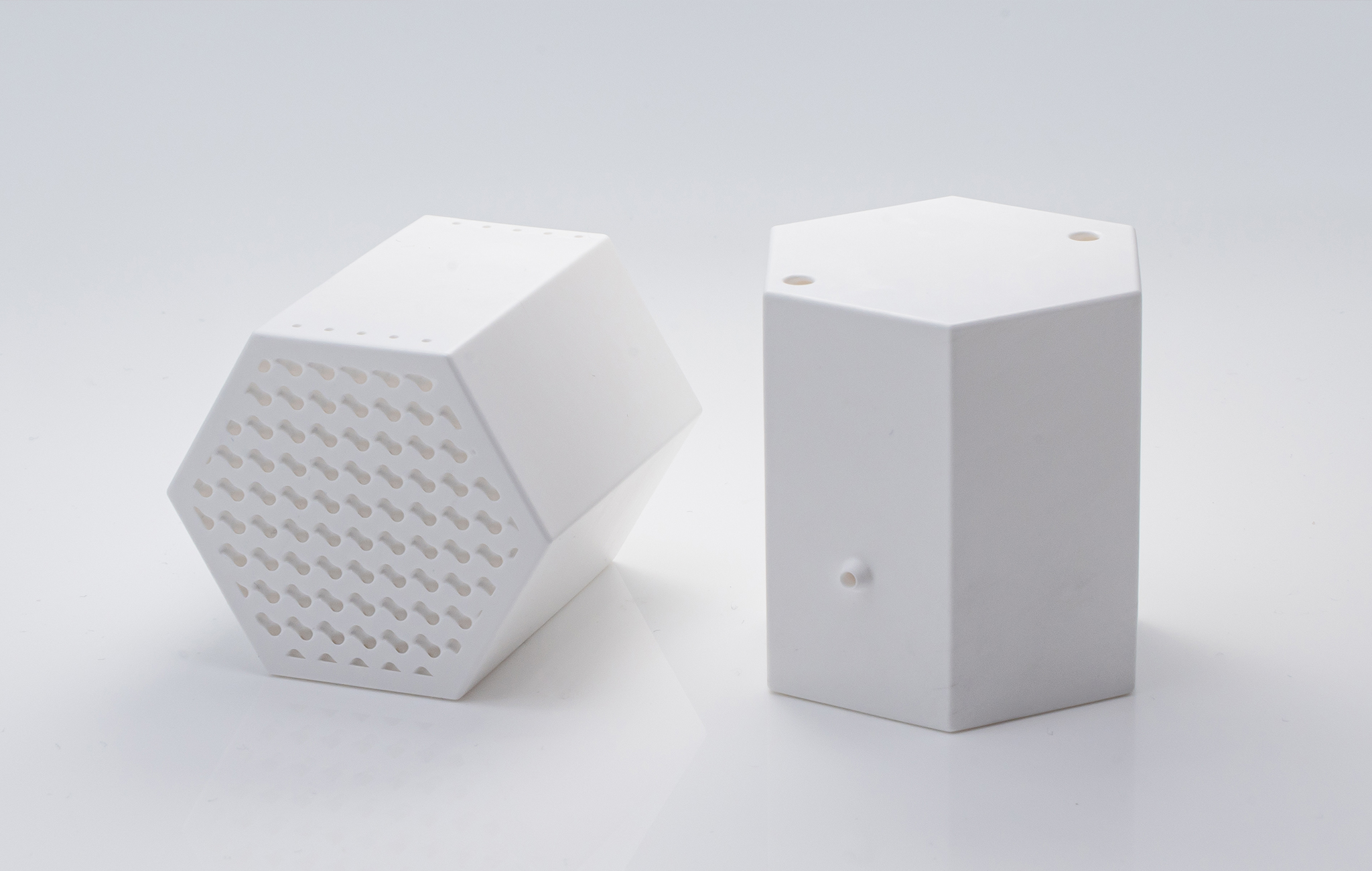
DTU SOFC.
Esposito continues,
“Our motto, ‘Escaping Flatland, ‘ sounds like a logical step, but it has long been impossible to achieve. The particular arrangement of materials and microstructures requires a significantly elevated level of complexity – but until recently, we simply lacked the tool to make this concept a reality. 8YSZ remains one of the most widely used and technologically mature electrolyte materials for SOFCs. With its mature precision and scalability, Lithoz LCM technology has demonstrated the highest repeatability for these bio-inspired TPMS geometries with the thinnest possible inner walls, which inherently meet the gas supply requirements. The monolithic concept could only be achieved by precisely replicating those gyroid units and adding a sealed shell frame to maintain gastight conditions.”
While Lithoz CEO Johannes Homa states,
“By realizing 8YSZ monolithic fuel cells with intricate gyroid geometries on their Lithoz CeraFab printer, DTU was able to reduce the dependence on conventional interconnect and sealing architectures inherent to stacked flat items. These elements have traditionally been the Achilles heel in the search for better power density in commercial planar SOFC stacks and, therefore, the traditional focus of attention in the quest for a more advantageous power-to-weight ratio. With their revolutionary monolithic concept, these elements eliminate the need to gradually optimize exit points, paving the way for a complete rethinking of fuel cell design. Of course, we are extremely excited about the impact this will have on the worldwide hydrogen-based industry.”
This seems like a great step forward, and it could become a sizable application in a possible future hydrogen economy. How prevalent hydrogen will become in the energy mix is not known for certain. Currently, geopolitical events in the Gulf make a hydrogen economy seem like a very investable thing indeed. With higher oil prices and instability, more governments will look to alternatives and ways to diversify their energy mix. Using hydrogen is kind of like using one battery technology, so this is perhaps limiting. But more broadly, there could be additional electrochemical processes that could benefit from more efficient, lightweight structures like this one.
Images courtesy of Lithoz
Subscribe to Our Email Newsletter
Stay up-to-date on all the latest news from the 3D printing industry and receive information and offers from third party vendors.
Print Services
Upload your 3D Models and get them printed quickly and efficiently.













You May Also Like
3D Printing News Briefs, September 26, 2026: Bioceramic Implants, 3D Concrete Printing, & More
In this weekend’s 3D Printing News Briefs, we’ll start with an integration between PanOptimization and AMCM, before moving on to healthcare news from KLS Martin and Lithoz, and then UltiMaker...
3D Printing News Briefs, September 24, 2026: Metallic Alloys, Nanobone, Alternative Meat, & More
In this week’s 3D Printing News Briefs, we’ll discuss some materials news: a reference material for standardizing photopolymer manufacturing, metallic alloys that help reduce energy loss in electric motors, a...
AMAsia Pulse: AM Investment Picks Up Across Asia-Pacific
The first half of September brought fresh investment and expansion activity across Asia-Pacific’s additive manufacturing sector. China’s Xinjinghe secured funding for an aerospace AM hub, South Korea’s Lincsolution outlined plans...
3D Printing News Briefs, September 17, 2026: 3D Printed Boat, UAS Development, & More
We’ll start with maritime manufacturing in this week’s 3D Printing News Briefs, and continue on to defense 3D printing. We’ll end with funding for Tripo AI. Read on for all...