Lund University’s 3D Printed Busts Display Alludes to China’s Terracotta Army


 There are all kinds of different ways that people choose to display the basic concept of 3D design and printing technologies. In fact, there are as many ways as there are design files, it seems, and I always get a kick out of covering creative projects that both entertain and educate. One good example of such a project recently happened at Lund University in Sweden. Kulturnatten 2015 is an annual cultural event in Lund celebrating arts and science. Lund University’s School of Engineering’s division of Product Development decided it needed to demonstrate 3D printed objects to demonstrate 3D printing technologies, and it chose a rather unique display concept.
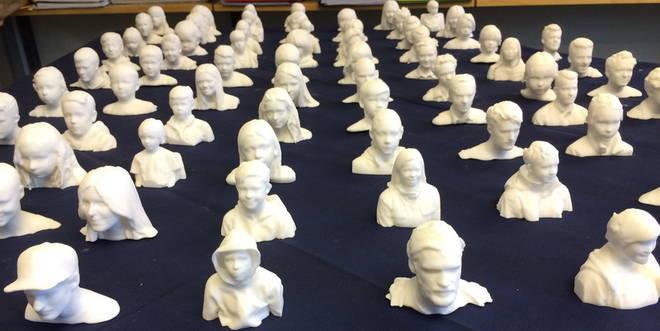
Flashback for a moment to ancient China. In 1974, farmers in the Shaanxi province discovered the now-famous Terracotta Army, which is said to have three pits containing 8,000 soldiers. China’s Xi’an Terracotta Army, which was funerary art (art related to buried remains) depicting the army of China’s First Emperor during the late 3rd century BCE. Well, Lund put its own spin on this remarkable discovery in China. The Lund display captures over 140 visitors (including children) in a 3D scanned and printed bust display that is quite a sight to behold. (Now if only they would bury the busts for future generations to discover!)
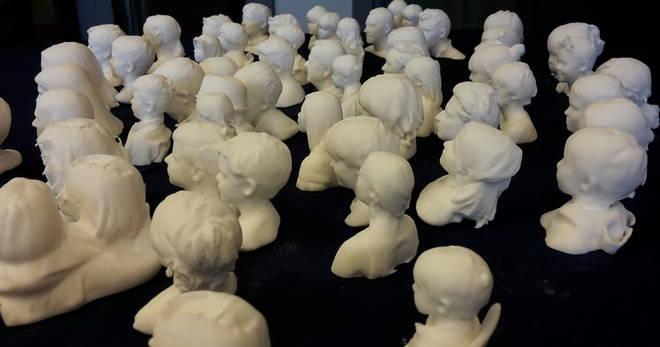
What prompted this idea is a desire to participate by displaying 3D technologies in Lund’s Kulturnatten. During Kulturnatten, individual heads were 3D scanned to make mini-me busts, and some were printed during the course of the day, but the bulk of them were printed in nylon with the University’s new Selective Laser Sintering (SLS) system. While the Xi’an warriors were formed out of terracotta, this project relied on a new and common 3D printing material instead: nylon.
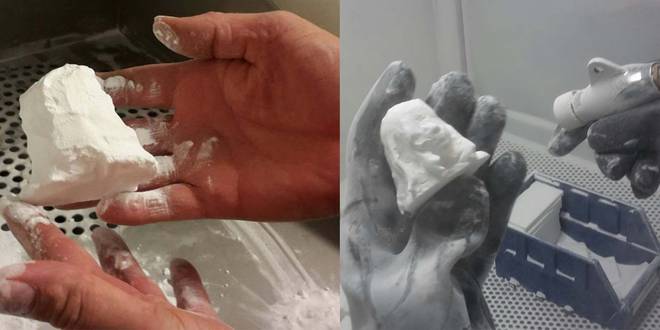
Using design software, the busts were made to be 6 cm tall, and many were printed at one time. The scan files were “nested together” for printing and each bust has the individual’s name underneath. (If only we could say the same for all of those Chinese terracotta warriors!) The results are pretty cool. Like the Terracotta Army, the display is interesting as each individual figure comes to be a mere part of the larger whole.
Projects like this are excellent ways to educate the public not only about 3D printing technology but about the historical role that statues/ figures have played as commemorative elements of ancient societies. It’s amazing to think that the Terracotta Army was discovered as recent as 1974. While 3D printing encourages us to get prepared for the future, it can also prompt us to reflect more deeply on past societies and the technologies used to create the kind of wonder that the Terracotta Army represents.
Discuss this story in the Terracotta Army forum thread on 3DPB.com.
Subscribe to Our Email Newsletter
Stay up-to-date on all the latest news from the 3D printing industry and receive information and offers from third party vendors.
Print Services
Upload your 3D Models and get them printed quickly and efficiently.













You May Also Like
50,000 Orders and Counting: EPlus3D & Chinese AM Services Provider Are Scaling Liquid Cooling Solutions for AI Servers
An under-appreciated story driving the additive manufacturing (AM) industry this year has been the divergence between what’s driving the market in China and what’s driving it everywhere else. Let’s start...
Seven Trends Reveal What’s Next for 3D Printing at TCT Shenzhen 2026
TCT Shenzhen 2026 opened on October 14 in Hall 15 of the Shenzhen World Exhibition & Convention Center in Bao’an, and ran through October 16. The event brought together equipment...
With Increased Aerospace & Defense Focus, CORE Industrial Partners Buys More Manufacturing Firms
Private equity’s march into manufacturing continues with CORE Industrial Partners’ latest acquisitions. CORE purchased Fathom a few years ago, and later bought 3DXTECH LLC, Triton 3D LLC, and Gearbox3D. It...
Can India’s AM Push Help Make it a Viable Supplement to China?
Diversifying manufacturing supply chains to locales outside of China has nothing to do with actually cultivating “substitutes” to the Chinese economy. The real stakes are these: China is an irreplaceable...