Off-Road or In Class 3D Printed RC Vehicle Gets Top Marks

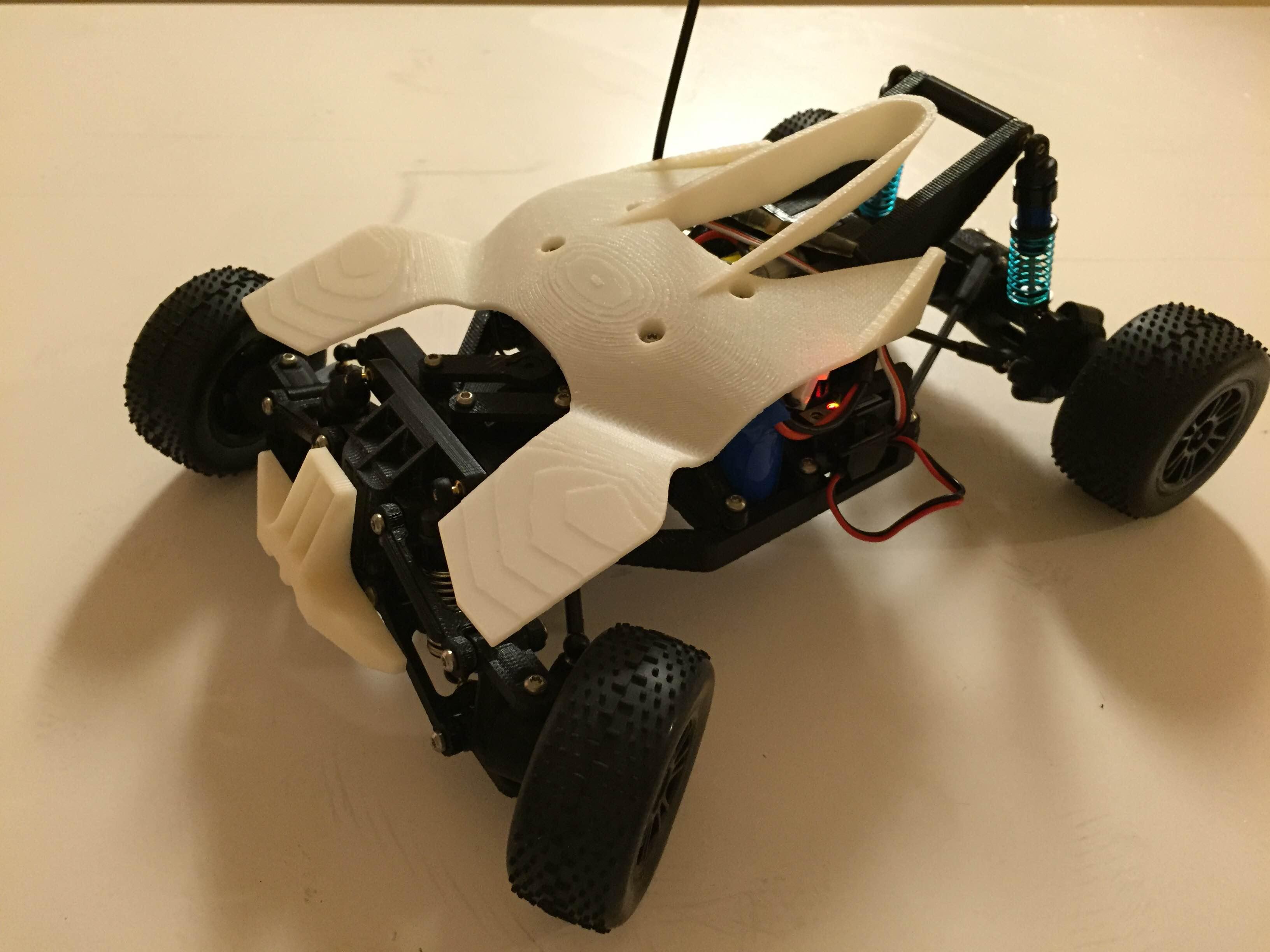
When Louis Lee, a student majoring in transportation design at the Art Center College of Design in Pasadena, California, was given an assignment for the Solid Modeling course in which he was enrolled, he knew exactly what he wanted to create: an off-road RC car.
In an interview with 3DPrint.com, Lee explained how he approached the project:
“The Project started with buying an actual 18th scale RC car by Team Associated’s and disassemble every component, and rebuilding the parts in solid works. This helped me understand the mechanism and parts that completes an production RC car. After finishing the rebuilding of the RC car in Solidworks, I decided to do an off-road RC car that is as durable as production RC car.”
And there’s nothing a teacher loves more than a student who is willing to go above and beyond the requirements.
Lee decided to model his off-road vehicle on the trophy trucks and so he designed it with a double wishbone setup in the front and a four-link solid axle suspension in the rear. His goal throughout the project was to reduce the number of parts to the greatest extent possible. The main reason behind that decision was his desire to keep the overall volume of the vehicle to a minimum as well as to reduce the number of screws and connections that were required.
 Having already designed a first RC car for the course, he decided to scavenge parts for the project from it to create his new off-road version. This meant that the design of the car had to take into account the parts that were already in existence and provided a further constraint for the decision making in the design process. The parts of the car that weren’t to be 3D printed mostly consisted of metal or plastics that need to be flexible such as the component parts of the ball joints.
 All told, the completed design consists of 26 3D printed parts which were fabricated on the Art Center College’s uPrint SE Plus FDM printers, which run 24 hours a day–a luxury that enabled Lee to have his prints with a much faster turnaround than could otherwise have been expected. And faster than you can say “full-tube chassis” the vehicle was ready for its test run.
Lee was pleasantly surprised by its performance, noting that it ran as smoothly as the original RC car but also had higher performance on rough surfaces and recovering from steep drops in terrain. As with any good school project, this only whetted Lee’s appetite for 3D printing and he is looking forward to experimenting more with it as a method for developing ideas and producing them.
“After completing the class, I was confident that I could rapid prototype a lot of things with low budget and fast timing,” Lee said. “Also, I was very surprised at how well those printers printed out parts that were both very strong and highly detailed. They were able to produce parts that fit together perfectly and I was quite surprised. I will definitely buy a of those 3D printers when I can!”
What do you think of this creation? How does this design compare to other 3D printed RC cars you’ve seen? Join the conversation in the 3D Printed Off-Road RC Car forum thread over at 3DPB.com.
Subscribe to Our Email Newsletter
Stay up-to-date on all the latest news from the 3D printing industry and receive information and offers from third party vendors.
Print Services
Upload your 3D Models and get them printed quickly and efficiently.












You May Also Like
The Manufacturing Race Behind the Drone Revolution
We are in the middle of a major manufacturing shift focused on the production speed and payload capacity of uncrewed aerial systems (UAS), or drones. A recent Manufacturing Dive article...
ADDMAN to Buy Up to $10.8M in Nickel 718 Powder from 6K Additive Over 30 Months
After years of buildup, we’re finally starting to see what the US metal additive manufacturing (AM) market could look like at scale. To be sure, it’s still not quite there,...
Metal AM in a Multipolar World, Part 2: How PBF and DED Could Change by 2035
The first decades of PBF development were heavily shaped by machine capability: more power, more lasers, larger build volumes, better recoating, and improved process monitoring. These developments will continue, but...
Advanced Manufacturing at IMTS 2026: 3D Printing and AI and Drones, Oh My!
Last week’s International Manufacturing Technology Snow (IMTS) in Chicago welcomed over 90,000 attendees to the jungle that is McCormick Place. With over 1.17 million square feet of exhibit space, and...