China Becomes Latest Space Power to Demonstrate Metal 3D Printing in Orbit

China has demonstrated metal 3D printing in space as part of its plan to develop manufacturing technologies for future space missions, including Moon construction. The experiment took place aboard the Qingzhou cargo spacecraft and was developed by researchers from the Chinese Academy of Sciences and its Institute of Mechanics.
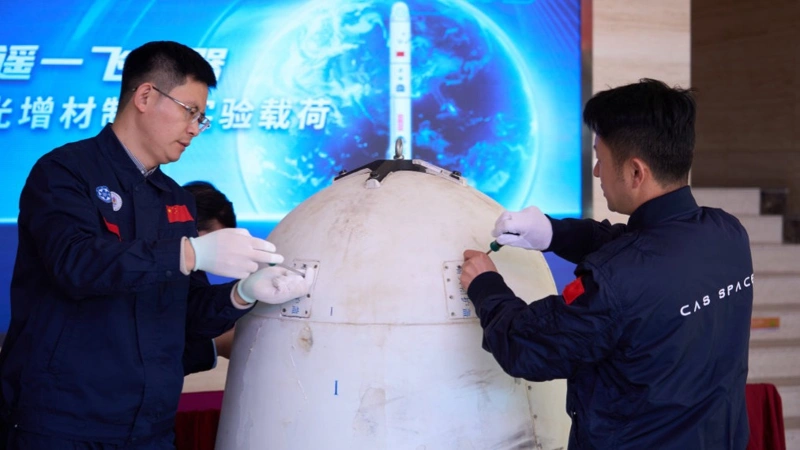
Chinese scientists have completed the country’s first space-based laser wire-fed metal AM experiment under microgravity conditions, conducting the work during a suborbital flight and achieving a breakthrough. Image courtesy of CAS Space.
Aboard the uncrewed Qingzhou spacecraft, the team used a laser-based system that melts metal wire and deposits it layer by layer in microgravity. Researchers said the equipment operated autonomously, using commands sent from Earth, and was able to start and stop remotely multiple times during the test.
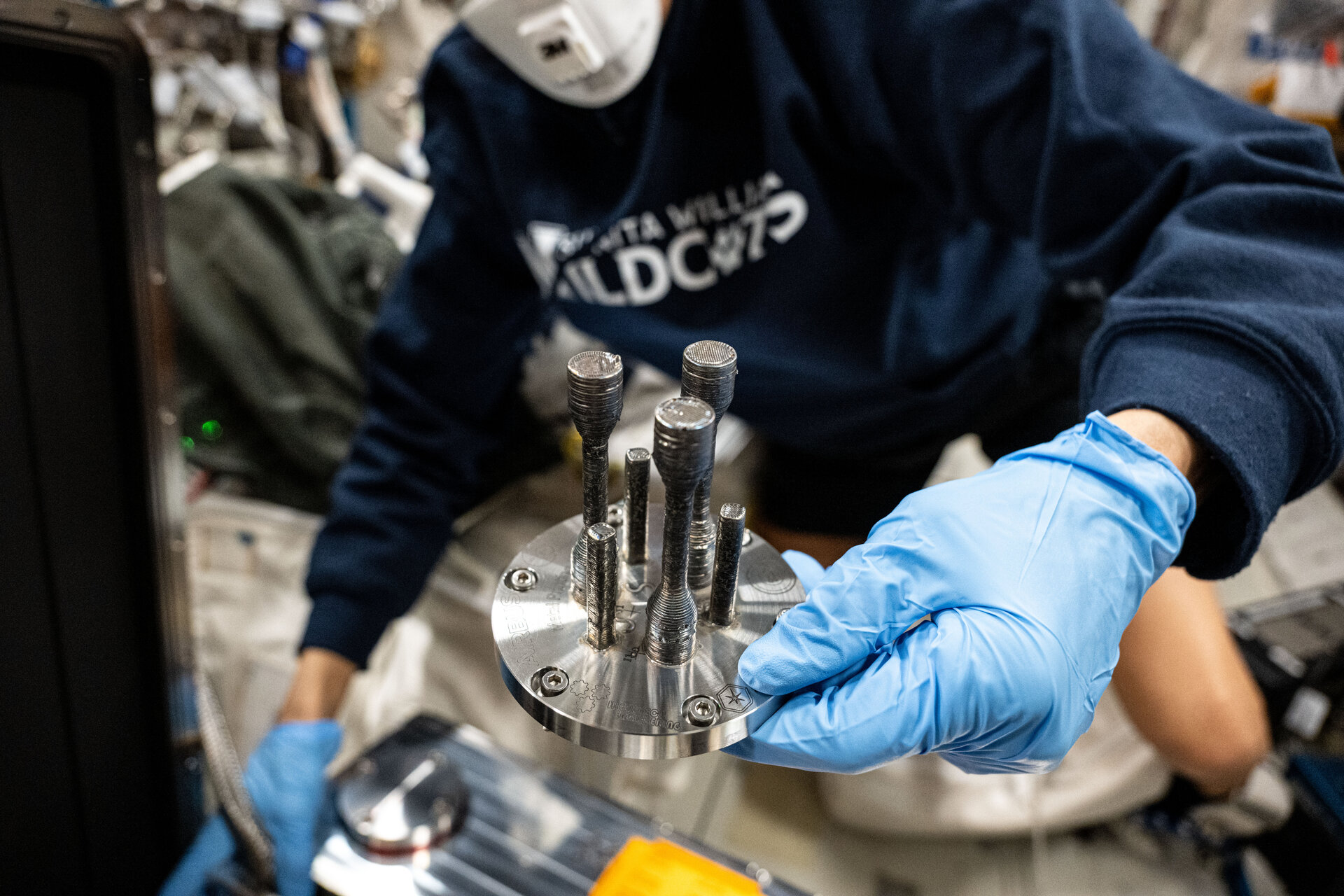
First metal part 3D printed in space. Image courtesy of ESA/Jeanette Epps.
This is not the first time metal 3D printing has been demonstrated in space. In 2024, the European Space Agency (ESA) installed the first metal 3D printer aboard the International Space Station (ISS), successfully producing the first metal part ever made in space. But China’s latest experiment shows that the country is now developing its own in-space manufacturing capabilities as interest grows in producing tools, spare parts, and structures directly in orbit and, eventually, on the Moon.
Metal printing in space is far more difficult than plastic printing because molten metal behaves differently in microgravity. On Earth, gravity helps control how molten metal flows and settles during printing. In space, there is almost no gravity, so the liquid metal can float, form unstable droplets, or cool unevenly. That makes it much harder to control the shape and quality of the printed part.
Chinese researchers said they had to solve several problems before the system could work well in orbit. One was controlling how molten metal droplets move in microgravity. Another was keeping the melt pool stable enough to print evenly layer by layer.
The system also had to survive launch vibrations, operate safely inside a spacecraft, and work autonomously, following commands sent from Earth. Since astronauts were not onboard, the printer needed to manage the process largely on its own once activated.
The development is important for China because future space missions may not be able to carry every single tool or spare part from Earth. Instead, astronauts could eventually make parts in space as they need them, including tools, replacement components, and maybe even parts of future habitats during long missions.
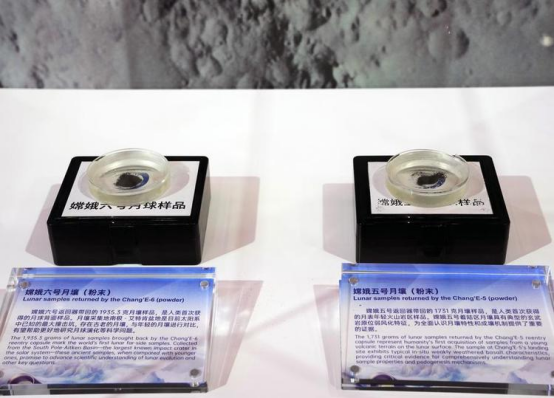
Chinese scientists have made a breakthrough in lunar science by analyzing samples returned by the Chang’e-6 mission, providing a crucial scientific basis for lunar research, according to the China National Space Administration. Image courtesy of China National Space Administration.
China has been expanding its work in space-based 3D printing over the last few years as part of its lunar ambitions. Through its Chang’e program, the country has already landed robotic missions on the Moon and returned lunar samples to Earth. Plans include building a long-term lunar research base and eventually sending astronauts to the Moon around 2030.
One of the best examples is the planned Chang’e 8 mission, expected later this decade, which aims to test technologies for building structures on the Moon using lunar soil. Chinese researchers and universities have also been experimenting with lunar regolith printing systems, robotic construction concepts, and brick-making technologies designed for harsh lunar environments. Some concepts involve autonomous robots assembling printed blocks into dome-shaped habitats for future lunar missions that could eventually help with long-term human presence on the Moon.
The work is part of China’s push to expand its space program, including the Tiangong space station and future lunar bases. Under the country’s Tiangong Kaiwu roadmap — unveiled in 2023 by China Aerospace Science and Technology Corporation (CASC) — manufacturing and resource extraction are expected to play a major role in future space operations. In fact, researchers have described this latest suborbital metal 3D printing test as a key step away from laboratory work toward real manufacturing experiments in space.
Subscribe to Our Email Newsletter
Stay up-to-date on all the latest news from the 3D printing industry and receive information and offers from third party vendors.
Print Services
Upload your 3D Models and get them printed quickly and efficiently.













You May Also Like
3D Printing News Briefs, October 10, 2026: Drones, WAAM, Ceramics, & More
We have a packed 3D Printing News Briefs for you this weekend! First, America Makes celebrated the recent National Manufacturing Day with 3D printed drones, and then it’s on to...
10 Years of Multi Jet Fusion: Onsite at HP’s Vancouver, Washington Facility
At this year’s RAPID event in Boston, HP Additive Manufacturing Solutions celebrated ten years in the additive manufacturing (AM) market. The company ushered in the milestone with several innovations, including...
PharmaTher Plans U.S. Network to 3D Print Medicines on Demand
3D printing medicines has often been tied to the idea of personalization, basically making a pill in the right dose, shape, or drug combination for a patient. PharmaTher is now...
3D Printing News Briefs, September 17, 2026: 3D Printed Boat, UAS Development, & More
We’ll start with maritime manufacturing in this week’s 3D Printing News Briefs, and continue on to defense 3D printing. We’ll end with funding for Tripo AI. Read on for all...