Altair’s OptiStruct Allows for Topology Optimization and 3D Printing of Lattice Structures

 Altair has twenty years in the business of optimizing strength in structure and design for just about every major industry. With their newest solution, OptiStruct, Altair is specializing in 3D printed lattice structures — something which has not been available for most of their clientele until the advent of 3D printing technology and further innovation propelled everyone into a new design age — with spectacular new tools. This will be added to their HyperWorks suite of engineering software.
OptiStruct gives a multitude of global companies the affordability to assess and create structures possessing the required characteristics necessary in terms of strength and reliability. With the combination of 3D printing, Altair can offer design of lattice structures and composites, helping clients in many industries to stay innovative, sharp, and ahead of the competition.
The OptiStruct solution, included in Altair HyperWork engineering software, is award-winning, and aids in optimization for: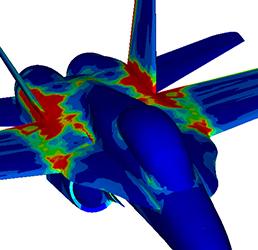
- Topology
- Topography
- Size
3D printing has come into play in optimizing structures due to its ability to allow for objects with complicated shapes that are also hollow. The lattice structures that can be created allow for assessment of:
- Tension
- Compression
- Shear
- Flexion
- Torsion
- Fatigue life
This new technology satisfies an unmet need, since no tools previously existed for designers of lattice structures. Now, OptiStruct will provide computer-aided engineering (CAE) analyses for optimal and structurally efficient material distribution.
“3D printing brings new structural freedom to product design, allowing more complexity in shapes and topology and the efficient production of customized products while accelerating the manufacturing process, since no tooling is needed,” said Uwe Schramm, Chief Technical Officer at Altair. “Topology optimization maximizes this design freedom, enabling complex free-form structure development, seamless individual designs, a shorter design process, and optimal 3D-printed structures.”
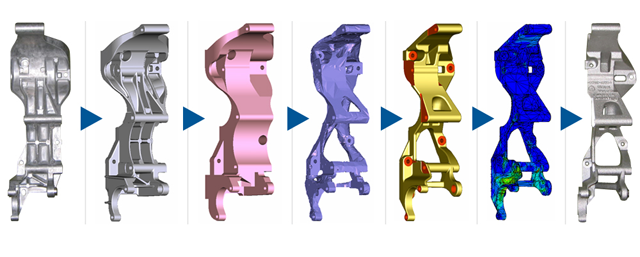 Optimization is key in OptiStruct, as the unique quality it offers designers is that they can easily decide where to place lattice structures, seeing clearly where they are — or aren’t — needed. The software optimizes for topology and then porous zones are used to create the lattice structures. Afterward, dimensions are optimized, resulting in a solid structure accentuated with lattice cells.
“OptiStruct’s lattice capability represents the first step towards integrating smart materials with unique properties in products,” said Ming Zhou, Vice President of Software Development at Altair. “Continuing research and development will explore directional behavior and smooth blending of varying lattice cell layouts to take advantage of exotic material characteristics that could bring innovation to various applications.”
Being able to place lattice structures and optimize the structures is crucial for models like biomedical implants where porosity plays a major role. For other designs, users may need to look at whether or not structures would buckle, and what their thermal performance would be like, as well as any other characteristics that need inspecting. Upon defining what the user wants and needs in the structure, optimization is then completed. While traditional .stl file transfer can be unwieldy, Altair is collaborating with Materialise to streamline efficient data transfer, and recommends their 3-MaticSTL software for 3D printing lattice structures with necessary supports.
Serving approximately 5,000 clients, and with nearly 50 offices in 22 countries, Altair is headquartered in Troy, Michigan.
Subscribe to Our Email Newsletter
Stay up-to-date on all the latest news from the 3D printing industry and receive information and offers from third party vendors.
Print Services
Upload your 3D Models and get them printed quickly and efficiently.











You May Also Like
Alloyed Develops New 1000°C Alloy for 3D Printed Flight-Ready Jet Engine Parts
Nickel-based superalloys and music (Bing Crosby and Fred Astaire, for starters) were best in the 1930s. Inconel and Hastelloy were invented in that decade, along with Scotch tape, the car...
Scaling AM Suppressor Production: Oerlikon AM & ATLIX Rise to the Challenge
End-of-barrel suppressors, oftentimes referred to as silencers, function by capturing and redirecting high-pressure propellant gases through carefully engineered internal structures and channels. By disrupting the gas flow before it exits...
From Material Maturity to Fleet Execution: What Comes Next for Additive Manufacturing in the U.S. Navy
Additive manufacturing is steadily moving from experimental use toward routine application in U.S. Navy shipbuilding, sustainment, and much more. In recent years, the Navy, working through its Maritime Industrial Base...
Fully Automated, “Continuously Re-Nested” Industrial 3D Printing: AMIS Launches AMIS Runtime
Automation is already a pillar of global manufacturing strategy, even as its practical limitations for continued expansion signal that manufacturers will require quite some time to figure out how to...