San Francisco as You’ve Never Seen it Before… 3D Printed

Possibly the world’s largest 3D printed cityscape has been unveiled in San Francisco, showing the potential that 3D printed models offer city planners, architects, and real estate developers.
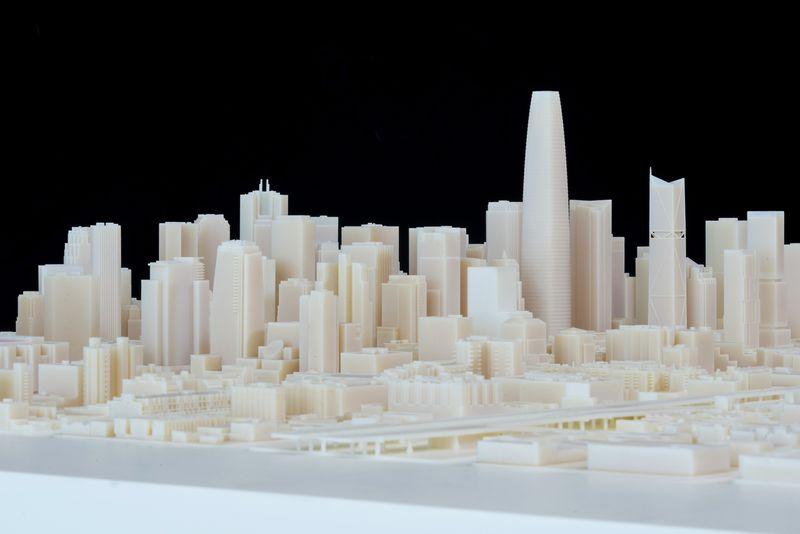
The model of San Francisco was built by Autodesk, the 3D design and engineering company, using a digital model from design company Steelblue. It shows San Francisco circa 2017, revealing how the city will look with the completion of several projects already under construction.
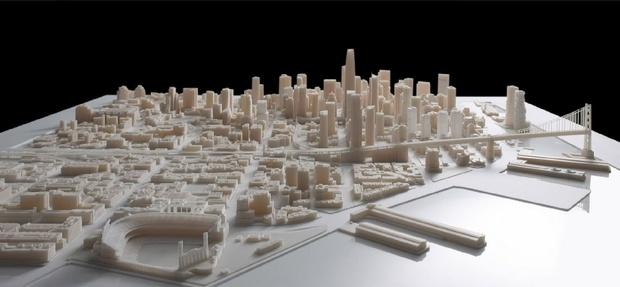
The model, which covers over 115 blocks and encompasses the Financial and ‘South of the Market’ Districts, was built for real estate developer Tishman Speyer, who wanted to tell the story of urban development in the rapidly changing SOMA neighborhood.
However, 3D printed cityscapes such as this, offer new opportunities for developers and town planners as it allows them to explore new buildings, highway routes, and even sunlight patterns.
“For developers, architects, urban planners, city officials and the public at large, there is nothing quite like a scale model of your city to gain new insights into your surroundings,” said O’Brien Chalmers, president of Steelblue.
“With 3D printing, we add in a rapid-prototyping capability. We can swap in buildings or entire city blocks to explore design options and to keep the model up to date in rapidly evolving neighborhoods,”
The resin model, which includes AT&T Park, the Ferry Building, the San Francisco Museum of Modern Art, as well as big public works, such as the Transbay Transit Center, might “actually be the largest 3D-printed model of any city,” Bill Danon, a spokesman for Autodesk claimed.

The model was created at Autodesk’s Pier 9 workshop on two Objet Connex 500 printers with print resolution of 16 microns and was based on a digital model provided by Steelblue. It took two months to fabricate, but the end results were worth it, claims O’Brien Chalmers.
“Adding layers of data visualizations gives us even more power to understand and visualize the way new buildings and infrastructure will impact the urban landscape and the people who live and work there,” he said.
Following the creation of the model, the companies intend to create printed models of other cities.
“We’ve been creating digital 3D models of cities around the world. They are incredible tools for urban planning, but sometimes the tactile experience of a physical model provides insights and understanding you can’t get from a screen,” said Justin Lokitz, senior product manager at Autodesk.
“This project is really the embodiment of our Pier 9 Workshop – experimenting with new fabrication methods to bring the digital and physical worlds closer together,” he added.
The cityscape was unveiled on Wednesday in the Bay Area but it will remain with Tishman Speyer. However, Autodesk is planning to make a replica, which will be displayed at the Autodesk Gallery in the One Market Building, for anybody in the San Francisco area who is keen to take a look.
Discuss this quite interesting use of 3D printing in the ‘San Francisco 3D printed‘ forum thread. Also check out the brief video clip below of the model:
Subscribe to Our Email Newsletter
Stay up-to-date on all the latest news from the 3D printing industry and receive information and offers from third party vendors.
Print Services
Upload your 3D Models and get them printed quickly and efficiently.













You May Also Like
Metal 3D Printers for the Desktop Are Finally Starting to Feel Like Desktop Products
FDM 3D printing is becoming increasingly accessible, yet metal 3D printers designed for everyday desktop use remain rare on an ordinary workbench. The real challenge is not making a metal...
3D Printing Financials: 6K Additive Sales Rise as Aerospace and Defense Demand Grows
6K Additive (ASX: 6KA) grew rapidly in the first half of 2026 as demand for its metal powders increased, particularly from aerospace and defense customers. The newly public company also...
When Data Becomes the Differentiator: Qualified Material Data is Changing the Future of Structural Additive Manufacturing
For years, additive manufacturing has promised engineers greater design freedom. The challenge wasn’t printing the part—it was proving the part belonged on an aircraft. Designing a lightweight bracket or consolidating...
Amaero Builds U.S. Metal Powder Capacity for Additive Manufacturing
For metal additive manufacturing (AM) to grow in the United States, companies need more than printers. They also need a reliable supply of the powders that go into those machines....