Japan Unveils World’s First 3D Printed Train Station


Japan is now home to what we believe is the world’s first train station built with 3D printing technology. Located in Arida City, just south of Osaka, the new Hatsushima Station is a collaborative effort between the West Japan Railway Company (JR West), its innovation arm JR West Innovations, and 3D printing construction trailblazer Serendix.
The station’s structure was assembled in March 2025, but it hasn’t officially opened yet. JR West plans to finish the interior work, including ticket machines and card readers, before welcoming passengers in July. When it opens, Hatsushima Station will replace the original wooden building from 1948 and is expected to become a model for modern, efficient infrastructure in rural areas.

Hatsushima Station, built in 1948, is a wooden building, now replaced with a 3D printed station. Image courtesy of Arida City.
The project is looking to fix two big problems in Japan’s railway system: aging infrastructure and labor shortages. Rebuilding with traditional construction methods often takes a lot of time and people, especially when rebuilding old wooden stations. With 3D printing, the work is much faster and less labor-intensive.
The new station building is a single-story structure covering just under ten square meters (about 107 square feet). Its design includes wall decorations that reflect local culture, featuring artistic motifs inspired by mandarin oranges, or “mikan,” and cutlassfish, or “tachiuo,” two well-known symbols of Arita City.

The crew worked at the train station at night. Image courtesy of Arida City.
One of the most interesting parts of this project is how quickly it was built. The 3D printed components were manufactured off-site and then assembled at the station during the night, reducing disruption to train services. The whole process, from setup to final build, was designed to be completed within six hours, between the last train at night and the first train in the morning.
Thanks to 3D printing, the construction moved quickly. The new concrete structure also offers better durability and resistance to corrosion than the old wooden building. On top of that, the 3D printing process doesn’t require formwork, which means less material waste and more freedom in design.
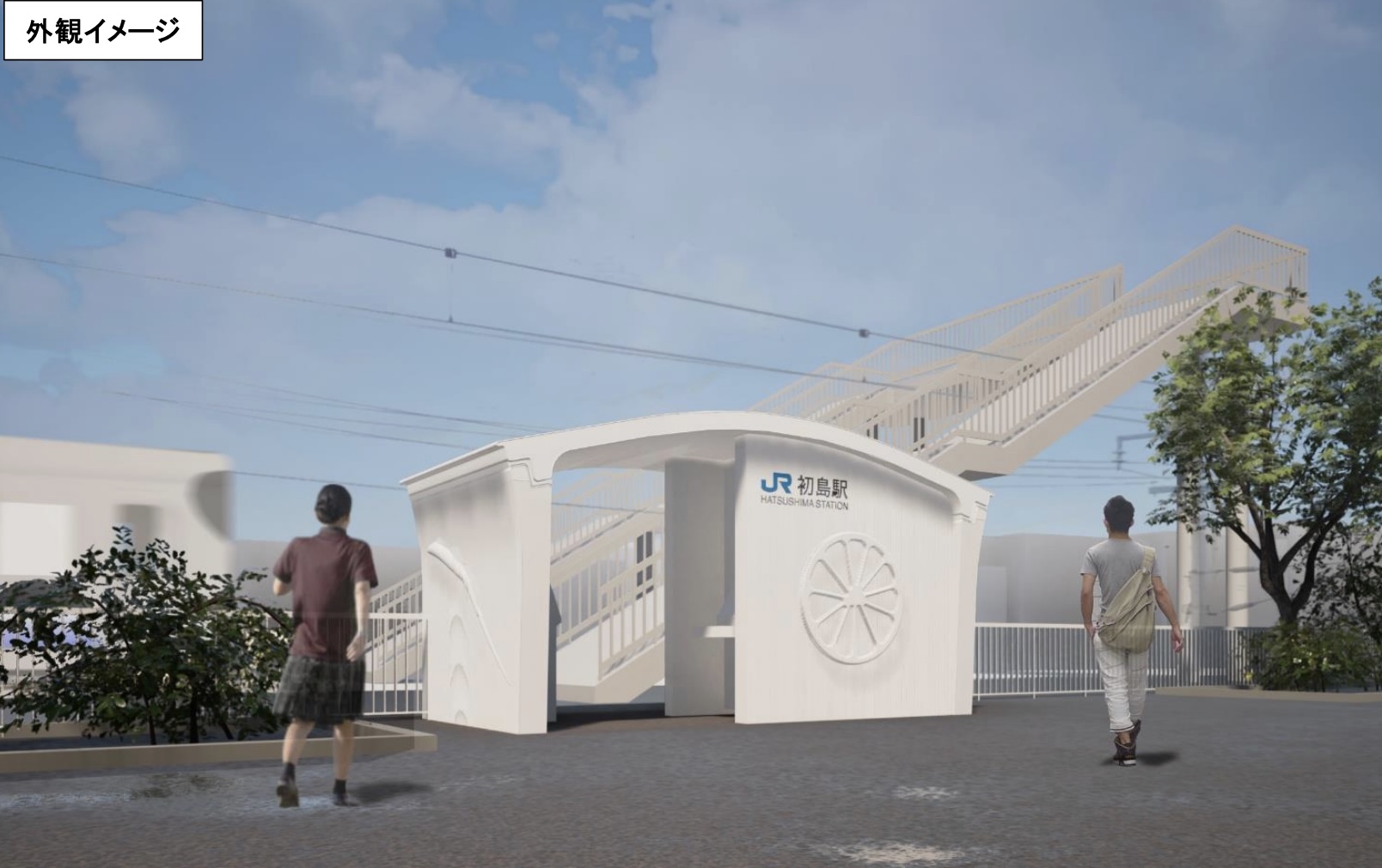
Rendering of the completed Hatsushima Station. Image courtesy of JR West.
Serendix, headquartered in Nishinomiya City, has been at the forefront of 3D printed housing in Japan. The company gained attention in 2022 when it completed “serendix10,” a 10-square-meter 3D printed house that was constructed in just 23 hours. Building on this success, Serendix introduced “serendix50,” a 50-square-meter home designed for two people, which can be built in under 45 hours and costs about ¥5.5 million ($38,500).
In 2024, the company expanded its capabilities by acquiring three new construction 3D printers, bringing its total to eight machines, with plans to increase to twelve by the end of 2025. These printers are installed across various locations in Japan, including Kumamoto, Chiba, and Okinawa, as part of Serendix’s affiliate output factory strategy. The company employs gantry-type printers, capable of handling large outputs up to 100 square meters, and robot arm-type printers, which excel at detailed modeling.
The Hatsushima Station project is the first step in exploring how 3D printing can be used in railway construction. JR West and Serendix plan to study the costs and upkeep to see if this method could work at other stations, too. Also, the project supports several of the United Nations’ Sustainable Development Goals (SDGs), especially those focused on innovation, sustainable cities, and strong partnerships. It shows how Japan is using new technology to build smarter, more resilient infrastructure for the future.
Subscribe to Our Email Newsletter
Stay up-to-date on all the latest news from the 3D printing industry and receive information and offers from third party vendors.
Print Services
Upload your 3D Models and get them printed quickly and efficiently.












You May Also Like
AM Demand Signals: the Tungsten Harbinger
Most everyone who’s concerned with the scarcity of industrial materials is focused on rare earths, and rightfully so. But aside from the direct impact resulting from tighter supplies of rare...
WASP Mixes Earth and Plastic to Make Recyclable 3D Printed Composites
WASP has an eco-friendly ethos. Indeed, the firm wants to build houses and communities using local, environmentally friendly, and sustainable materials. WASP works with ceramics, biocement, and earth. The company...
3DPOD 318: 3D Printing at ORNL, Part II – Thomas Feldhausen
Thomas Feldhausen works at Oak Ridge National Laboratory (ORNL) on hybrid manufacturing, DED, digital twins, and new manufacturing solutions. For years, he’s tried to marry traditional subtractive manufacturing with additive...
The First Million’s the Hardest: Carbon’s Achievement with 3D Printed Bike Saddles
Last month I wrote an ode to 3D printed football helmet liners, as well as a brief overview of some of the biggest additive manufacturing (AM) success stories for the...