Amaero Targets $52.6M U.S. IPO Amid Major Metal Powder Expansion, Later Postpones Offering

UPDATE, September 24, 2026: Amaero has postponed its planned U.S. initial public offering, citing adverse market conditions. The company planned to raise about $52.6 million by selling 7.46 million shares and listing on the Nasdaq Global Select Market under the ticker AMRO. Amaero said its registration statement remains filed with the U.S. Securities and Exchange Commission but has not yet been declared effective. The company did not provide a new timetable for the offering.
Amaero is taking another major step in its U.S. expansion. The metal powder producer has filed for an initial public offering (IPO) in the United States that could raise roughly $52.6 million, with plans to list on the Nasdaq Global Select Market under the ticker AMRO.
According to its latest filing with the U.S. Securities and Exchange Commission (SEC), Amaero plans to offer about 7.5 million shares. The $52.6 million figure is based on an assumed price of $7.06 per share, so the final size of the offering could change.
But the IPO is about more than a new stock listing. Amaero is in the middle of a major buildout of its U.S. manufacturing operations, with metal powders right at the center of that strategy.
More Powder Capacity in Tennessee
Amaero produces spherical refractory and titanium alloy powders used in additive manufacturing (AM) and other advanced manufacturing processes. It also makes large components using Powder Metallurgy Hot Isostatic Pressing (PM-HIP). Both operations are based at the company’s manufacturing facility in McDonald, Tennessee. There, the firm currently operates three Electrode Induction Melting Inert Gas Atomization (EIGA) systems. The third was commissioned in June 2026, and a fourth is expected to come online in June 2027.
Current production capacity is about 680 metric tons of powder a year. Once the fourth atomizer is running, that is expected to rise to about 920 metric tons. The company has already spent heavily to get there. According to the filing, Amaero invested roughly $48.3 million in property, plant, and equipment through June 30, 2026, as it built its U.S. manufacturing operations.
More spending is coming. Amaero expects to invest another $16.5 million to complete its current production buildout. That includes roughly $3.3 million for the fourth EIGA system, $2.2 million for an argon gas recycling system, and $11 million for powder processing equipment, PM-HIP equipment, and facility improvements.
The IPO would give Amaero additional money for that expansion. The company says it plans to use up to roughly $17.5 million of the net proceeds to buy capital equipment over the next 12 months. The remaining proceeds are expected to go toward general corporate purposes, including working capital, operating expenses, and research and development.
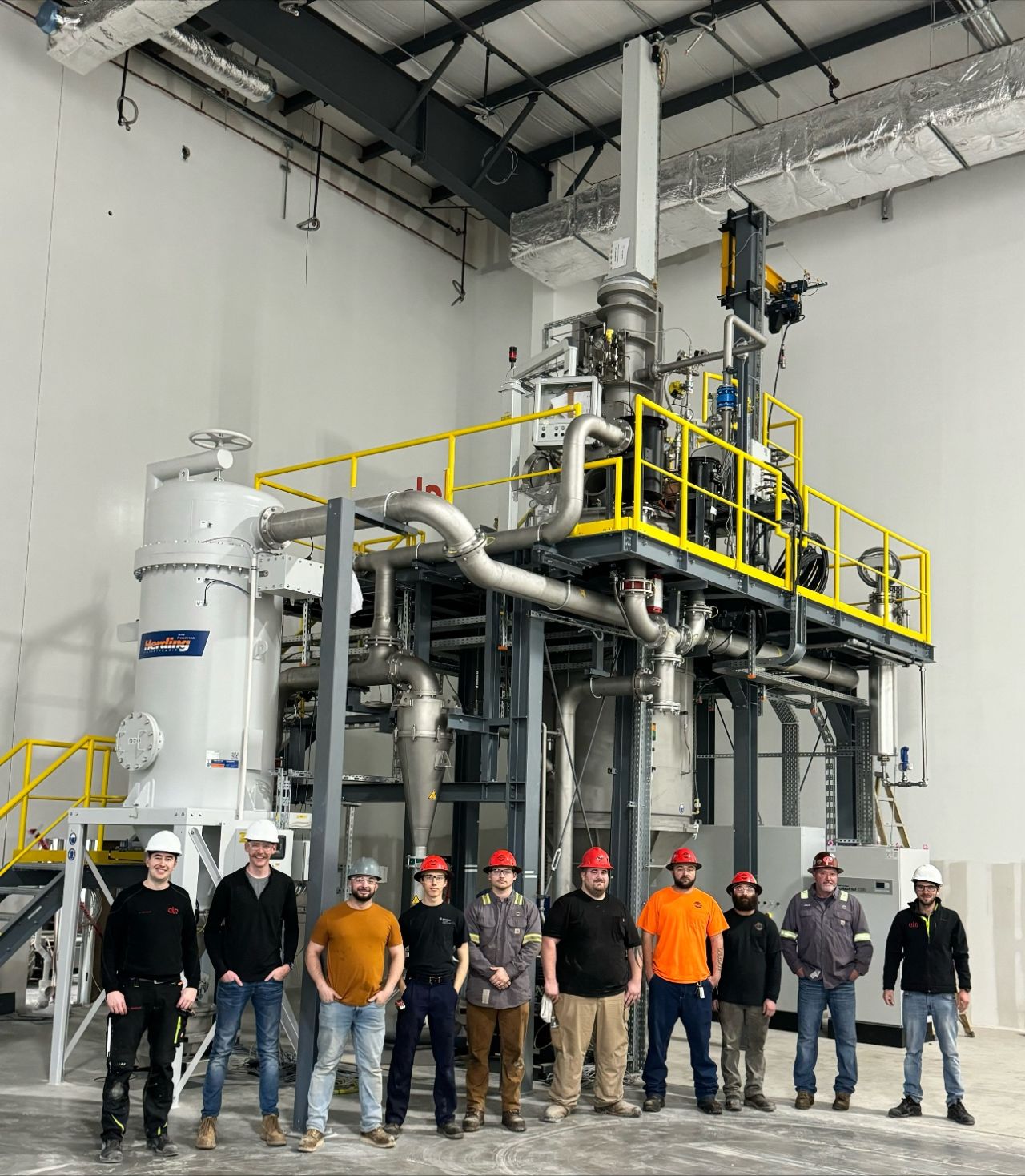
Installation of atomizer. Image courtesy of Amaero.
Revenue Is Growing, but So Are Losses
The SEC filing also gives a closer look at Amaero’s finances as it prepares for a U.S. listing. Revenue reached $7.4 million during the first six months of 2026, up from $1.2 million during the same period in 2025. Backlog also increased, with Amaero reporting $10 million in backlog as of June 30, 2026, compared with $3.2 million a year earlier.
But the company is still losing money as it expands. Amaero reported a net loss of $13.4 million for the first six months of 2026, compared with a loss of $8.7 million during the same period last year. It also used $12.9 million in cash for operating activities during the first half of the year.
As of June 30, Amaero had $13.6 million in cash and cash equivalents and $19.6 million in total debt. Those figures come as the company continues to spend heavily on new equipment and production capacity.
From Australia to the U.S.
The Nasdaq move is also part of a larger change at Amaero. The company was originally founded in Australia and went public on the Australian Securities Exchange (ASX) in 2019. Its shares continue to trade there under the ticker 3DA. In June 2026, Amaero completed its move from an Australian parent company to a Delaware-based U.S. parent company. According to the SEC filing, the move was designed in part to support a U.S. IPO and help the company qualify for U.S. classified defense contracts.
Today, all of Amaero’s revenue comes from the United States. Its products serve customers in defense, aerospace, and space, with metal powders used in applications ranging from hypersonic systems and satellite propulsion to aerospace and medical manufacturing. Amaero has also signed supply and development agreements with companies like ADDMAN, Velo3D, and Titomic.
But Amaero remains unprofitable, and the expansion comes with challenges. The company points to long qualification cycles and uncertain demand in aerospace and defense as risks to its business.
Amaero has not yet set an IPO date. According to its SEC filing, the offering is expected to move forward once the registration statement becomes effective.
Subscribe to Our Email Newsletter
Stay up-to-date on all the latest news from the 3D printing industry and receive information and offers from third party vendors.
Print Services
Upload your 3D Models and get them printed quickly and efficiently.












You May Also Like
3D Printing News Briefs, August 22, 2026: Polymers for CubeSats, Animal Mobility Devices, & More
We’re starting with defense news in this weekend’s 3D Printing News Briefs, before moving on to polymers for CubeSats and 3D printed prosthetics. We’ll end with a story about engineering...
Pusan National University & ORNL Develop Elastomeric Liquid Crystal Actuators
Researchers from Korea’s Pusan National University and Oak Ridge National Laboratory (ORNL) have developed 3D printed elastomeric actuators. In a paper published in Nature, the team used elastomeric liquid crystal...
Scientists Use BMF to 3D Print Seal Whiskers That Track Prey Long After It’s Gone
Seals use their whiskers to hunt. Not Navy Seals, although they may in some way also, but this article is about lowercase seals. Not Seal the musician either; as far...
Harvard’s Jennifer Lewis Lab Is 3D Printing Artificial Muscles That Twist and Bend on Demand
Researchers at Harvard John A. Paulson School of Engineering and Applied Sciences (SEAS) have developed a new way to 3D print materials that can move on their own, bending, twisting,...