DOE Awards $50M to Coreshell Technologies & AM Batteries for Domestic Anode Production

One topic that I do my best to stay on top of is the inseparability between rising adoption of metal additive manufacturing (AM) and the growing awareness of a need to build resilience into critical minerals supply chains. The latter clearly represents a much larger scope of activity than the former, but precisely for that reason, metal AM’s primary long-term value ultimately lies in its being situated within the ongoing, global rearrangement of critical minerals supply and demand relationships.
Among other factors, the anticipated sustained boom in battery demand over the next decade is a major driver pushing nations outside of China to get a bit more proactive, and collaborative, about securing their critical minerals supplies. The AM industries in the relevant countries — many, but by no means all, located in the West — should benefit greatly from that dynamic, with objectives including the scale-up of new recycling techniques and heightened R&D investment figuring as focal points of the new international partnerships.
A new $50 million contract that the US Department of Energy (DOE) just awarded to Bay Area company Coreshell Technologies points in the direction of how the critical minerals/AM nexus could grow in years ahead, even as the funding comes from the Infrastructure Investment and Jobs Act that was passed years ago under President Biden. (Indeed, the fact that this is where the money came from emphasizes just how long all this will take.) Coreshell uses metallurgical silicon (MGS) as a replacement for graphite in lithium-ion battery anodes, a mineral that China is responsible for supplying well over 90 percent of globally. The subrecipient of the DOE contract, Massachusetts-based AM Batteries, is working with Coreshell to incorporate the dry-coating process for the battery cathodes.
According to the two companies, the DOE grant will enable them to build facilities capable of supplying 2 gigawatt hours of electrode manufacturing capacity and 1.5 gigawatt hours of cell assembly capacity domestically, thereby creating over 100 jobs. The companies claim that their process is compliant with the National Defense Authorization Act (NDAA), and that it is the first scalable process in the US that can completely eliminate Chinese minerals from the battery supply chain.
AM Batteries, founded in 2020, leverages a proprietary roll-to-roll (R2R) AM process that incorporates powder deposition to bypass limitations associated with conventional battery manufacturing methods. AM Batteries claims that its process is both more cost-efficient and less environmentally destructive than the industry standard based on wet slurry coating.
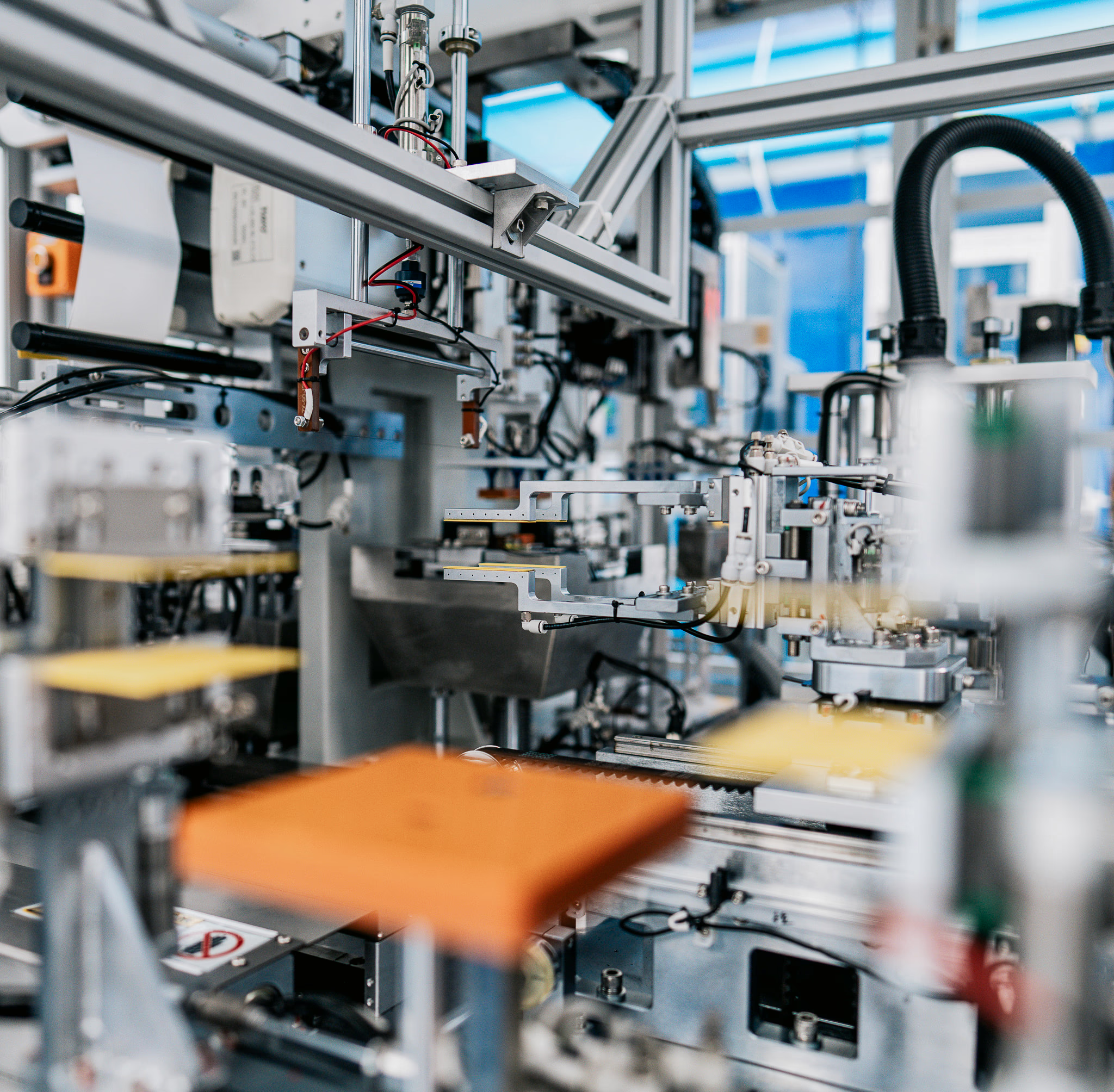
Image courtesy of AM Batteries
In my writing about AM’s impact on the semicap market, I’ve focused mainly on advanced packaging methods, many of which also leverage R2R processes. The more I’ve paid attention to that market segment, the more it appears to me that the Western AM industry largely ignores it simply because it doesn’t fit the arbitrarily determined categories that define what constitutes “AM.”
Nonetheless, TDK Ventures, which has been an investor in AM Batteries since the seed round, specifically referred to it as a “precision additive manufacturing” technique in its announcement of its initial investment. Earlier this year, of course, the parent company acquired Fabric8Labs, another company whose production process doesn’t fit conventional definitions of AM, but counts as AM all the same.
Anzu Partners, another regular investor in the AM industry, led the $25 million Series A for AM Batteries, and the startup has also received funding from Toyota Ventures. R2R seems to be drawing significant interest despite being overlooked by what is, ostensibly, the industry that should find it most interesting. Perhaps how these things are defined only matters insofar as there’s overlap between the more niche processes and the ones that have been designated as part of the 3D printing industry. But along those lines, there is surely extensive overlap in the materials and software used, as well as the relevant labor pools, if not the machines themselves. One consequence of this is that the AM industry is almost certainly much larger than is typically understood, at least in the US.
Featured image courtesy of Coreshell Technologies
Subscribe to Our Email Newsletter
Stay up-to-date on all the latest news from the 3D printing industry and receive information and offers from third party vendors.
Print Services
Upload your 3D Models and get them printed quickly and efficiently.













You May Also Like
3DPOD 316: Beehive’s Gordie Follin on 3D Printed Engines and More
Gordie Folin had deep experience in engineering at Pratt & Whitney, GE, and GE Aviation before becoming the Chief Product Officer at Beehive Industries. Among his achievements, he served as the...
3DPOD 315: Dirk Simon, from BASF to Farsoon to FKM, and now Square New Business
Dirk Simon had already spent years in the chemicals industry before joining and pioneering BASF‘s 3D printing effort. We get to hear how that firm looked at 3D printing and...
Printing Money Episode 42: Q2 2026 Public Markets 3D Printing Earnings Analysis with Troy Jensen, Cantor
Welcome to Printing Money Episode 42. Troy Jensen (Managing Director, Cantor) returns, joining Danny Piper (Managing Partner, NewCap) to review Q2 2026 publicly traded 3DP/AM company earnings reports. Troy’s quarterly...
3DPOD 314: Debinding, Sintering, and Metal Binder Jetting with Stefan Joens, Elnik Systems and DSH Technologies
Stefan Joens of Elnik Systems sells ovens. Their debind and sintering equipment powers a lot of high-volume binder jet and MIM production. We learn about Elnik and its origins. But...