3D Printed Weapons Keep Showing Up in Crime


In the past few weeks, activity around 3D printed weapons in the U.S. has increased across several fronts. States including California, Colorado, New York, and Washington are moving forward with new laws, courts are deciding how digital gun files can be regulated, and law enforcement continues to report arrests tied to 3D printed firearms and other dangerous uses. While making firearms can be legal in some cases, much of the recent activity is focused on how 3D printed guns and their files are regulated, shared, and handled by law enforcement. Because so much is happening with laws and arrests, some of the more unusual cases stand out more.
States Push New Laws
Several states are trying to tighten the rules around 3D printed guns, an issue that has been building for months as lawmakers look for ways to deal with untraceable “ghost guns” made outside of the traditional channels. Officials say many of these weapons are difficult to track and have shown up in criminal cases, which is driving much of the recent push. The focus is not just on the weapons themselves, but also on the digital files that make these guns possible.
In Colorado, lawmakers are pushing a bill to limit 3D printed ghost guns, as part of a broader effort to address untraceable firearms that officials say have become harder to track and regulate, including requirements for serialization and restrictions on how these weapons can be made and assembled. However, they are still debating how strict the proposal should be.
In New York, Governor Kathy Hochul and Manhattan District Attorney Alvin Bragg have been pushing for stricter rules after a series of high-profile cases involving ghost guns. Their focus has been on limiting access to online files used to produce these weapons and increasing penalties that are tied to their use.
Washington State, meanwhile, has passed a law targeting 3D printed firearms, 3D printed gun parts, and the digital files used to make them, adding restrictions on both the production of these weapons and the distribution of the files used to make them.
California is taking a different approach, filing lawsuits against websites that host these types of files, and arguing that they make it easier to produce guns outside the existing rules and should be held responsible for their distribution.

Glock designed its civilian-purchased pistols to be easily modified. Image courtesy of the City of Chicago.
Courts are also starting to play a larger role. In a recent decision, a federal appeals court found that regulating the distribution of 3D printed gun files may not violate the Constitution. This could give states more room to control how these files are shared online.
At the same time, California has filed lawsuits against websites that host 3D printed gun files, arguing that they enable unlawful manufacturing. These cases could help set boundaries for how digital designs are treated going forward.
Federal agencies have also been paying close attention in the last few years. The Bureau of Alcohol, Tobacco, Firearms and Explosives (ATF), for one, has been warning about the danger of machine gun conversion devices (MCD) since at least 2024. Easy to manufacture and illegal for decades, MCDs can turn a semi-automatic firearm into a fully automatic weapon—delivering hundreds of rounds with a single pull of the trigger. also known as “switches” or “auto sears,” are small components—usually made from metal or plastic—that can be easily attached to a handgun or rifle to convert it from semi-automatic to fully automatic. While possessing or manufacturing MCDs is illegal in the U.S., their production has exploded in the last two years, largely because it is very easy to create them with 3D printers, and they are often sold online or printed at home.
Recently, WKRN news talked to the ATF field office in Nashville about the growing use of 3D printers to create conversion devices, like Glock switches. Officials have said these items are increasingly showing up in investigations and are difficult to trace, which is driving concern, especially if they end up in the hands of violent offenders or serial shooters.
Enforcement and Arrests Continue
At the same time, police continue to report cases involving 3D printed guns. For example, in Massachusetts, police in Dartmouth seized ghost guns and a 3D printer after arresting a man who was not allowed to own firearms. Officers said they found rifles without serial numbers, a 3D printer used to make parts, and digital files tied to gun production.
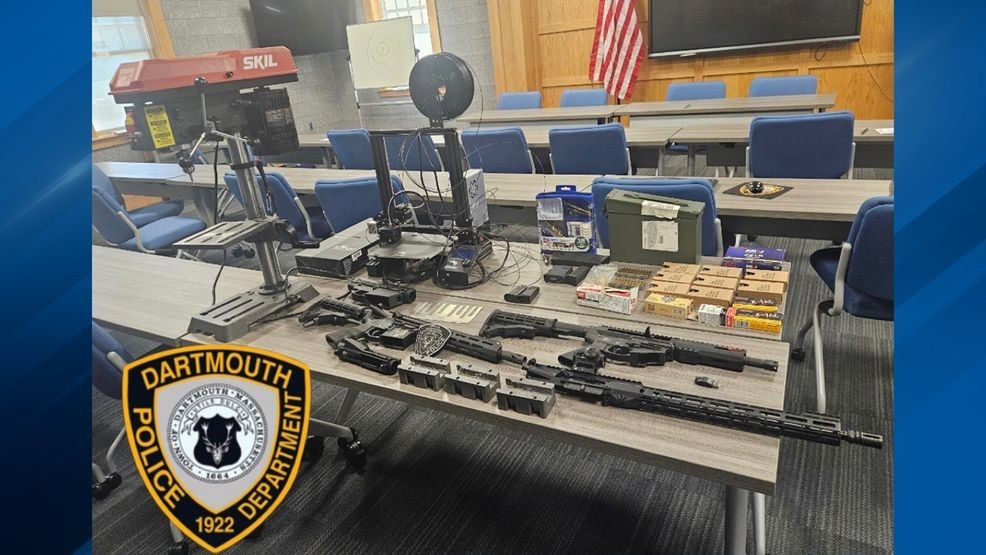
Dartmouth police said they seized ghost guns and a 3D printer after a man was arrested. Image courtesy of the Dartmouth Police Department.
In Louisiana, a man in Breaux Bridge was arrested for using a 3D printer to make illegal switches. Authorities pointed out that manufacturing or possessing devices that convert firearms into fully automatic weapons without proper federal registration is illegal under both state and federal law. However, these devices are increasingly being made and shared.
Also, in Pennsylvania, police in Sunbury reported finding close to two dozen 3D printed gun switches along with other weapons, including grenades, during an investigation. Authorities said the case involved a mix of firearms, drugs, and equipment tied to making gun components.
Similar cases have been reported outside the U.S., as usual. In the U.K., police in the West Midlands made six arrests after seizing a 3D printed gun during a raid, in what they described as a serious case involving illegal firearms production. The bust was part of Operation Target, a 24/7 mission to tackle serious and organized crime across the region.
Brazilian authorities, led by the Brazilian Federal Police, dismantled a major global 3D printed weapons network under Operation Shadowgun, arresting a figure known as “Zé Carioca,” a young engineering student who was also a key developer and distributor tied to open-source gun designs and online communities. Investigators say the group operated across borders, using encrypted platforms, VPNs, and cryptocurrencies like Monero to fund and distribute files and parts that were tied to ghost guns. The raid not only removed one of the most influential figures in the 3D printed weapons scene in South America, but also exposed how decentralized and international these networks have become, local law enforcement said. Ultimately, it led to panic now that users realized they could, in fact, be tracked.
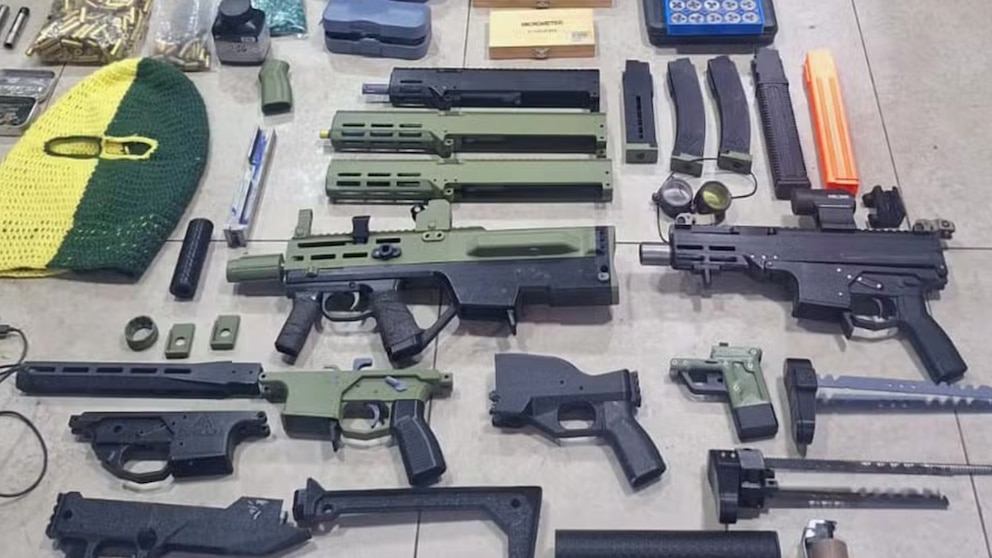
Material seized during Operation Shadowgun, including Zé Carioca’s balaclava. Image courtesy of the Brazilian Federal Police.
Overall, these cases show how 3D printing is increasingly being used in illegal and criminal situations. It’s undeniable that the technology itself has countless positive and legitimate uses, but when it comes to 3D printed weapons, a lot of the attention focuses on how it can be misused to make untraceable firearms and parts that end up in the hands of criminals, being used outside the law. To law enforcement, that is becoming a real and growing problem.
Subscribe to Our Email Newsletter
Stay up-to-date on all the latest news from the 3D printing industry and receive information and offers from third party vendors.
Print Services
Upload your 3D Models and get them printed quickly and efficiently.













You May Also Like
AM Investment Strategies 2026 Sets the Stage for AMS 2027
AM Investment Strategies 2026 Nov. 5 · 12 p.m. ET · Free online event RESERVE YOUR SPOT ↗ A one-hour online discussion featuring some of the biggest names in 3D...
With Its Latest $200M Round, ICON May Be Running Away With the 3D Printed Construction Market
I used to view ICON, the Austin-based additive construction (AC) firm, as one of a handful of companies that could realistically consider itself the leader of the 3D printed construction...
How Should Businesses Build New Business? Dirk Simon Weighs In — Part 1
Dirk Simon had deep experience in materials and chemistry before joining the 3D printing industry. Instrumental in BASF and Farsoon’s market introduction, Dirk has spent a lot of time thinking...
3D Printing Services Near $2.5B as AM Market Shifts Beyond Hardware
The additive manufacturing market may be growing again, but one of the more interesting numbers behind that recovery has little to do with selling 3D printers. AM services generated nearly...