Microprinting Microcap XTPL Reports 2025 Sales Growth Despite Net Loss

The Polish company XTPL is among a category of small startups sitting at the overlap between additive manufacturing (AM) and advanced packaging for the semiconductor industry. 3DPrint.com’s Vanesa Listek wrote a nice profile of the company’s overall business model and value proposition in the summer of 2024, and while the company has slightly modified certain aspects of its growth forecast and sales strategy, XTPL is still generally working from the playbook Vanesa laid out a couple of years ago.
The company, which has a ~$50 million market cap and trades on the Warsaw Stock Exchange (WSE), just announced its 2025 results, and while it reported a loss of PLN 16.3 million (~$4.6 million), XTPL also saw healthy revenue growth of 14 percent, finishing 2025 with PLN 15.6 million (~$4.4 million) in revenue, an all-time high for the company. XTPL also finished 2025 with a cash position of nearly $2 million, which doesn’t include proceeds from a PLN 19.5 million (~$5.5 million) share offering in Q1 2026, or a PLN 10.1 million (~$2.8 million) grant from Poland’s National Center for Research and Development (NCBR).
The key addition to the company’s long-term business model is the commercialization of the ODRA system, the production-scale version of the company’s prototyping Delta Printing System (DPS), both of which draw upon XTPL’s Ultra-Precise Dispensing (UPD) printhead module. As I wrote about back in March, XTPL sold its first ODRA system to an unnamed Silicon Valley client, which is part of a Silicon Valley consortium dedicated to advanced packaging R&D.
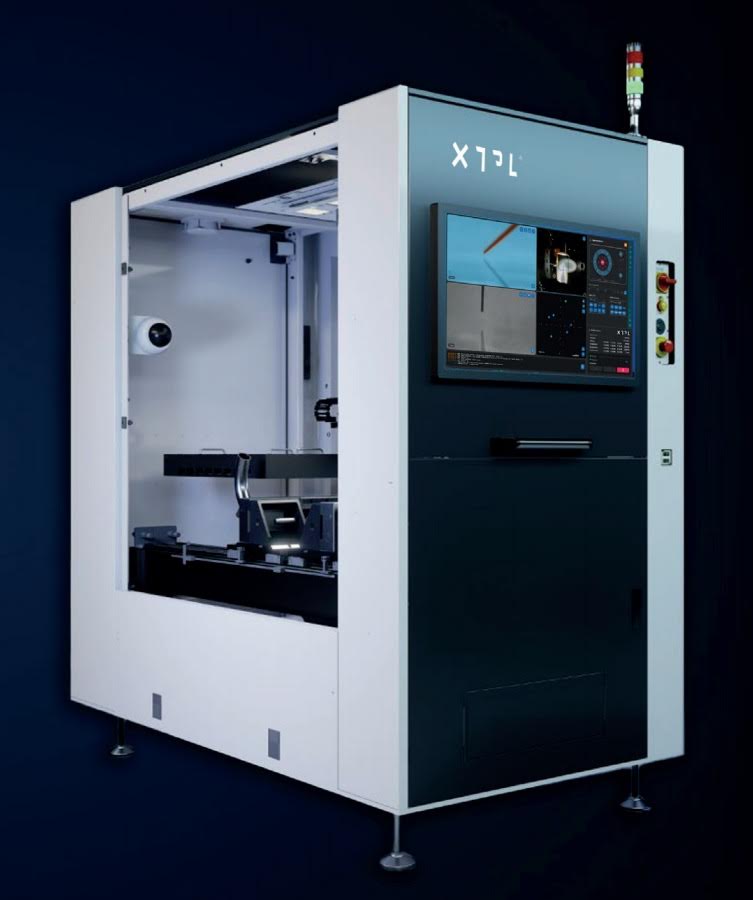
The ODRA industrial system
As I always must include in discussions of companies like XTPL, the move by semiconductor manufacturers towards 2.5D/3D chip design—stacking multiple dies and packaging them with vertical interconnects—has catalyzed interest in leveraging AM for backend electronics assembly. XTPL’s addition of the ODRA system to its lineup now gives it four main business divisions, with advanced materials rounding out the trio of hardware offerings.
In a press release about XTPL’s 2025 performance, the company’s CEO, Filip Granek, said, “In 2025, we delivered a total of 13 DPS devices and 8 UPD modules to clients across our key markets – North America, Asia and Europe – marking XTPL’s strongest performance to date. In parallel with these sales activities, we have been intensively developing the Company’s next growth driver: the new ODRA system business line. The prototype was first presented at the Productronica trade fair in Germany in November and in March this year we secured an order from a Silicon Valley-based client valued at approx. USD 0.4–0.5 million, with delivery scheduled for Q4 2026. Unlike DPS units, ODRA systems are designed not for R&D applications but for HMLV (High-Mix, Low-Volume) production. This dramatically increases their sales potential by enabling multiple deliveries to a single client. Currently, our most active negotiations are within the defense sector and we expect to generate further orders for delivery either later this year or in 2027.”
It’s obviously difficult to predict the the growth trajectory for microcaps, but a cursory glance at some conventional wisdom surrounding this class of stocks does suggest that XTPL—and the advanced packaging original equipment manufacturers (OEMs) more broadly—plays in the sorts of markets most conducive to microcap growth. Historically, the semiconductor industry has a power to rapidly scale that’s unmatched by any other vertical, and the geopolitical wrangling between the US and China over packaging supply chains looks poised to create some unusually strong demand catalysts.
For XTPL specifically, it’s especially reassuring to see that the company is getting public funding from the Polish government. I just wrote about how the European Defense Agency (EDA) will be supporting Ukraine with funding to scale the nation’s emerging tech developed in response to the Russian invasion. Assuming this defense tech acceleration push in Europe continues, XTPL would seem to be a perfect candidate to receive support from such an effort.
Personally, I think the EU would do well to go all in on advanced packaging solutions. That would give the continent much-needed leverage in trade negotiations with both the US and China, while also providing the opportunity for high-growth tech that EU nations are eager to cultivate.
Meanwhile, XTPL’s entry into the Silicon Valley market, combined with Poland’s significance to both the EU and NATO, could, down the line, also make the company an attractive target for funding opportunities from American sources. AM for advanced packaging is still in its early phases, but I think it has massive dark-horse growth potential that could start to be realized well before the end of this decade.
Images courtesy of XTPL
Subscribe to Our Email Newsletter
Stay up-to-date on all the latest news from the 3D printing industry and receive information and offers from third party vendors.
Print Services
Upload your 3D Models and get them printed quickly and efficiently.













You May Also Like
Advanced Manufacturing at IMTS 2026: 3D Printing and AI and Drones, Oh My!
Last week’s International Manufacturing Technology Snow (IMTS) in Chicago welcomed over 90,000 attendees to the jungle that is McCormick Place. With over 1.17 million square feet of exhibit space, and...
Amaero Targets $52.6M U.S. IPO Amid Major Metal Powder Expansion, Later Postpones Offering
UPDATE, September 24, 2026: Amaero has postponed its planned U.S. initial public offering, citing adverse market conditions. The company planned to raise about $52.6 million by selling 7.46 million shares...
Let the Games Begin! Xi Throws Down the Advanced Manufacturing Gauntlet
Sangmin Lee went to TCT Asia back in March and reported on the event for 3DPrint.com. He wrote two articles arguing that China’s AM industry looks “ready to scale.” This...
How Drone Proliferation Is Forcing a Rethink of Defense Manufacturing
The rapid proliferation of low-cost drones is forcing manufacturers to rethink their approach to design, production, quality, and scale. For defense manufacturing teams, the challenge is both how quickly a...