3D Printing Top Technologies & Trends to Watch in 2026

What if we take a helicopter view of the additive manufacturing market? Beyond silos, technologies, and market segments, what are going to be the most interesting trends, strategies, tactics, technologies, and events? What are the things that will change the 3D printing market overall in 2026? And what if we asked a bunch of the wisest people in 3D printing what their key things to watch out for in 2026, and then synthesized them into a single sentence?
Leading binder jet and inkjet consultant Gareth Neal believes a new seriousness and industrial focus will power us forward, driven by software. He thinks that,
“Software will start to play a larger part in the overall production of metals. To be crude, rather than waving our light sabres like a broadsword, being ruthlessly dominant over all variables, rapier-like precision and control over power, shape and direction and more will be more than a possibility, a niche. It will become prevalent in those large manufacturers that have been waiting for it and are now driving it. This will drive up quality, efficiency and TCO down. Therefore, the part cost will come down, enabling more applications. That same software control will then enable newer avenues of development, such as multi-materials and material development. I have heard of as much as a 10x reduction in cost just through software. I also think that there will be a resurgence in Binderjet driven by a deeper understanding of why Binderjet has not been successful so far, Software to control it and most importantly of all, a willingness to develop materials that work to enable it.”
This jives with what the software startup crowd was preaching in the Software Predictions article, but it’s notable for being a solution for binder jetting and also an efficient way to turbocharge your efforts without having to buy a whole bunch of packing crates. 3MF’s Duann Scott,
“One of the things I am finding most interesting is the emergence of volumetric and simulation-driven toolpath optimisation to simultaneously define variable material properties from a single material for part performance, and tuning the manufacturing process for both speed and dimensional accuracy. The convergence of laser beam shaping capabilities by companies like nLIGHT, volumetric toolpathing by Materialise, Autodesk and Dyndrite along with open hardware systems like Aconity3D and EOS M4 ONYX could all be brought together using the 3MF Volumetric and Toolpath Extensions to give voxel level fine grained control in an incredibly efficient manner. What is needed next is for CAD/CAE tools to allow engineers to better define this volumetric information, with feedback from simulation, empirical testing, and maybe even a little ML augmentation to truly make 3D dimensional components, not just a 3D form with mystery bulk properties inside.”

Novineer toolpathing.
Oh, what magic would this be? If we could make progress towards truly known parts at every voxel, we could make real progress in many areas. Novineer’s
“The focus of AM software over the last decade has been mostly on metal. Over the next 12 months, the real change will be print-aware software for polymer AM that collapses the walls between modeling, mechanical simulation, and print prep. When geometry, anisotropy, and 3D-printing toolpaths are all solved in a single workflow, polymer AM becomes a more attractive option for tooling, production, and repair.”
A truly integrated solution that doesn’t require you to flit between many tools and takes all primary considerations into account would let us optimize components, assemblies, and craft in tune with properties, capabilities, and possibilities. Rather than the hazy world of possibility, we could aim for optimal success.
“It seems like every year gets its own topic, and I believe the coming year will be the year of Automation. Though application will still be king, executing on very-high production quantity application opportunities will simply require better ways both up and down-stream of the AM machine. It’s been building for some time, and the pieces are coming together. The winners will be those who partner with other best-in-class OEMs of ancillary products and services and who can provide a true 360-degree solution.”
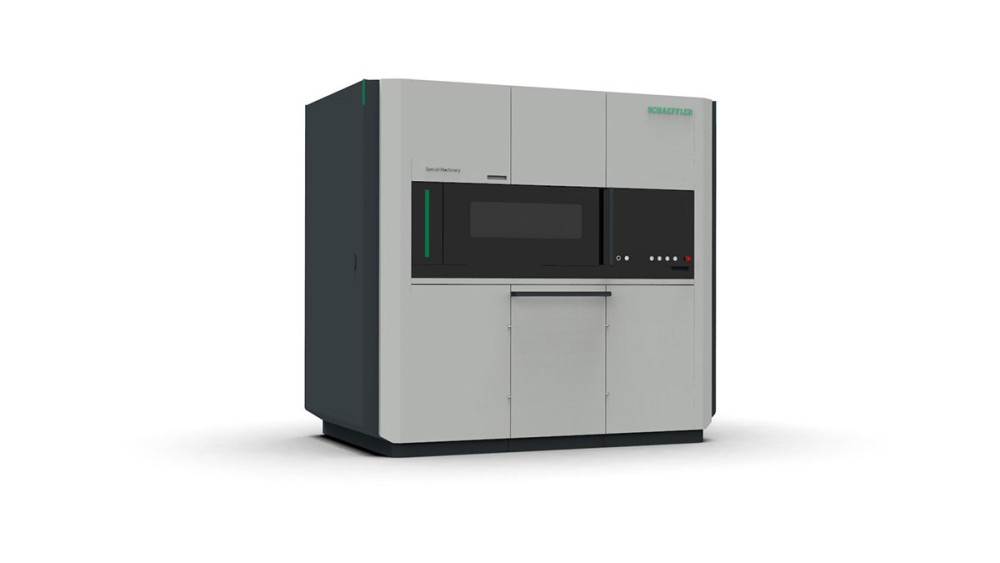
The new multi-material 3D printer from Schaeffler. Image courtesy of Schaeffler.
“The two most significant technology trends right now are Cold Metal Fusion and Multi-Material Metal 3D printing. Cold Metal Fusion, done by Headmade Materials and others, is a really old idea, similar to the DTM days, that is finding new life. Exciting that you can print interesting metal materials on something as simple as a Formlabs Fuse. Multi material metal printing as done by Schaeffler and Amnovis. This has cool industrial and medical implant uses. For medical, the first step is CP Ti combined with Ti64.”
“I believe 2026 will be the year of large-scale 3D printed applications. Apple’s recent adoption of LPBF for watch cases, the largest metal AM application to date, validates metal LPBF as a true production technology. We will see more of these high-volume applications emerging across industries. Concepts such as deformable implants, enabling patient-specific solutions at the cost of standardized components are an example of this. Additionally, multi-metal AM will gain traction. With academia and research institutes increasingly exploring multi-metal AM, expect this breakthrough technology to make headlines in 2026.”
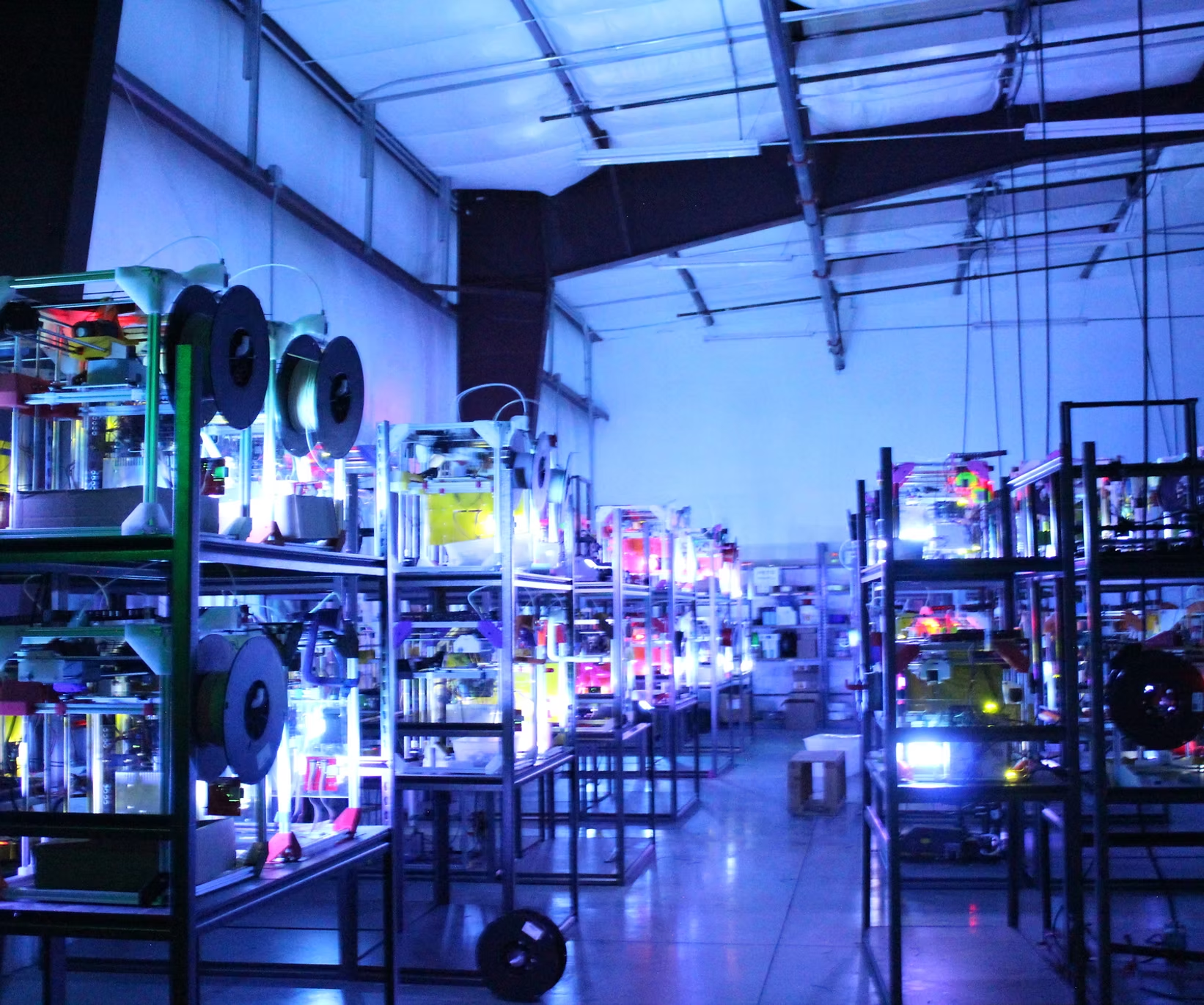
Operator of one of the largest print farms, Slant3D, Gabe Bentz, said,
Subscribe to Our Email Newsletter
Stay up-to-date on all the latest news from the 3D printing industry and receive information and offers from third party vendors.
Print Services
Upload your 3D Models and get them printed quickly and efficiently.











You May Also Like
Scaling AM Suppressor Production: Oerlikon AM & ATLIX Rise to the Challenge
End-of-barrel suppressors, oftentimes referred to as silencers, function by capturing and redirecting high-pressure propellant gases through carefully engineered internal structures and channels. By disrupting the gas flow before it exits...
Unlocking Big Part Manufacturing for the Energy Sector: How EPRI’s Convergent Approach Proves the Potential of Large-Area DED 3D Printing
The U.S. hydropower fleet, more than 2,200 plants averaging 65 years of age, relies on large, bespoke components that are increasingly difficult to source. Long lead times, disappearing suppliers, and...
In-Situ Automated Toolpath Generation and Auto-Alignment for Performance-Driven Directed Energy Deposition (DED)
The evolution of Directed Energy Deposition (DED) systems has increasingly focused on improving process adaptability, geometric fidelity, and integration into automated manufacturing environments. FormAlloy has advanced this progression through the...
From Material Maturity to Fleet Execution: What Comes Next for Additive Manufacturing in the U.S. Navy
Additive manufacturing is steadily moving from experimental use toward routine application in U.S. Navy shipbuilding, sustainment, and much more. In recent years, the Navy, working through its Maritime Industrial Base...