In-Situ Automated Toolpath Generation and Auto-Alignment for Performance-Driven Directed Energy Deposition (DED)



The evolution of Directed Energy Deposition (DED) systems has increasingly focused on improving process adaptability, geometric fidelity, and integration into automated manufacturing environments. FormAlloy has advanced this progression through the development of in-situ, automated toolpath generation combined with auto-alignment capabilities, enabling precise material deposition on both additively and traditionally manufactured components. These capabilities address longstanding challenges associated with geometric variability, part registration, and throughput limitations in metal additive manufacturing.
Traditional DED workflows rely heavily on offline CAD models and pre-programmed toolpaths, assuming consistent part geometry and ideal fixturing. In practice, however, dimensional variation introduced during machining, casting, forging, or service wear often necessitates manual rework, reprogramming, or conservative deposition strategies. FormAlloy’s in-situ toolpath generation approach mitigates these constraints by incorporating real-time scanning and coordinate registration directly within the deposition cell, allowing toolpaths to be generated and adjusted based on the actual part geometry.
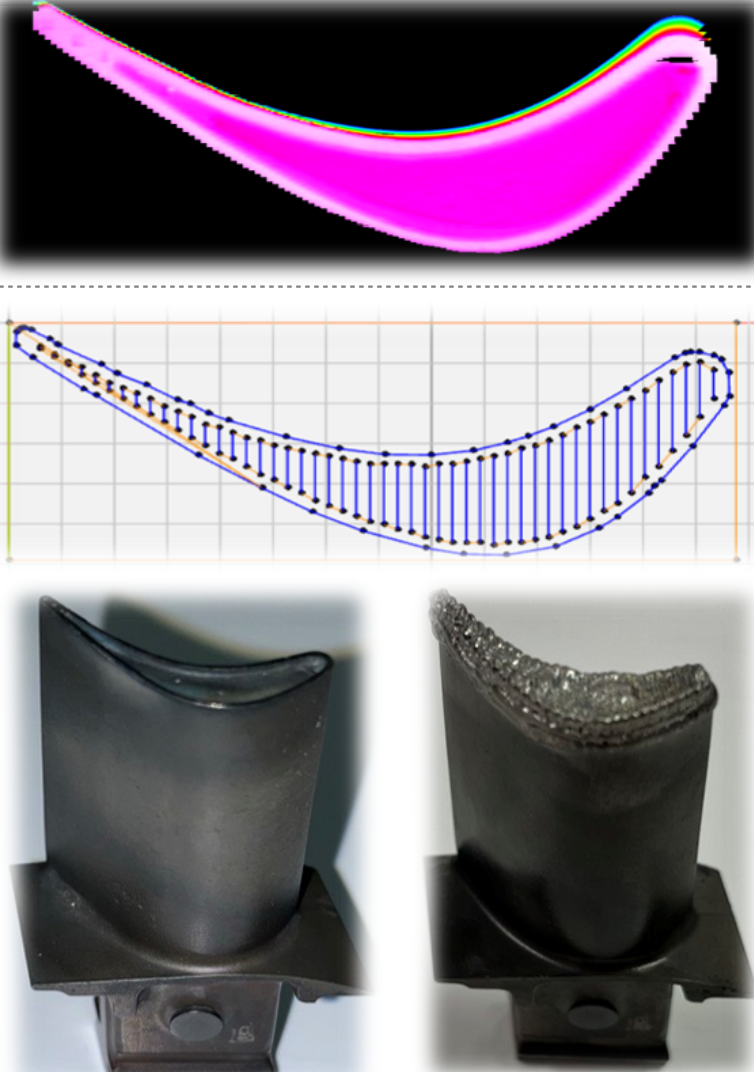
FormAlloy’s DEDSmart® Path enables in-situ, automated alignment and toolpath generation
In-Situ Toolpath Generation and Auto Alignment
Central to FormAlloy’s approach is the ability to automatically align scanned part geometry to the machine coordinate system prior to deposition. Through the use of fiducial features, surface registration algorithms, and integrated sensing, the system establishes accurate spatial alignment without manual intervention. This auto-alignment capability is particularly critical in high-throughput environments, where minimizing setup time and ensuring repeatable deposition across large part volumes are essential.
Once alignment is established, toolpaths are generated in situ to conform to the measured surface geometry. This enables deposition that is tightly coupled to the true part condition rather than an idealized model, reducing excess material, minimizing post-processing, and improving dimensional control. The closed-loop nature of this workflow supports consistent results even when parts exhibit batch-to-batch or part-to-part variability.
Performance Enhancement in Consumer Goods Tooling
In consumer goods manufacturing, tooling such as molds, dies, and forming tools are often produced using conventional manufacturing methods but experience localized wear or performance degradation during service. FormAlloy’s in-situ toolpath and auto-alignment capabilities enable selective deposition of high-performance materials directly onto these tools without requiring full remanufacture.
For example, wear-prone regions of an injection mold can be scanned and automatically aligned, after which a toolpath is generated to deposit a wear-resistant or high-hardness alloy only where required. This approach allows manufacturers to enhance tool performance while preserving the bulk tool material and geometry. Because alignment and toolpath generation are automated, the process is compatible with production-scale workflows where rapid turnaround and repeatability are critical.
In addition to repair, this capability enables functional enhancement, such as reinforcing edges, improving thermal resistance in high-heat zones, or modifying surface properties to extend tool life. The ability to integrate these enhancements into existing tooling workflows supports increased uptime and reduced total cost of ownership.
Turbine Blade Enhancement for Energy Applications
Energy-sector components, particularly turbine blades, present complex geometries and operate under extreme thermal and mechanical conditions. FormAlloy’s automated toolpath generation enables precise deposition on airfoil surfaces, leading edges, and blade tips by conforming deposition paths to scanned geometries. Auto-alignment ensures accurate registration between the blade and deposition system, even when blades exhibit distortion or service-induced wear.
This capability allows selective addition of high-value materials—such as oxidation-resistant or high-temperature alloys—only in regions that experience the greatest operational stress. By minimizing the volume of expensive material used and maintaining aerodynamic fidelity, FormAlloy’s approach supports both performance improvement and cost efficiency.
High-Throughput Integration and Manufacturing Implications
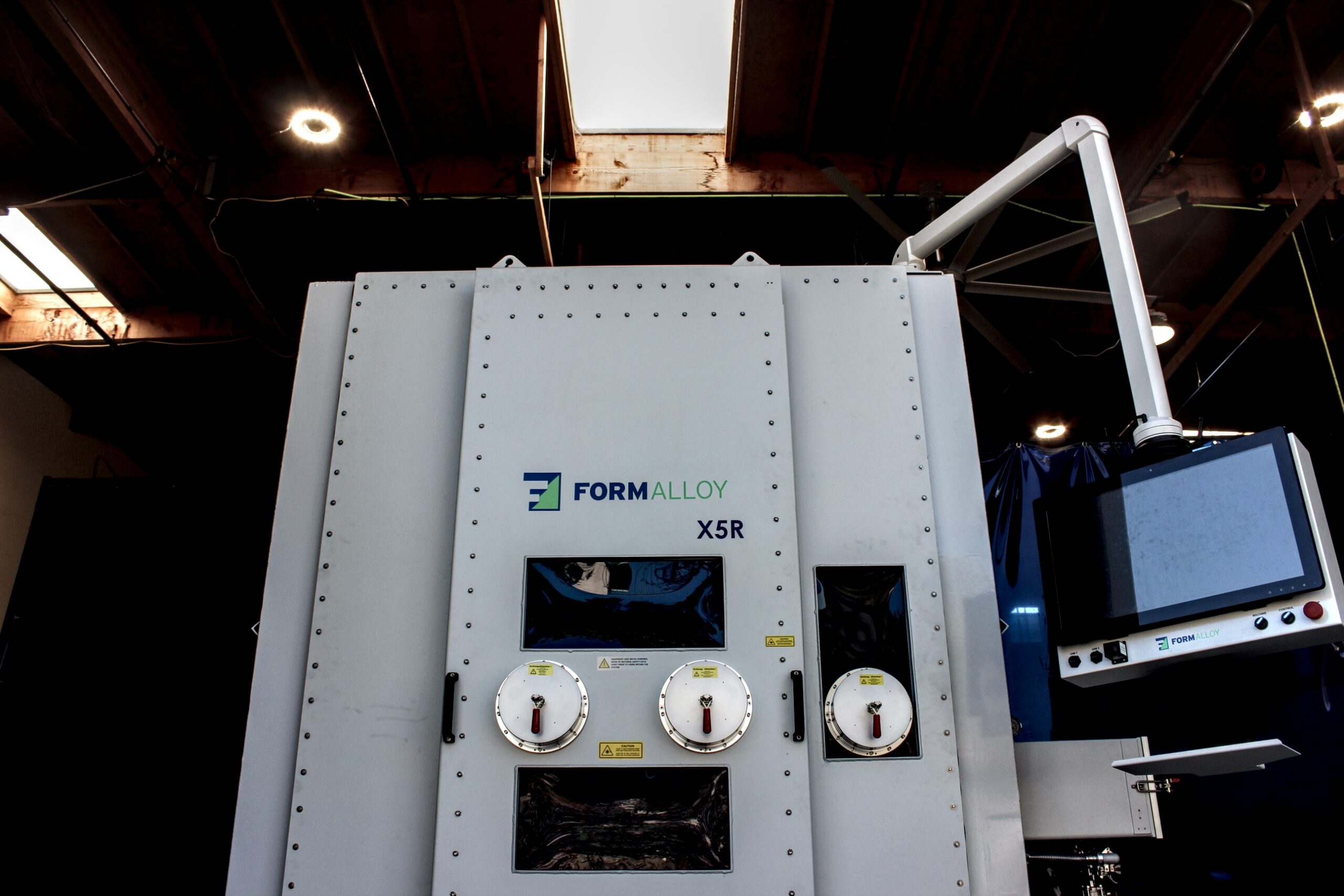
FormAlloy’s X5R Machine boasts a 1.8m x 1.1 x 1.1m build volume
The combination of in-situ toolpath generation and auto-alignment enables FormAlloy DED systems to operate effectively in high-throughput manufacturing environments. By reducing reliance on manual programming and accommodating part variability, these capabilities facilitate scalable deployment for both production and sustainment applications.
As manufacturers seek to integrate additive processes alongside traditional manufacturing, FormAlloy’s approach demonstrates how DED can be used not only for part creation but also for targeted performance enhancement of existing components. This represents a significant step toward intelligent, adaptive metal manufacturing systems capable of meeting the demands of modern industrial production. And it aligns strongly with what customers are asking for now.
As Melanie Lang, CEO of FormAlloy, puts it:
“Across our customer conversations, the market pull is unmistakable: defense programs want resilient, qualified repair and sustainment at speed; energy operators want higher‑temperature performance and longer service intervals; and consumer goods manufacturers want faster tool modifications and more uptime. In‑situ toolpath generation and auto‑alignment are what make DED practical at scale—because we’re no longer programming for an ideal CAD model, we’re manufacturing to the real part in front of us.”
For more information, visit www.formalloy.com, or contact FormAlloy’s team of engineers at info@formalloy.com.
At Additive Manufacturing Strategies (AMS) 2026, FormAlloy Co-Founder and CEO Melanie Lang will participate in a panel about “Really Big Parts for Energy” on February 25th. This session is part of the broader AMS 2026 conference, which brings together industry leaders, policymakers, and innovators from across the global AM ecosystem. Learn more and register here.
Subscribe to Our Email Newsletter
Stay up-to-date on all the latest news from the 3D printing industry and receive information and offers from third party vendors.
Print Services
Upload your 3D Models and get them printed quickly and efficiently.













You May Also Like
Phillips Federal Participates in Marine Corps Exercise
Phillips Federal will participate in a Marine Corps exercise that will use several additive manufacturing technologies. The 1st Maintenance Battalion, 1st Marine Logistics Group, I Marine Expeditionary Force (IMEF), will...
Ceramics 3D Printing at Ceramitec 2026
Ceramitec is a key event for the ceramics industry. Held in the lovely city of Munich, it is the leading global event for the ceramics community. With around 13,000 participants...
AM Forum Berlin 2026: Tough Love From BMW’s Timo
We’re once again in the lovely city of Berlin, at the absolutely immense Estrel Center. The congress center, a musical and theater venue, towers over the easternmost reaches of the...
Printing Money Episode 35: Notable VC and M&A Deals, with Arno Held and Alex Kingsbury
Welcome to Printing Money Episode 35 and let us be the last to wish you a happy new year. For this episode Danny is joined by Arno Held (Managing Partner,...