A U.S. AM Hub in the Indo-Pacific: ASTRO America’s Guam Ecosystem Is Officially Open

A multi-year effort by the Applied Science and Technology Organization (ASTRO) America to build an additive manufacturing (AM) hub in Guam that can serve the U.S. Navy’s demand for submarine parts has finally come to fruition. Last Thursday, the Guam Additive Materials and Manufacturing Accelerator — GAMMA — officially broke ground.
As ASTRO president Neal Orringer detailed in a 2023 piece for 3DPrint.com, in 2020, the Governor of Guam, Lou Leon Guerrero, worked with the Guam Chamber of Commerce to create a task force dedicated to working with private industry to diversify the island territory’s economy. ASTRO was soon contracted for a feasibility study assessing the potential for an AM hub on Guam, leading to a phase-by-phase initiative that has resulted in GAMMA.

ASTRO America research team with Gov. Lourdes Leon Guerrero
The cornerstone of GAMMA’s initial activity is an 8,000 square-foot warehouse at the 40-acre Pacific Industrial Park in Dededo, the most populous community in a territory with a population of well under 200,000. In 2024, ASTRO linked up with a similar organization, BlueForge Alliance, once it had been determined that GAMMA’s work would begin with a focus on parts for the U.S. Submarine Industrial Base (SIB).
The SIB, of course, has for years been one of the key areas leading the charge in the Department of War’s (DoW) accelerated AM adoption. The Guam Pacific Daily News reported how Orringer contextualized GAMMA’s work within that trajectory at the groundbreaking ceremony:
“‘So why do we start with submarine parts? For decades, this island has served as a key base of operations for the world’s most sophisticated attack submarines,” Orringer said.
Governor Guerrero, meanwhile, emphasized how GAMMA’s collaborations with academic institutions — not just local schools like the University of Guam and Guam Community College, but the Colorado School of Mines, as well — would benefit the local economy: “They are going to develop a program where our students can go to our university, continue on to the School of Mines, and get a degree in mechanical engineering, something very much needed in our island. How many times do our ambulances go down and we can’t get the parts quick enough for those ambulances to get back on the streets?”
The Pacific Daily News noted that five paid interns from the local participating colleges “are already on the payroll at GAMMA.” The factory, which includes metal 3D printers, welding robots, and CNC machines, is expected to have its initial operating capacity online by Q1 of next year.
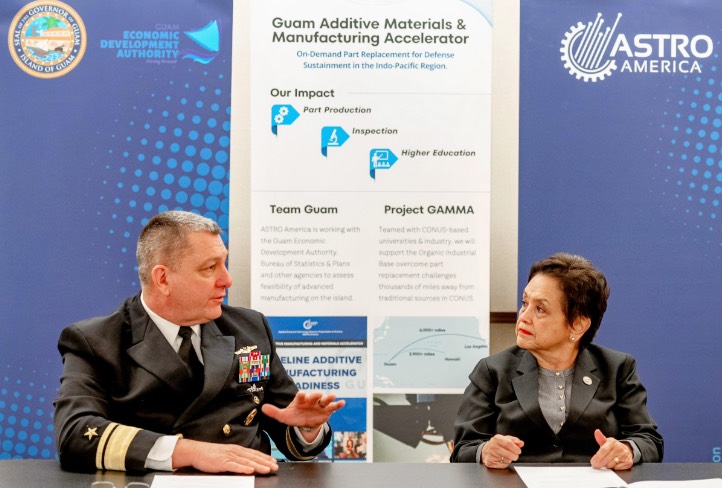
Rear Admiral Scott Pappano and Governor Lourdes A. Leon Guerrero in Early 2024.
I think we can expect that all branches of the U.S. military will ultimately benefit from GAMMA, not just the Navy. And the island’s significance to U.S. Indo-Pacific Command (INDOPACOM) suggests that the scale-up beyond its initial operating capacity could be rather quick: U.S. Army officials seemed very optimistic about AM’s potential to bolster INDOPACOM supply chains at a recent defense tech event.
The genuinely intriguing possibilities, however, involve GAMMA’s potential as a model for tariff workarounds. The Vice Speaker of the Guam Legislature, Tony Ada, told the Pacific Daily News, “I think the only thing that hasn’t been said is that when these parts are manufactured, that you have a nice little tag on there that says ‘Made in Guam, USA.’”
That is an excellent point, and brings to mind other U.S. territories and Free Associated States in the Indo-Pacific, as well as U.S. territories in general, like Puerto Rico, that might also benefit from AM. The idea of building AM hubs in such locales might’ve previously seemed impossible, but ASTRO has debunked that notion, and provided a blueprint for succeeding at establishing advanced manufacturing ecosystems virtually from scratch.
Obviously, the key lies in analyzing the extent to which Guam sees tangible benefits from GAMMA over the first few years of its existence. But if the results are positive, whoever builds the next AM hubs in similar locations should find the tasks much less difficult thanks to the precedent GAMMA is setting.
All images courtesy of ASTRO America
Subscribe to Our Email Newsletter
Stay up-to-date on all the latest news from the 3D printing industry and receive information and offers from third party vendors.
Print Services
Upload your 3D Models and get them printed quickly and efficiently.













You May Also Like
3D Printing News Briefs, October 10, 2026: Drones, WAAM, Ceramics, & More
We have a packed 3D Printing News Briefs for you this weekend! First, America Makes celebrated the recent National Manufacturing Day with 3D printed drones, and then it’s on to...
10 Years of Multi Jet Fusion: Onsite at HP’s Vancouver, Washington Facility
At this year’s RAPID event in Boston, HP Additive Manufacturing Solutions celebrated ten years in the additive manufacturing (AM) market. The company ushered in the milestone with several innovations, including...
PharmaTher Plans U.S. Network to 3D Print Medicines on Demand
3D printing medicines has often been tied to the idea of personalization, basically making a pill in the right dose, shape, or drug combination for a patient. PharmaTher is now...
3D Printing News Briefs, September 17, 2026: 3D Printed Boat, UAS Development, & More
We’ll start with maritime manufacturing in this week’s 3D Printing News Briefs, and continue on to defense 3D printing. We’ll end with funding for Tripo AI. Read on for all...