Firestorm Labs’ xCell Helps U.S. Army Train for 3D Printed Drone Missions


The U.S. Department of War (DoW) has been telling anyone who will listen that the Pentagon is making major changes to how it procures equipment. In a recent speech at the National War College, Secretary Pete Hegseth told the audience, “Speed to delivery is now our organizing principle. It is the decisive factor in maintaining deterrence and warfighting advantage.”
The U.S. Army has been instrumental to this changing approach, and it looks like additive manufacturing (AM) will be, too: Army officials, including Secretary of the Army Dan Driscoll, have cited AM as a way for the Army to use organic production capabilities to speed up maintenance, repair, and operations (MRO) for defense hardware. As I’ve detailed in a number of posts throughout the year, drones are the centerpiece of these U.S. Army efforts.
In the latest revelation about the U.S. Army’s growing experience with 3D printed drones, the 3rd Combat Aviation Brigade (CAB), 3rd Infantry Division, is learning to produce drone components on Firestorm Labs’ Expeditionary Manufacturing Cell (xCell). Firestorm has made a name for itself this year with a $100 million Air Force contract, a $47 million Series A, and a partnership with HP to integrate Multi Jet Fusion (MJF) printers into the xCell.
The xCell is a perfect fit for the role that the U.S. Army has cultivated for drone 3D printing: an enabler for a comprehensive training curriculum fully attuned to the latest catalysts driving the evolution of warfare. In its training with the xCell, the 3rd CAB printed over 90 different drone components, assembled the systems, and then subjected the drones to test flights.
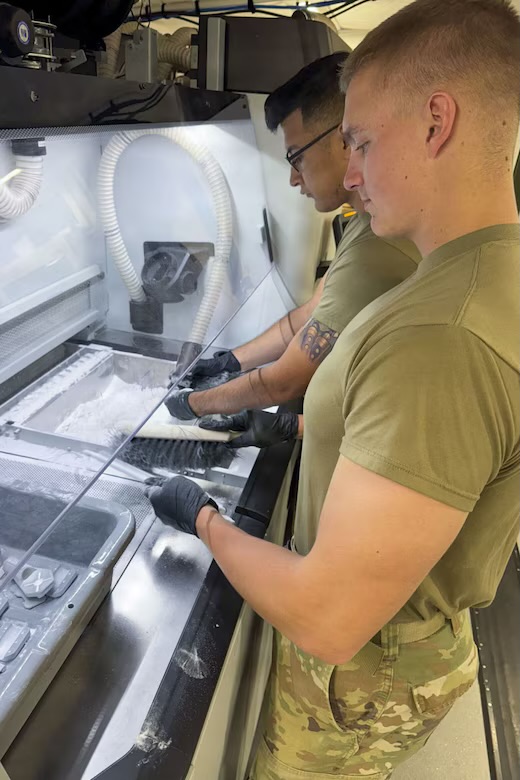
Soldiers assigned to Hunter Army Airfield Innovation Center receive initial training on the Expeditionary Manufacturing Cell and first-person-view drones.
One of the main themes in the training exercises involved “layering” the drones into operations in which Apache, Black Hawk, and Chinook helicopters were still the principal weapons systems involved. The drones were tasked with jobs like scouting, supplementary munitions capabilities, and providing live video feeds.
Additionally, in one of the many lessons from the war in Ukraine that are being incorporated into the U.S. Army’s 3D printed drone program, the 3rd CAB studied tactics for using the unmanned systems to mask the acoustic and thermal signatures emitted by U.S. aircraft. This echoes another effort by the U.S. Army, announced earlier this year, to test the use of small 3D printed drones for surveillance.
In a U.S. Army article about the 3rd CAB’s drone 3D printing training on Firestorm Labs’ xCell, Army Staff Sgt. Christian Dodson, the HAAF Innovation noncommissioned officer in charge, said, “Today’s battlefield is adapting rapidly. By teaching our soldiers to understand how drones work and are built, we are giving them the skills to think creatively and apply emerging technologies to enhance mission effectiveness and readiness.”
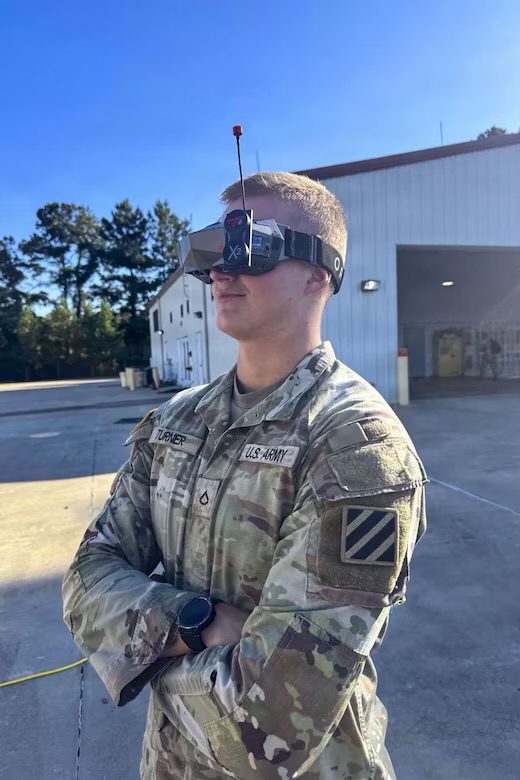
Soldier receives initial training on the Expeditionary Manufacturing Cell’s first-person-view drones.
I think the most notable dynamic to keep in mind here is how holistic an approach the Army is taking. The author of the original article referenced here, Captain Lydia Laga from the 3rd Infantry Division, put it very nicely: “More than hardware, the change is cultural.”
As much as the Army is using soldiers to create 3D printed drones, the branch is using 3D printed drones to create soldiers capable of making their own equipment. In this context, it’s notable that, when Firestorm Labs announced its partnership with HP over the summer, the partners highlighted how the xCell could be used to produce medical equipment in areas without ready access to global supply chains.
Thus, the soldiers getting familiarized with the xCell may begin their AM training with drones, but that training can quickly branch off into any other use case that’s feasible for ruggedized manufacturing, or even any other area of the DoW’s supply chain where AM is prioritized. AM is an enabling technology for drone production, but it’s also an enabling technology for the manufacturing sector workforce development.
That’s a lesson from the U.S. military that I think the rest of the AM industry would do well to apply. It’s not enough to change hardware: you have to change the culture of manufacturing.
Images courtesy of U.S. Army and 1st Lt. Decean Brown, 3rd Infantry Division
Subscribe to Our Email Newsletter
Stay up-to-date on all the latest news from the 3D printing industry and receive information and offers from third party vendors.
Print Services
Upload your 3D Models and get them printed quickly and efficiently.













You May Also Like
SWISSto12 Closes $70 Million Series C Round
Swiss satellite manufacturer SWISSto12 has closed a $70 million Series C round. This follows $84.8 million that the company received from ESA and ESA member states, and previous rounds that...
Rocket Lab Buys Iridium in $8 Billion Deal, Creating a New SpaceX Rival
Rocket Lab is buying Iridium for $8 billion in a cash-and-stock deal worth $54 per share. Shareholders will receive $27 in cash plus additional Rocket Lab common stock. The company...
SWISSto12 and HPS/LSS Build Unfurling Antenna for Next-Gen Satellite
SWISSto12 is to work with HPS/LSS. High Performance Space Structure Systems and Large Space Structures are two separate firms that work together on large antenna reflectors. The two will work...
Japan’s Space Compass Corporation Buys a SWISSto12 Satellite
Japanese firm Space Compass Corporation has agreed to buy a SWISSTo12 GEO optical data relay satellite. The compact Hummingsat will be used for Space Compass’ optical data relay service. Space...