Stratasys Adds Metal & Ceramic to Its 3D Printing Portfolio with Tritone Investment


Stratasys once began the process of launching its own metal additive manufacturing (AM) technology, Layered Powder Metallurgy (LPM). According to a 2023 Yoav Zeif interview with TCT Magazine, the company shuttered the concept without ever commercializing it in 2019, when Zeif became the company’s CEO.
I only learned about LPM because of TCT’s coverage of Stratasys’s latest move, in which the AM pioneer invested in Israel’s Tritone Technologies. According to the 2023 interview, Stratasys decided against commercializing LPM “because there was not enough differentiation compared to what was already out there.” The Tritone investment solves that problem.
Tritone’s proprietary AM technology, MoldJet, creates a wax mold of a part, then fills it with metal or ceramic paste, after which the parts are placed into a solution that dissolves the mold. The mold-free part is then sintered.
Stratasys’s minority stake in Tritone was part of a funding round that also included investors like private equity firm Fortissimo Capital, an existing investor in Tritone which, earlier this year, also took a 15% stake in Stratasys for $120 million. Stratasys’s investment in Tritone gives the company the option for an increased stake later on and “potential future ownership.”
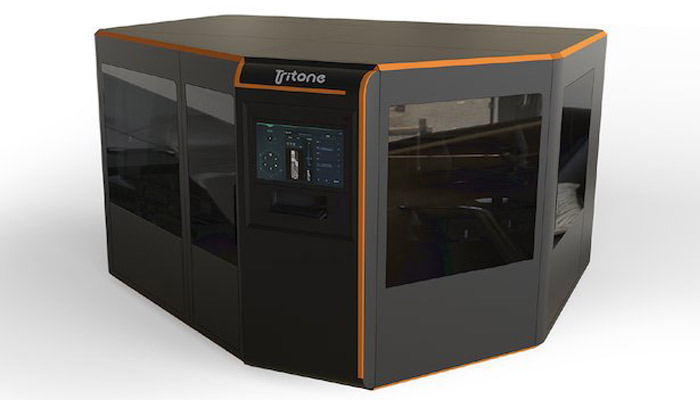
Image courtesy of Tritone
In a press release about Stratasys’s investment in Tritone, Zeif said, “Manufacturers that trust Stratasys as their AM partner — including in government, defense, and aerospace — frequently ask us to complement our polymer offering with a reliable, industrial-grade metal solution. After a long search, we found Tritone to offer a unique combination of part quality, cost-efficiency, with a sustainable business model built around consumables and services. This agreement significantly expands our total addressable market.”
Ofer Ben Zur, the CEO of Tritone, said, “This exciting investment and partnership are a strong validation of our team’s vision and tireless efforts. Our strategy to deliver innovative solutions to manufacturers is clearly gaining traction. By joining forces with Stratasys, the leading player in [AM], we’re extending the reach of our offerings and giving customers the confidence to adopt AM technology for producing precise parts in metals and ceramics that meet the high standards of industrial production.”
The agreement behind Stratasys’s minority stake also includes an agreement that supports collaboration between the companies, with a central feature being Stratasys’s support for Tritone’s reseller network. I would imagine that Stratasys has one of the best reseller networks of any AM company globally, so that’s probably among the most valuable assets that Stratasys could offer to an OEM like Tritone.
I’m not too familiar with Tritone’s technology, but it seems pretty similar to what Skuld is doing with its combination of AM and evaporative casting, and the selling points there are metal AM at a lower cost and faster pace. The company’s website also features a diverse array of tooling applications.
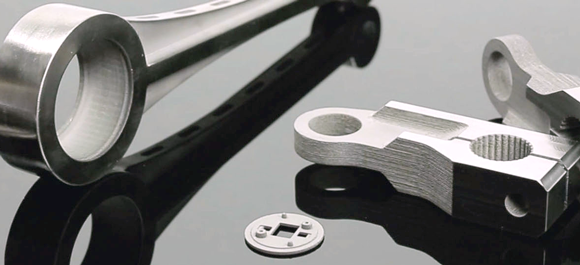
Image courtesy of Tritone
Along those lines, Stratasys’s positioning as a leader in AM-enabled tooling should be significantly bolstered by the ability to provide customers with the option to print metal tooling in-house. One of Stratasys’s particular strengths there is automotive tooling, and auto manufacturers are looking for all possible solutions to replace imported metal.
Stratasys obviously has had a rough go of it in the last several years in its attempts to enter the metal market via an acquisition. But this seems like a far more conservative bet than the Desktop Metal purchase it floated not too long ago, and given how the Desktop story unfolded, the upside potential with Tritone could be much higher.
Featured image courtesy of Stratasys
Subscribe to Our Email Newsletter
Stay up-to-date on all the latest news from the 3D printing industry and receive information and offers from third party vendors.
Print Services
Upload your 3D Models and get them printed quickly and efficiently.












You May Also Like
AM Demand Signals: the Tungsten Harbinger
Most everyone who’s concerned with the scarcity of industrial materials is focused on rare earths, and rightfully so. But aside from the direct impact resulting from tighter supplies of rare...
WASP Mixes Earth and Plastic to Make Recyclable 3D Printed Composites
WASP has an eco-friendly ethos. Indeed, the firm wants to build houses and communities using local, environmentally friendly, and sustainable materials. WASP works with ceramics, biocement, and earth. The company...
3DPOD 318: 3D Printing at ORNL, Part II – Thomas Feldhausen
Thomas Feldhausen works at Oak Ridge National Laboratory (ORNL) on hybrid manufacturing, DED, digital twins, and new manufacturing solutions. For years, he’s tried to marry traditional subtractive manufacturing with additive...
The First Million’s the Hardest: Carbon’s Achievement with 3D Printed Bike Saddles
Last month I wrote an ode to 3D printed football helmet liners, as well as a brief overview of some of the biggest additive manufacturing (AM) success stories for the...