Sydney Manufacturing Hub Installs WarpSPEE3D to Speed Up Materials Research


Australian metal additive manufacturing OEM SPEE3D announced that it has installed a WarpSPEE3D system at the Sydney Manufacturing Hub (SMH) located at the University of Sydney. The WarpSPEE3D, which can print large parts that measure up to 1m x 0.7m in diameter and weigh up to 40kg, is the latest technology to be added to SMH’s leading Large-Format Additive Manufacturing Lab, and will be used to support and accelerate novel materials research in cold spray additive manufacturing (CSAM), as well as enable industry partner collaboration.
“We are thrilled to partner with the University of Sydney and see WarpSPEE3D become an integral part of their Manufacturing Hub. This collaboration marks an exciting step forward in advancing cold spray application research. Together, we can pave the way for innovative solutions to address the needs of local and national industries to drive practical outcomes,” said Steven Camilleri, the CTO of SPEE3D.
The SMH is a Core Research Facility within the university, located in the Mechanical Engineering Building. It offers expertise in additive manufacturing, materials processing, and industrial design to serve both applied and fundamental research. The SMH welcomes collaboration with innovators, be they industry professionals or academic researchers, and is focused on developing and applying advanced manufacturing techniques, with specific services including AM and post-processing, characterization, and heat treatment and melt processing. It already houses over one dozen other 3D printing systems for metals, ceramics, and polymers, like the Arcam Spectra H, DeltaWASP 40100 Clay, Prusa i3 MK3S, AON M2+, Formlabs Form 3+, and more.
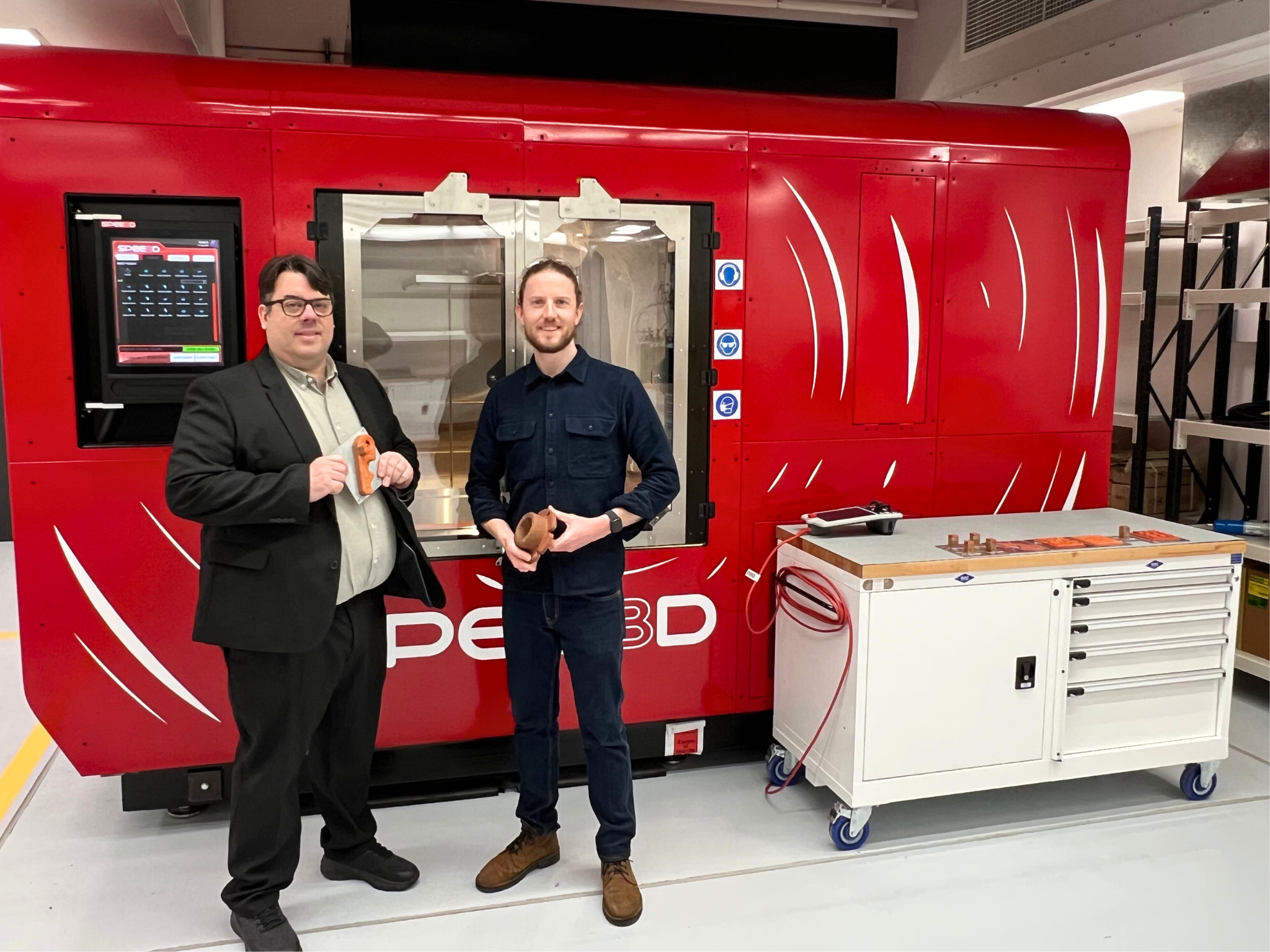
University of Sydney WarpSPEE3D Installation. L-R: Steven Camilleri, SPEE3D CTO, and Patrick McCarthy, Senior Staff Engineer. Image courtesy of SPEE3D
The WarpSPEE3D will be located in the SMH’s Large-Format Additive Manufacturing Lab, for use by University of Sydney researchers, industry collaborators, and other academic institutions. It utilizes SPEE3D’s patented CSAM technology to print high-density metal parts at supersonic speeds that conventional manufacturing methods just can’t match. With its very flexible system, the printer supports open materials experimentation with a wide range of metal powders, like aluminum, copper, copper nickel alloys, and stainless steel. Researchers should easily be able to test out new materials on the WarpSPEE3D in the SMH for industry-relevant applications, which will set up the University of Sydney as a CSAM research leader.
“The WarpSPEE3D will significantly enhance our capability to pioneer research in Cold Spray Additive Manufacturing, offering an opportunity to collaborate between academia and various industries,” Bruce McLean, the Sydney Manufacturing Hub’s Chief Engineer, said about the acquisition of the printer. “This technology provides a platform to experiment, innovate, and bridge the gap between cutting-edge research and real-world applications.”
While its machines are often used for military applications, this isn’t the first time SPEE3D has installed one of its CSAM printers at an academic institution. Last year, the Aussie firm, which Macro Analyst Matt Kremenetsky once called “the most American 3D printing company,” sold a WarpSPEE3D system to the New Jersey Innovation Institute (NJII) to use in its Collaborative Operationalized Manufacturing Engineering Training (COMET) Initiative for undergraduates. In 2023, SPEE3D partnered with the University of California Irvine (UC Irvine) to deploy the WarpSPEE3D for cold-spray-based materials consolidation studies.
As I learned during an interview with SPEE3D’s Chief Sales Officer Paul Maloney at RAPID a few years ago, there are multiple benefits to these types of partnerships between industry and universities. One is obviously workforce development, as having these systems available onsite gives students a great chance to learn about the technology in a hands-on way before entering the job field. It can even give them a jumping-off point to start their own business. Another is mutually beneficial research, which can result in further technology development.
Subscribe to Our Email Newsletter
Stay up-to-date on all the latest news from the 3D printing industry and receive information and offers from third party vendors.
Print Services
Upload your 3D Models and get them printed quickly and efficiently.













You May Also Like
ORNL Improves Error Mitigation in Large Polymer Parts
Oak Ridge National Laboratory (ORNL) has commercialized a number of large-format 3D printing technologies. Now, scientists are working on error mitigation in large parts. ORNL is using six thermal cameras...
Aibuild Says New FETS Simulation Tool Is 10,000x Faster for AM
Aibuild has launched FETS for Additive Manufacturing, a Finite Element Thermomechanical Simulation tool that lets you simulate stress, distortion, thermal effects, and thermomechanical effects. The solution has been optimized for...
Ceramic 3D Printing Applications on Display at Ceramics Expo USA
There’s a lot of crossover between ceramics and additive manufacturing (AM). Now, we just need to get the two industries to talk to each other more. It was nice to...
3D Printing News Briefs, April 8, 2026: LiDAR Scanning, Vapor Smoothing, FDM Optimization, & More
We’ll kick off today’s 3D Printing News Briefs with some 3D scanning news from Artec 3D, and then move on to new America Makes Project Calls. Then, Raise3D and AMT...