3MF Becomes ISO Standard


The 3MF file format has become an ISO Standard, becoming part of ISO/IEC 25422:2025. The file format is still open source, and it is hoped that this move will build confidence in 3MF while aiding it in replacing the antiquated STL format. 3MF is kind of like going to the gym; we all know it’s good for us, we gladly sign up, and, full of hope and optimism, we promise ourselves that we will make the change we need. But, time and time again, our dreams of a better future are marred in the morass that is the everyday. We embark on optimistic journeys in our minds, time and time again, only to get stuck with the abs we have, not the ones we want. This is why we still today mostly use a hopelessly inadequate, clunky file format that does not come close to describing the files in the way we wish them to be described and does not encode the information we need these files to contain. This ISO standard will hopefully drive more adoption and help us kick our unhealthy STL habit like the nicotine-encrusted smokers that we all are.

nTopology 3MF file includes extensions designed to better handle complex geometries. Image courtesy of 3MF.
Materialise CEO Brigitte de Vet-Veithen said,
“Adopting and scaling additive manufacturing to create real, impactful solutions in manufacturing means overcoming long-standing hurdles. Seeing 3MF become an official ISO/IEC standard is a proud moment for all of us who work towards that future. At Materialise, we’ve been committed to this journey from the start, and I’m proud of the role our team played in making this milestone possible.”
While 3MF’s Executive Director, Duann Scott, stated,
“Achieving ISO recognition for 3MF proves what’s possible when competitors join forces to clean up disparate AM workflows. Instead of every company patching its own fragile hacks to try and make arcane file formats ‘work’, we now share one rigorous, extensible standard, eliminating duplicated effort, lowering adoption barriers, and unlocking scalable growth for the entire industry.”
And Technical Director Alexander Oster,
“For a decade, we’ve dedicated ourselves to standardizing additive data pipelines with the right craftsmanship. It’s incredible that 3MF is now the standard backend format for everything from millions of desktop FDM printers to multi-million-dollar aerospace equipment. Becoming an ISO standard is another important milestone in our journey to build a professional software ecosystem for Additive Manufacturing.”

Save copyright information with 3MF. Image courtesy of 3MF.
3MF wants to become an Esperanto for Additive, letting us all communicate simply with less interference and loss of information. If that occurs, we will all save time and make fewer errors. Being able to encapsulate more information in 3MF will allow us to encode settings, date, material data, versioning information, multiple materials, multiple processes, and more. The format will make it easier for people to adhere to other standards such as the MDR, NADCAP, ITAR, and more. Implementing measures like locking down particular build settings helps ensure that the original intent — from doctors, designers, subcontractors, and vendors — is preserved from conception through to the final built part.
In the future, information exchange of complex build or part files, complete workflows, and processes can be exchanged more simply and with lower error rates. It will be easier for you to stitch together a workflow from different software tools or to exchange information in the way you’d like with others. This move towards ISO also makes 3MF more independent and more likely to be used across vendors and large firms.
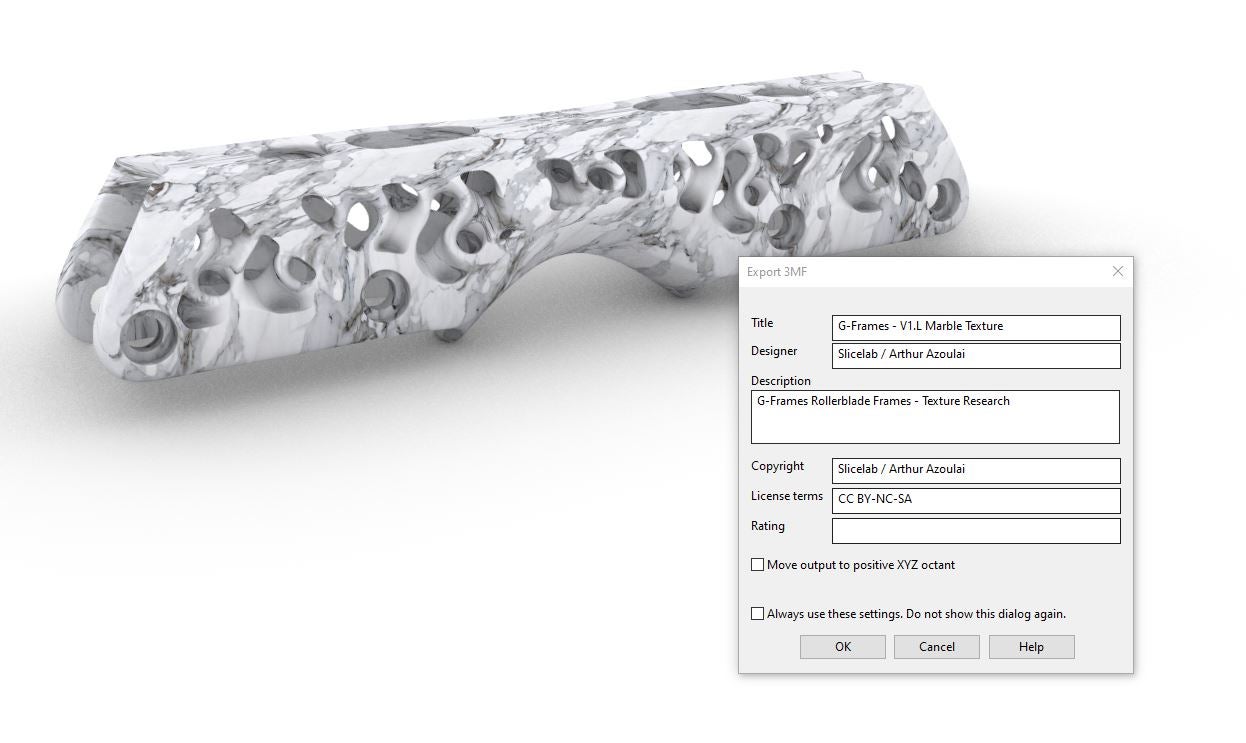
Exporting 3MF file. Image courtesy of 3MF.
Be the change. You can put in the work, put in the sweat, and we can together enter the Walhalla that is 3MF. Now, most of you won’t further clog my Atherosclerosis-like workflows and necessitate lots of Dropbox space forevermore. But we must admire Alex, Duann, and the rest’s valiant fight for our futures. Like Alan Carr, they fight for your life as it could be. Institutional lethargy and lack of time generally mean that many are still wedded to STL. In the next phase of our industrial development, we’ll be making more parts for planes and people. We should really drop STL while we still can so as not to be tied to these files for decades to come. Take this moment to move yourself away from STL and towards a higher fidelity, less disk space future.
Subscribe to Our Email Newsletter
Stay up-to-date on all the latest news from the 3D printing industry and receive information and offers from third party vendors.
Print Services
Upload your 3D Models and get them printed quickly and efficiently.












You May Also Like
3DPOD 318: 3D Printing at ORNL, Part II – Thomas Feldhausen
Thomas Feldhausen works at Oak Ridge National Laboratory (ORNL) on hybrid manufacturing, DED, digital twins, and new manufacturing solutions. For years, he’s tried to marry traditional subtractive manufacturing with additive...
Push Button Metal: SnowX
In addition to MetalBase and ScrapLabs, we now have a new competitor in the low-cost LPBF space. Chinese firm SnowX aims to release its SnowPod through Kickstarter. The 80 ×...
Solukon Goes Big with New SFM-AT850 Depowdering System
Solukon has released the SFM-AT850 depowdering system. The German depowdering specialist has updated its product line, and this machine replaces the SFM-AT800-S and SFM-AT1000-S. Rather than many small parts, this...
The Hidden Economics of Powder Bed 3D Printing: Closing the Loop in Powder Management
Automation is a very topical thing in additive manufacturing at the moment. With renewed scale, some clients are fervently looking to automate production. Other business cases only make sense with...