AM Research Reports $3.58B AM Market in Q1 2025, Upgrades Metal Forecast

The global 3D printing market grew to $3.58 billion in Q1 2025, according to the latest data from Additive Manufacturing Research (AM Research). This marks a 9% year-over-year increase, suggesting the market is starting to recover after a stronger-than-expected finish to 2024.
AM Research’s newly published Q1 2025 3DP/AM Market Data and Forecast and its companion Market Insights report break down key trends across hardware, materials, and services in both the metal and polymer AM markets. The data includes information on companies, regions, and industries, offering one of the most detailed looks at the current state of additive manufacturing (AM).
According to AM Research, in the first quarter of 2025, metal AM reached $1.52 billion, up from $1.37 billion the year before. Polymer AM also saw an increase, growing to $2.06 billion, compared to $1.90 billion in the first quarter of 2024. The combined market for AM services followed a similar trend, rising to $2 billion from $1.77 billion the previous year.
While the growth isn’t very big, it shows a steady upward path for the industry—and a challenging industry at that. Metal materials and hardware grew only slightly, but metal powder bed fusion (PBF) systems stood out as one of the stronger-performing technologies.
Polymer materials continued to grow as well, thanks in part to increased use in print services. This was especially true in China, where large service providers like UnionFab operate hundreds of printers and produce millions of parts. Dental labs also played a key role, as more of them are turning to 3D printing for the fast and cost-effective production of crowns, aligners, and other devices. Together, these areas are helping to keep momentum going in the AM market.
Industry Shifts Toward “Solution-First” Growth
Executive VP of Research Scott Dunham summarized a key takeaway: the AM industry is shifting from venture-backed expansion toward organic growth based on real-world needs.
“Q1 2025 saw continuing and rapid consolidation of financially struggling assets. We see emerging a new path to industry expansion, one not fueled by fundraising and selling a technology, but rather by new products developed internally and as the result of specific needs and opportunities, summed up as ‘solution first organic growth’,” Dunham said.
This trend is reflected in companies like IRPD in Switzerland and Additive Plus in the U.S., which are bringing internally developed AM systems to market.
AM Research increased its long-term forecast for the metal AM market, citing rapid developments in sectors such as satellites, drones, and data centers, which exhibit strong signs for AM adoption. The report particularly highlights dental 3D printing as a case study for how AM can dominate a market. Thanks to falling hardware prices, improved automation, and robust application development, dental labs now widely rely on AM.
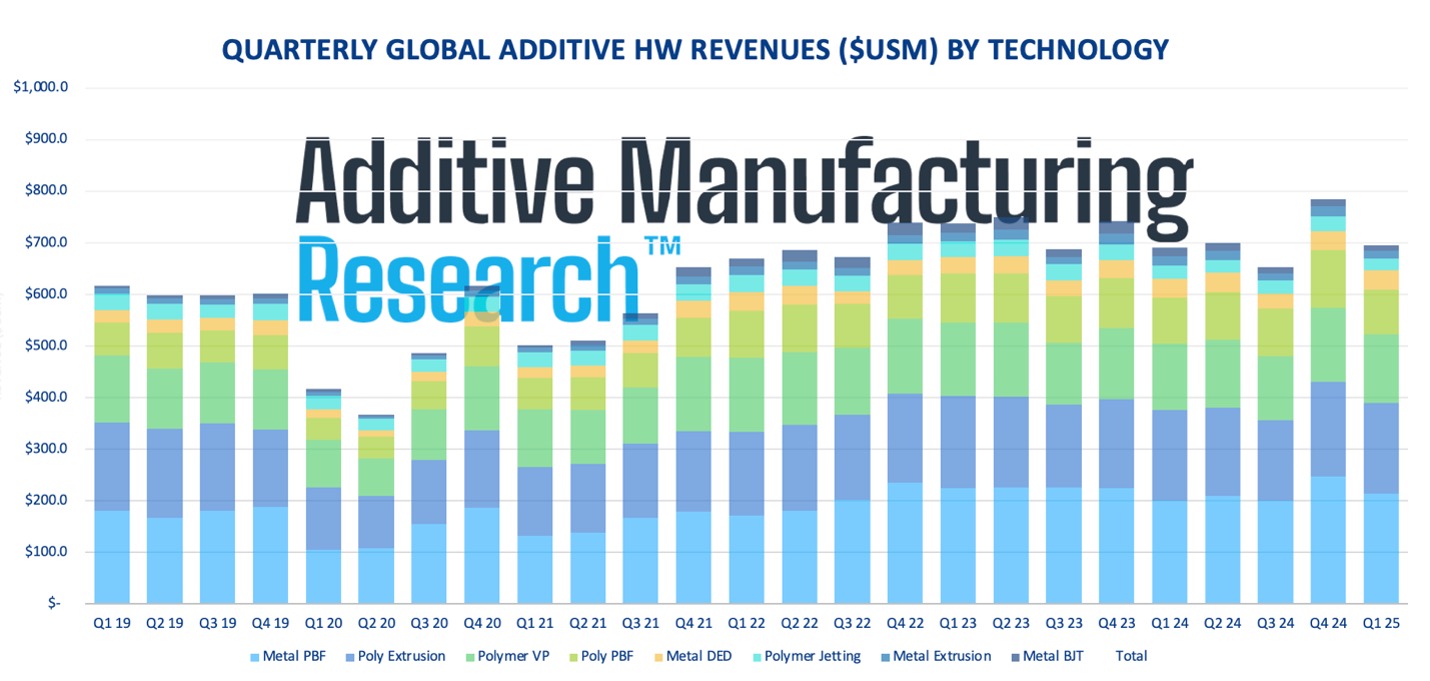
Image courtesy of Additive Manufacturing Research.
AM Research’s quarterly data products include nearly a decade of historical data and ten-year forecasts. Reports are available as one-time or subscription purchases and can be customized for specific client needs. These core products—Core Metals and Core Polymers—track global trends across hardware, materials, and services, with quarterly updates to reflect real-time changes in the market.
To access the full reports or learn more about AM Research’s services, visit www.additivemanufacturingresearch.com/reports.
Subscribe to Our Email Newsletter
Stay up-to-date on all the latest news from the 3D printing industry and receive information and offers from third party vendors.
Print Services
Upload your 3D Models and get them printed quickly and efficiently.













You May Also Like
Kickstarter is Testing the Next Wave of Desktop 3D Printing
3D printers are raising serious money again…on Kickstarter, that is. Over the last few months, a new group of 3D printer campaigns has attracted millions of dollars and thousands of...
Stratasys vs. Bambu Lab: What’s Really Behind the $27.6M Patent Verdict?
Editor’s note: This is Part 1 of a two-part series by Xu Fanglei examining the technology and patent issues behind the Stratasys-Bambu Lab dispute. Part 1 looks at the U.S....
Bambu Lab and SUSAN FANG 3D Print for London Fashion Week
At London Fashion Week, some of the more unusual pieces on the runway came from 3D printers. Chinese fashion designer SUSAN FANG presented her Spring/Summer 2027 Air-Illusion collection at the...
Stratasys Wins $27.6M in Patent Case Against Bambu Lab; Bambu Challenges Verdict
Update, September 21, 2026: This article has been updated with a statement from Bambu Lab responding to the verdict, along with additional information about the company’s ongoing patent challenges against...