
ORNL Continues Research Into Making Large Format Metal Parts by Combining AM and HIP

This can’t be stressed enough: the US needs to secure its supply chains for energy and power generation components. And, while the US needs to prioritize that objective across the board, the current greatest risk of shortage arguably lies with large format, metal parts.
There are few American organizations doing more to address this issue than Oak Ridge National Laboratory (ORNL). Moreover, ORNL is approaching the problem from a variety of different angles, exploring a broad range of advanced manufacturing techniques both individually and in concert with one another. Two years ago, for instance, the Knoxville-based institution announced it was developing a method to use wire-arc additive manufacturing (WAAM) to produce large vessels that could be used for powder metallurgical hot isostatic pressing (PM-HIP).
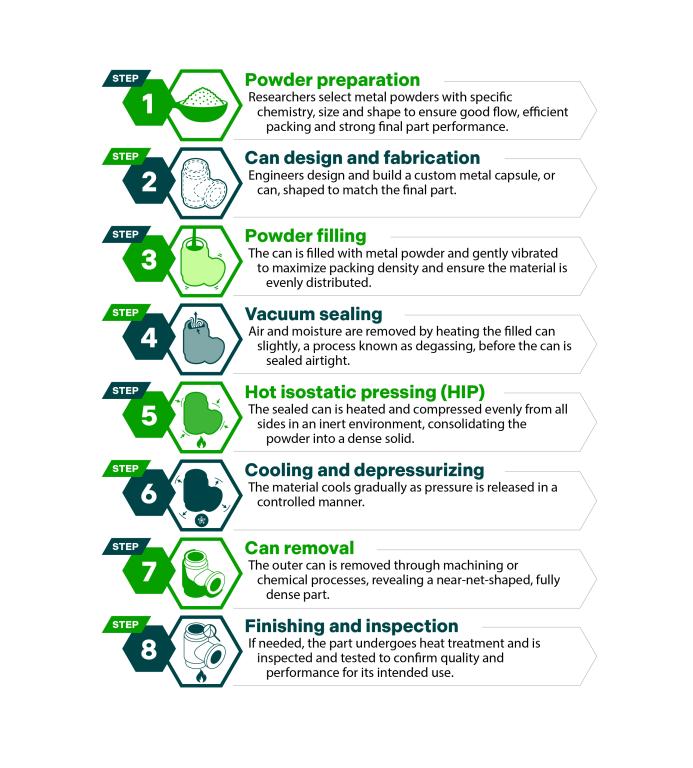
PM-HIP is a method that utilizes pressure-sealed vessels and furnaces to form metal powder without melting. By making the PM-HIP molds with AM, ORNL was aiming to establish a process for making very large metal components without relying on casting and forging supply chains. Now, ORNL has announced an update on the project, with the researchers revealing that they’ve successfully made a component that appears to be a turbine blade by using a 2,000 pound canister made with multiple forms of 3D printing, which was subsequently incorporated into the standard PM-HIP process.
In addition to enabling a bypassing of the US’s traditional domestic metal supply chains that have been gutted over the last several decades, the combination production method also unlocks the same geometric advantages associated with AM more generally. Additionally, the viability of using advanced alloys in PM-HIP gave ORNL the opportunity to draw from its wealth of materials science knowledge.
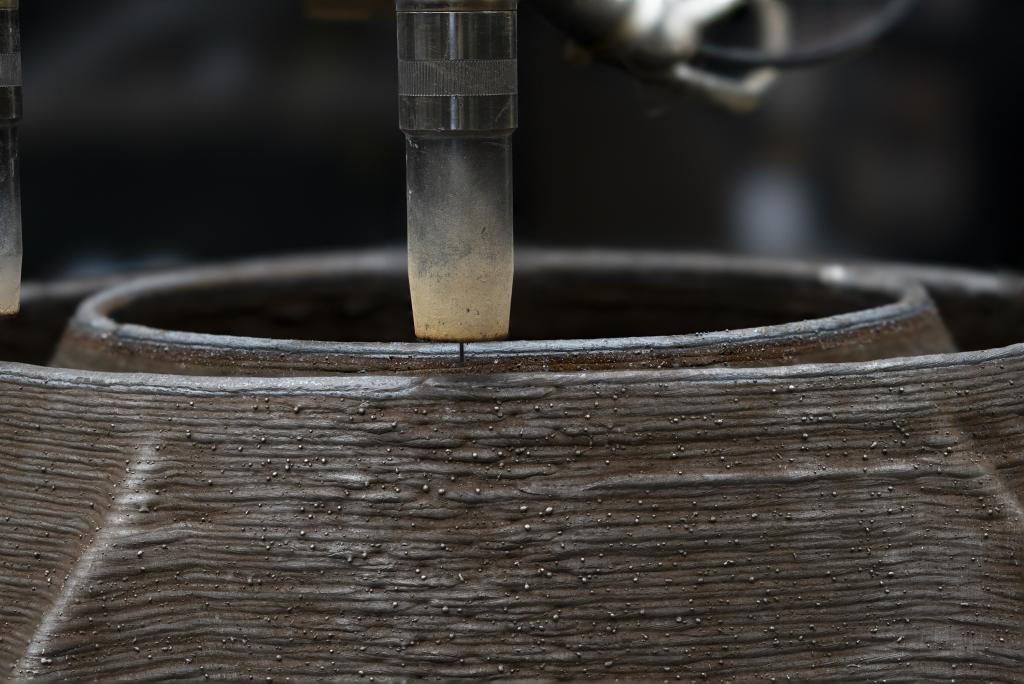
In a press release about ORNL’s successful production of a large format PM-HIP component using a 3D printed mold,ORNL researcher Pavan Ajjarapu said, “This work lays the foundation for a transformative shift in the PM-HIP landscape for large-scale components. By harnessing the strengths of both additive manufacturing and hot isostatic pressing, we are paving the way for greater design freedom and expanded applications in hydropower and next-generation nuclear reactors.”
ORNL’s Jason Mayeur said, “We further enhanced the effectiveness of PM-HIP technology by using a mechanics-based computational model to reduce developmental costs and lead times by eliminating trial-and-error approaches.”
As with the vast majority of critical components that comprise US infrastructure, the US’s energy and power supply chains are existentially dependent on imports from China. It goes without saying how much leverage this gives China over the US, particularly given that the two nations are also at each other’s necks in an AI arms race (not to mention all the other arms races sustaining the tension between the two powers).
The smartest thing the US could do right now is take half the defense budget and give it to the Department of Energy (DOE), but we would be silly to expect the US to do the smartest thing it could do. In lieu of that, then, it would be nice to see more companies like ARC form and partner with ORNL to help the lab commercialize its technology, at the same time as ORNL is helping expand access to high quality research.
I do think that a vast wave of privatization is on the horizon for the US government, which is only surprising insofar as there is even still anything left to privatize. The Trump administration has already signaled that it wants to do this with NASA, continuing a pet project begun in the president’s first term.
A final push to maximize privatization of US government services would likely change the entire appearance of how pure research is done in this country, although that already seems to have been happening regardless. Even in such a scenario, I would think that ORNL is one of the handful of entities that will endure no matter what. In any case, the US can’t afford to lose the contributions that the lab makes on a daily basis.
Images courtesy of ORNL
Subscribe to Our Email Newsletter
Stay up-to-date on all the latest news from the 3D printing industry and receive information and offers from third party vendors.
Print Services
Upload your 3D Models and get them printed quickly and efficiently.













You May Also Like
3D Printing News Briefs, August 22, 2026: Polymers for CubeSats, Animal Mobility Devices, & More
We’re starting with defense news in this weekend’s 3D Printing News Briefs, before moving on to polymers for CubeSats and 3D printed prosthetics. We’ll end with a story about engineering...
Pusan National University & ORNL Develop Elastomeric Liquid Crystal Actuators
Researchers from Korea’s Pusan National University and Oak Ridge National Laboratory (ORNL) have developed 3D printed elastomeric actuators. In a paper published in Nature, the team used elastomeric liquid crystal...
Scientists Use BMF to 3D Print Seal Whiskers That Track Prey Long After It’s Gone
Seals use their whiskers to hunt. Not Navy Seals, although they may in some way also, but this article is about lowercase seals. Not Seal the musician either; as far...
Harvard’s Jennifer Lewis Lab Is 3D Printing Artificial Muscles That Twist and Bend on Demand
Researchers at Harvard John A. Paulson School of Engineering and Applied Sciences (SEAS) have developed a new way to 3D print materials that can move on their own, bending, twisting,...























































