
Nanochon Gets Health Canada Approval for First-in-Human Clinical Trial of 3D Printed Implant

Biotechnology company Nanochon, based in Washington, DC and Baltimore, Maryland, is focused on developing orthopedic medical device solutions. Specifically, the company is working on a new approach to cartilage treatment, using 3D printing, so active patients with joint damage can return to their normal lifestyles without expensive and invasive short-term fixes. Nanochon just announced that it’s received approval from Health Canada for a first-in-human clinical trial of its 3D printed implant.
The minimally-invasive Chondrograft implant, based on research from the Tissue Engineering and Nanotechnology lab at the George Washington University, is used to treat articular cartilage defects in the knee. It was designed to integrate with a patient’s healthy tissue over time. Nanochon says the implant allows for immediate motion and weight-bearing, for maximum benefit and stability to the patient and less time recovering.
With this approval from Health Canada, the 3D printed Chondrograft system is being evaluated in a prospective, 10-patient, early feasibility study for restoration of knee cartilage in eligible patients, between the ages of 22 and 60, who suffer from femoral condyle and /or trochlea articular cartilage lesions and have failed conservative therapy.
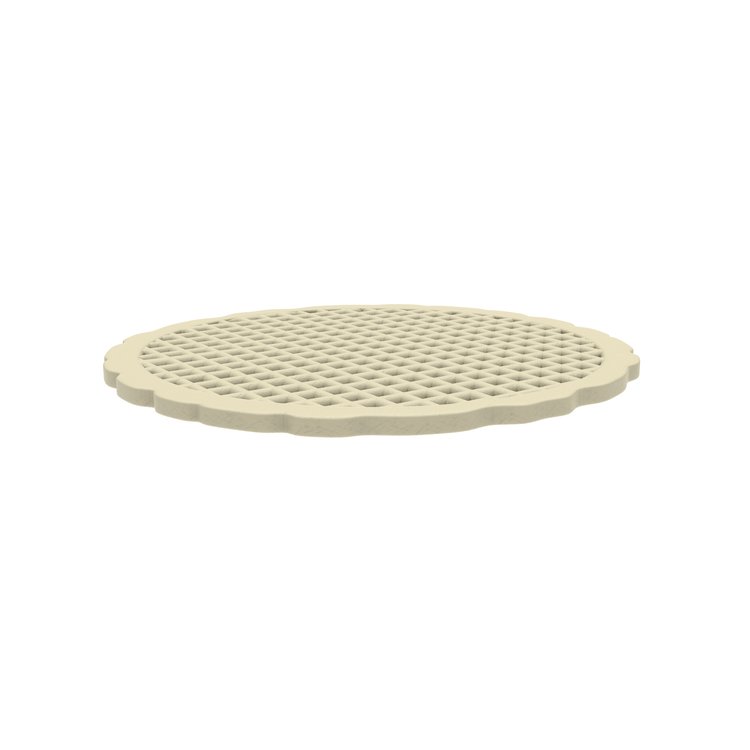
Nanochon has developed highly-engineered implants for clinical trials. Image courtesy of Nanochon.
The trial will be led by Principal Investigator Dr. Fathi Abuzgaya, an orthopedic surgeon and researcher who’s led over 600 clinical trials over the last 25 years. He will work with Sub-Investigators and Sports Medicine Specialists Drs. Joel Lobo, Kajeandra Ravichandiran, and Marcin Kowalczuk at Durham Bone &Joint Specialists (DBJS) in Ontario.
“Our team is delighted that we are the first center to start enrolling participants for the Chondrograft™ study, which represents a novel, minimally invasive treatment for patients with loss of or damaged knee cartilage. DBJS is a multidisciplinary musculoskeletal center providing non-operative and operative treatments with accessibility to a variety of sub-specialties. Our study site with dedicated researchers enables greater, more efficient patient recruitment for clinical research and we are privileged to support Nanochon,” said Dr. Abuzgaya.
Nanochon was supported by HN Clinical Consulting in Missouri during the clinical trial design and regulatory approval process, which will continue to offer its support during the full life cycle of the Chondrograft implant.
Heather Neill, Founder and Principal of HN Clinical Consulting, said, “Improving the lives of young adults and athletes by providing a solution to restore knee cartilage and hopefully help patients avoid costly knee replacement is a crucial therapy needed in the orthopedic world. We appreciate Health Canada’s thought-provoking questions throughout their review that helped us put forward the strongest application possible, which ultimately led to our approval.”
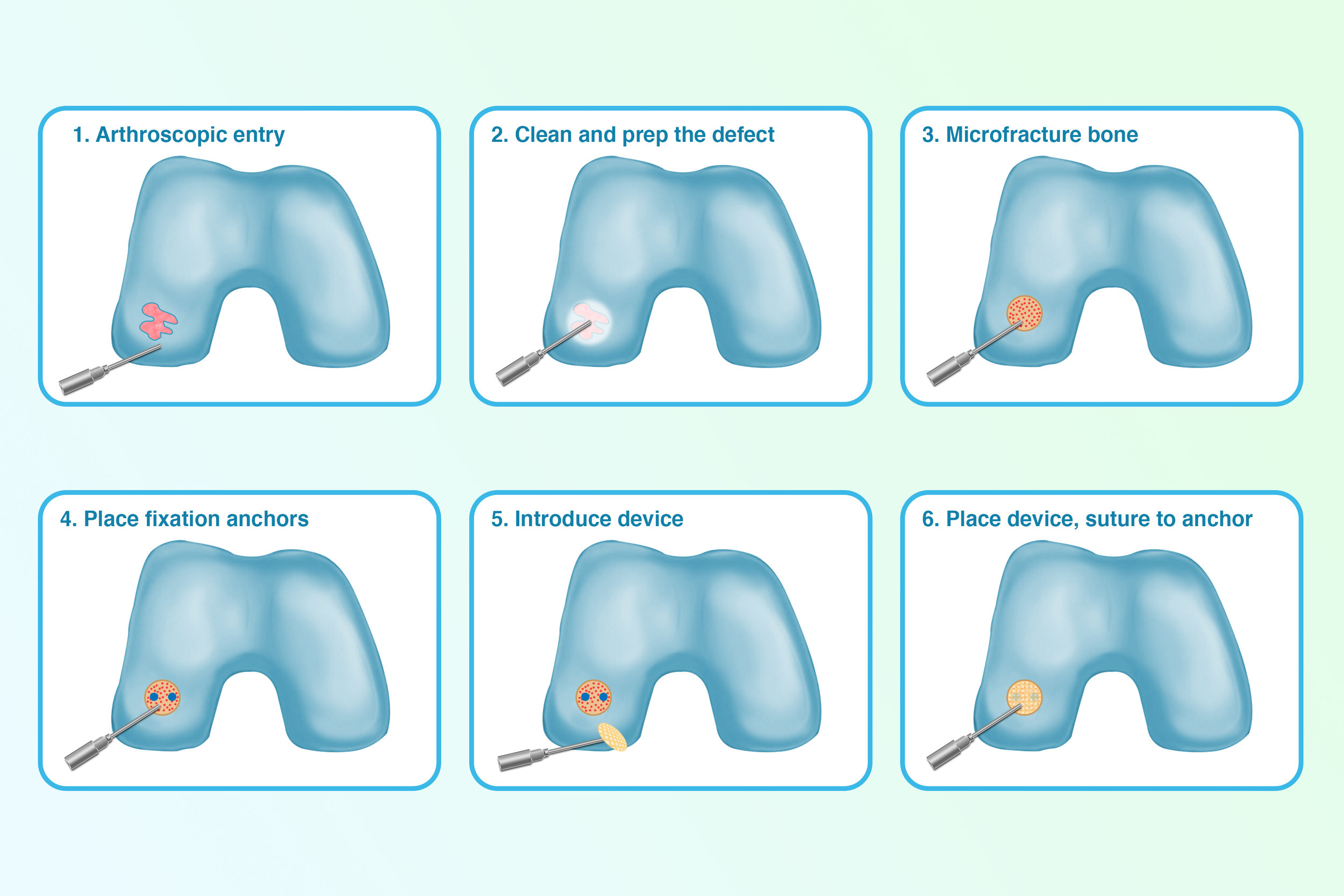
How the Nanochon medical device is used in joints. Image courtesy of Nanochon.
The purpose of Nanochon’s first-in-human clinical trial is meant to assess the safety and performance of the 3D printed Chondrograft implant. Procedural goals of the trial include regrowth of the cartilage-bone matrix, delayed need for arthroplasty, and improvement in the patients’ knee function and pain.
“Achieving Health Canada approval allows us to gain the clinical data needed to take a giant step forward towards design and execution of a large pivotal North American study. We have the utmost confidence in Dr. Abuzgaya and his clinical team at DBJS to help us recruit the right patients and execute the trial protocol that we have so carefully designed,” said Ben Holmes, CEO of Nanochon.
This trial will take place in Canada, but it’s a first big step toward what Nanochon and its clinical trial partners hope will be a much larger clinical program.
“Thousands of patients with chondral defects, that may evolve to osteoarthritis, live with a reduced quality of life. We are looking forward to the potential for a new treatment option and are excited to begin the Chondrograft™ study at DBJS. The results of this study could open up a new surgical option, that is minimally invasive to address this unmet clinical need,” explained Dr. Lobo.
3D printing has had a major impact on the healthcare sector, helping with “production of personalized medical devices, reduced development costs, fostered innovation in advanced devices, and improved accessibility to prosthetics,” according to an AM Research report on market trends and opportunities for additive in the medical device sector.
“Over the past two decades, its integration into healthcare has notably enhanced patient outcomes and expanded healthcare accessibility.”
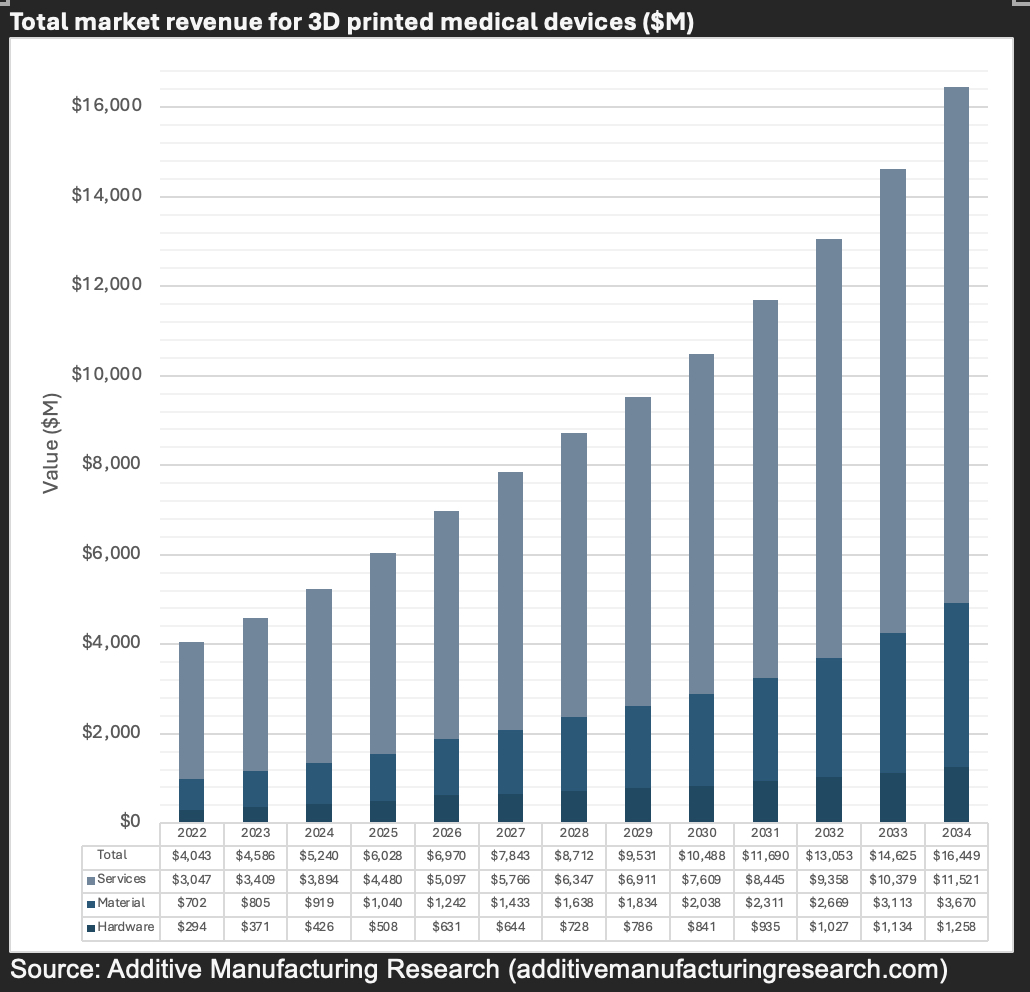
Total market revenue for 3D printed medical devices. Image courtesy of Additive Manufacturing Research.
The report states that by 2034, the 3D printed medical device market will skyrocket to $16.5 billion in revenues, growing from $4.5 billion in 2023 at a 10 year CAGR of 12%. So, not only would a larger clinical program for knee cartilage restoration be good news for patients looking to improve their quality of life, but it would also be financially lucrative as well.
Subscribe to Our Email Newsletter
Stay up-to-date on all the latest news from the 3D printing industry and receive information and offers from third party vendors.
Print Services
Upload your 3D Models and get them printed quickly and efficiently.













You May Also Like
AMAsia Pulse: AM Investment Picks Up Across Asia-Pacific
The first half of September brought fresh investment and expansion activity across Asia-Pacific’s additive manufacturing sector. China’s Xinjinghe secured funding for an aerospace AM hub, South Korea’s Lincsolution outlined plans...
3D Printing News Briefs, August 26, 2026: Meshy 7, 4D Printed Implants, & More
We’re kicking things off today with software news, as the new Meshy 7 is now live. Then we’ll move on to business, with ExOne and voxeljet now operating as a...
AMPulse Asia: India’s Orbital Launch Headlines a Busy Second Half of July
The second half of July brought major developments across Asia’s additive manufacturing sector. Highlights included India’s first private orbital launch powered by 3D printed engines, a billion-yuan ownership change at...
3D Printing News Briefs, July 9, 2026: RIMPAC 2026, Software, Housing, & More
In today’s 3D Printing News Briefs, Massivit continues its focus on aerospace and defense manufacturing, and Meltio is collaborating with Phillips Corporation for RIMPAC 2026. Moving on to software, AMIS...
























































