Havaianas Collaborates with Zellerfeld to Launch 3D Printed Flip-Flops

The shoe of the summer is undoubtedly the flip-flop. Easy on, easy off, your feet won’t get sweaty because there’s not much material, and they’re available in a veritable rainbow of colors. And, as with most types of shoes these days, you can use 3D printing to make flip-flops and other sandals. At the upcoming Copenhagen Fashion Week in August, Brazilian flip-flop brand Havaianas will debut its first 3D printed flip-flops, made in collaboration with Zellerfeld, a definite leader in 3D printed footwear.
Inspired by the traditional Japanese Zori sandal, Havaianas was founded in 1962. The brand swapped out the cloth straps and woven rice straw soles for rubber, and in 1966, parent company Alpargatas registered the patent of its “world famous rubber thong.” In 1980, the Brazilian government included Havaianas flip-flops on a list of everyday fundamental products to help control inflation, and the sandals made their high fashion debut in a 1999 Jean Paul Gaultier runway show.

Women’s Slim Square Trendy Flip Flops by Havaianas. These are not 3D printed.
“Bringing innovative technologies into the originality of our design has been essential to strengthening our timeless aesthetic,” said Ieda Pavani, global design director for Havaianas. “It’s a way to honor our essence while connecting with new audiences who appreciate authenticity, innovation, and value.”
Zellerfeld has worked with its share of icons and famous names, like Kanye West (Ye, Yeezy, Yeezle, whatever he’s calling himself today), Moncler, and Chris Brown. The company has a proprietary, full-stack 3D printing process that enables shoes to be printed in one piece out of zellerFOAM, a specially developed foaming TPU (thermoplastic polyurethane). Zellerfeld’s shoes are said to be 100% recyclable, breathable, and washable, as well as odor resistant. They feature a dense grid structure, which offers maximum comfort and softness—features that Havaianas also promises.
Cornelius Schmitt, CEO and co-founder of Zellerfeld, said, “I am thrilled that Zellerfeld is collaborating with the world’s most iconic flip-flop brand to bring flip-flops into the era of 3D printing.”
View this post on Instagram
The Havaianas innovation team collaborated with Zellerfeld every step of the way during the design process. Together, they came up with a new silhouette for the Brazilian brand’s famous sandals, but without sacrificing what makes Havaianas flip-flops special. The Havaianas x Zellerfeld features a new sculpted toe cap, but kept the footbed’s recognizable rice grain texture, and reinterpreted the strap—still in the same position—with a more rounded shape.
“Together with Havaianas, we have worked hard to develop this design have created a new split-toe silhouette that will lay the foundation for future printed flip-flops, opening up new possibilities,” Schmitt said. “This is not just a collaboration, but another important step towards a future where all footwear will be printed. Who wouldn’t want custom-made flip-flops?”
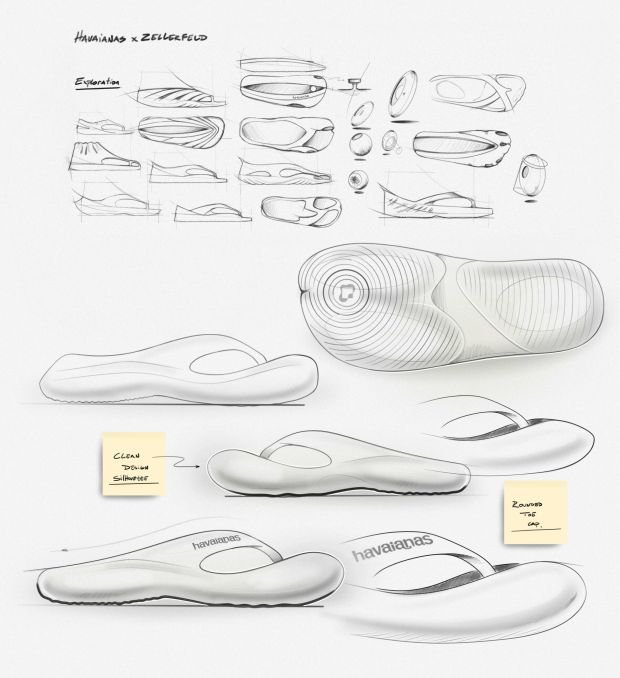
A sketch of the Havaianas 3D printed flip-flops
Zellerfeld, based in San Francisco and Hamburg, is backed by some big investors, like SpaceX and Tesla. The company created a new infrastructure for manufacturing shoes, replacing more traditional supply chains with platform-driven commerce and real-time, customized production. With its automated, on-demand, and waste-free production, Zellerfeld’s platform has the potential to replace traditional tools and factories. This could be a huge business opportunity, as the global footwear market is predicted to reach $500.55 billion in revenue this year. What’s more, non-luxury shoes are said to contribute to 92% of these sales, and nothing could be further from a luxury shoe than flip-flops…except maybe Crocs.
In terms of the 3D printed footwear market, five years ago Additive Manufacturing Research (formerly SmarTech Analysis) estimated that it would reach $4.2 billion in revenues by this year. I don’t know how much of that is represented by 3D printed flip-flops; you’d think it would be a significant amount. In 2023, Executive Editor Joris Peels said that 3D printing the whole shoe was problematic and costly, but that 3D printing sandals and flip-flops was “a perfectly viable 3D printed footwear product for the masses,” because only one material and very little labor would be needed. Plus, because it’s such a low structure, a flip-flop is a fairly cost-effective print.
But, as Peels also noted, there haven’t been many successful brands built around 3D printed flip-flops. In fact, FitMyFoot, previously known as Wiivv Wearables, was once a major proponent of custom 3D printed flip-flops. But this winter, the company decided to drop its sandals, and since then has been running a “Sandal Send-Off Sale” and selling its flip-flops for 50% off, noting that “once they’re gone, they’re gone for good.”
“Most of the 3D printed efforts were simply not promoted well enough and didn’t reach a wide audience. Others looked horrible or were poorly made. Generally no one has seemed to make a good brand, a good idea and a good design come to life in the minds of many. This is a straightforward business opportunity but getting it right won’t be easy,” Peels wrote.
Maybe Havaianas and Zellerfeld will be the ones to get it right. Starting in September, the new 3D printed Havaianas x Zellerfeld will be available in five colors, for purchase exclusively on the Zellerfeld website.
Subscribe to Our Email Newsletter
Stay up-to-date on all the latest news from the 3D printing industry and receive information and offers from third party vendors.
Print Services
Upload your 3D Models and get them printed quickly and efficiently.













You May Also Like
Stratasys vs. Bambu Lab: What’s Really Behind the $27.6M Patent Verdict?
Editor’s note: This is Part 1 of a two-part series by Xu Fanglei examining the technology and patent issues behind the Stratasys-Bambu Lab dispute. Part 1 looks at the U.S....
The Money Behind AM: What to Watch at AM Investment Strategies 2026
For years, simply being a 3D printing company could attract attention from investors. New machines, new materials, faster speeds, and the promise of mass production were often enough to get...
Stratasys Showcases 3D Printed Automotive Applications & New Printer at IMTS 2026
Just ahead of last week’s International Manufacturing Technology Show (IMTS) in Chicago, Stratasys launched the F870, a new large-format, production-grade FDM 3D printing platform designed to drive industrial manufacturing at...
Stratasys Wins $27.6M in Patent Case Against Bambu Lab; Bambu Challenges Verdict
Update, September 21, 2026: This article has been updated with a statement from Bambu Lab responding to the verdict, along with additional information about the company’s ongoing patent challenges against...