Ye Debuts 3D Printed Boot Powered by Zellerfeld for Paris Fashion Week


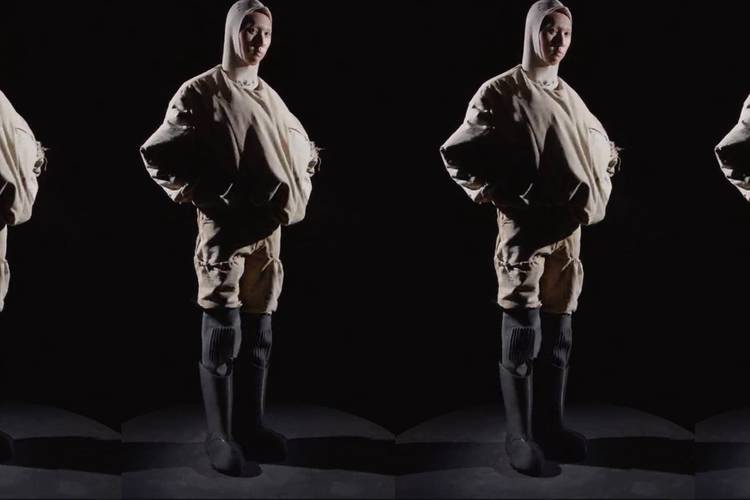
Amidst outrage at his decision to wear a “White Lives Matter” T-shirt at Paris Fashion Week while debuting the YEEZY Season 9 collection, other aspects of the show naturally flew under the radar. For instance, it turns out that the boots Ye has been seen wearing in photos for the past month are not only part of the Season 9 collection, but were also entirely printed by the Brooklyn-based, US division of German additive manufacturing (AM) firm Zellerfeld.
Zellerfeld has collaborated before with Yeezy Supply — in addition to many other brands — to print small runs of footwear produced from a spongy, recyclable TPU. It is not clear if this is the Boost material that adidas developed in partnership with BASF, which it uses on multiple shoe lines, including those produced in collaboration with Yeezy.
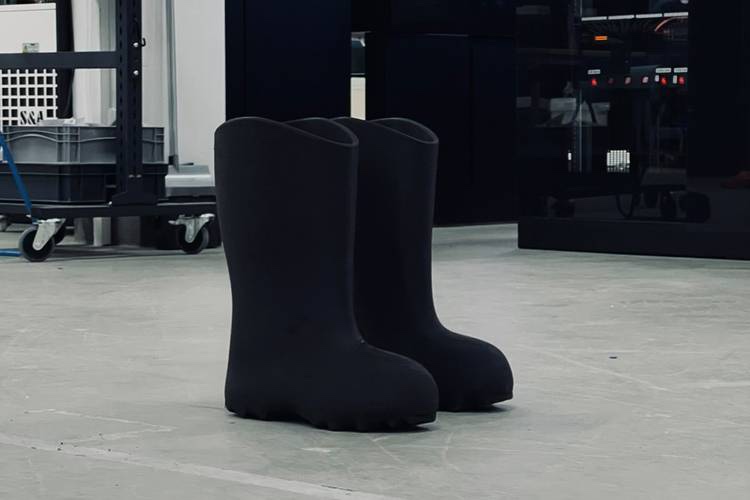
Zellerfeld intensifies the demand surrounding its products by requiring customers to apply to be beta testers for the company’s shoes before they’re even given permission to purchase them. As with the recently-released 3D printed climbing shoes made by ATHOS, the customer simply sends a picture of their feet to the manufacturer, and a unique pair of footwear is produced for that specific customer.
For better or worse (and obviously, most often, worse), Ye is perhaps the most famous proponent of 3D printing. This is particularly ironic since, in 2015, Ye said he feared the technology: that “the Internet destroyed the music industry…[and] this is what we’re afraid of right now with the textile industry.”
The Internet did not destroy the music industry so much as change the way that profits were made, to which Ye himself is a living testament. Instead of buying an artist’s music at the store, we pay our phone company, or some similarly anonymous provider, for the right to listen to the music. The anonymous providers don’t give the artists very much of our money, leaving performing and endorsement deals as the main revenue streams for popular musicians. And that’s why Ye is no longer afraid of 3D printing!
With that in mind, the number of soles that adidas has already been printing for years should’ve been an indicator of this, but footwear clearly seems to be the front-runner amongst sectors, in the race to make mass customized 3D printing commonplace. Thus, given the rather openly conspiratorial nature of the fashion industry — it not only incepts its customer base, it’s proud to do so! — if Ye is 3D printing footwear, we’re all going to be wearing 3D printed shoes soon enough. The controversies he creates simply make the subsequent ubiquity of his influence easier for us to ignore.
Images courtesy of Zellerfeld and Donda Collective
Subscribe to Our Email Newsletter
Stay up-to-date on all the latest news from the 3D printing industry and receive information and offers from third party vendors.
Print Services
Upload your 3D Models and get them printed quickly and efficiently.













You May Also Like
Phillips Federal Participates in Marine Corps Exercise
Phillips Federal will participate in a Marine Corps exercise that will use several additive manufacturing technologies. The 1st Maintenance Battalion, 1st Marine Logistics Group, I Marine Expeditionary Force (IMEF), will...
Ceramics 3D Printing at Ceramitec 2026
Ceramitec is a key event for the ceramics industry. Held in the lovely city of Munich, it is the leading global event for the ceramics community. With around 13,000 participants...
AM Forum Berlin 2026: Tough Love From BMW’s Timo
We’re once again in the lovely city of Berlin, at the absolutely immense Estrel Center. The congress center, a musical and theater venue, towers over the easternmost reaches of the...
Printing Money Episode 35: Notable VC and M&A Deals, with Arno Held and Alex Kingsbury
Welcome to Printing Money Episode 35 and let us be the last to wish you a happy new year. For this episode Danny is joined by Arno Held (Managing Partner,...