What’s Pushing 3D Printing Into Rail Production?


For years, simply proving that a rail part could be 3D printed was a big step. Now, that is becoming the easy part. Rail companies want to know whether those parts can be made reliably, meet strict safety standards, and ultimately be approved for use on actual trains. Trains can stay in service for decades, often long after some of their original parts are no longer being made.
“Today, customers ask how to integrate additive manufacturing into production, how to qualify components, how to manage digital inventories, and how to scale manufacturing across multiple facilities while maintaining consistency. Five years ago, many discussions focused on how a part could be printed,” Gurvinder Kahlon of Stratasys told 3DPrint.com. The change is already showing up in conversations with customers.
From Printing Parts to Qualifying Them
Rail is a good fit for 3D printing in part because trains stay in service for so long. Operators may need replacement parts decades after a train was built, sometimes when those parts are no longer available. Making a small number of replacements through traditional manufacturing can be expensive or take months. With 3D printing, operators can store some of those parts as digital files and produce them when needed. Still, getting those parts onto actual trains has been slow.
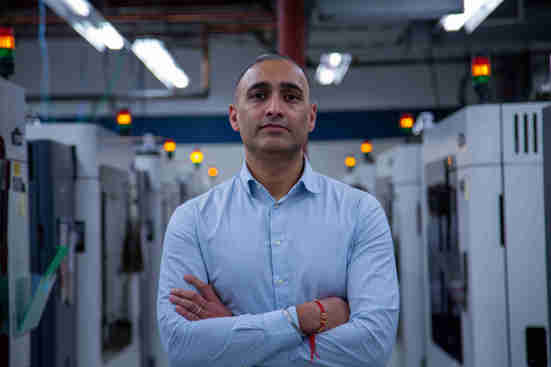
Gurvinder S. Kahlon is the Vice President & General Manager of Stratasys Direct. Image courtesy of Stratasys.
“Rail has different economic and regulatory drivers than aerospace, which benefits from significant weight reduction opportunities that justify higher manufacturing costs. Rail, meanwhile, is often driven by cost efficiency, long product lifecycles, and strict maintenance requirements. In addition, rail fleets can remain in service for decades, meaning introducing new manufacturing methods requires careful validation and integration into established maintenance practices,” Kahlon said.
The technology itself has also changed. According to Kahlon, industrial printers have become more reliable, materials have improved, and certification frameworks have become clearer. Supply chain disruptions have also pushed manufacturers to take local production and digital inventories more seriously. As a result, rail companies are starting to use 3D printing for more than prototypes.
“The shift happened when additive manufacturing consistently demonstrated value beyond design validation. Rail operators and manufacturers increasingly recognized that AM could address spare parts availability, long lead times, low-volume production, and component obsolescence. As materials, machine reliability, and qualification processes matured, companies became more comfortable deploying printed parts in operational environments where they deliver measurable business value,” he went on.
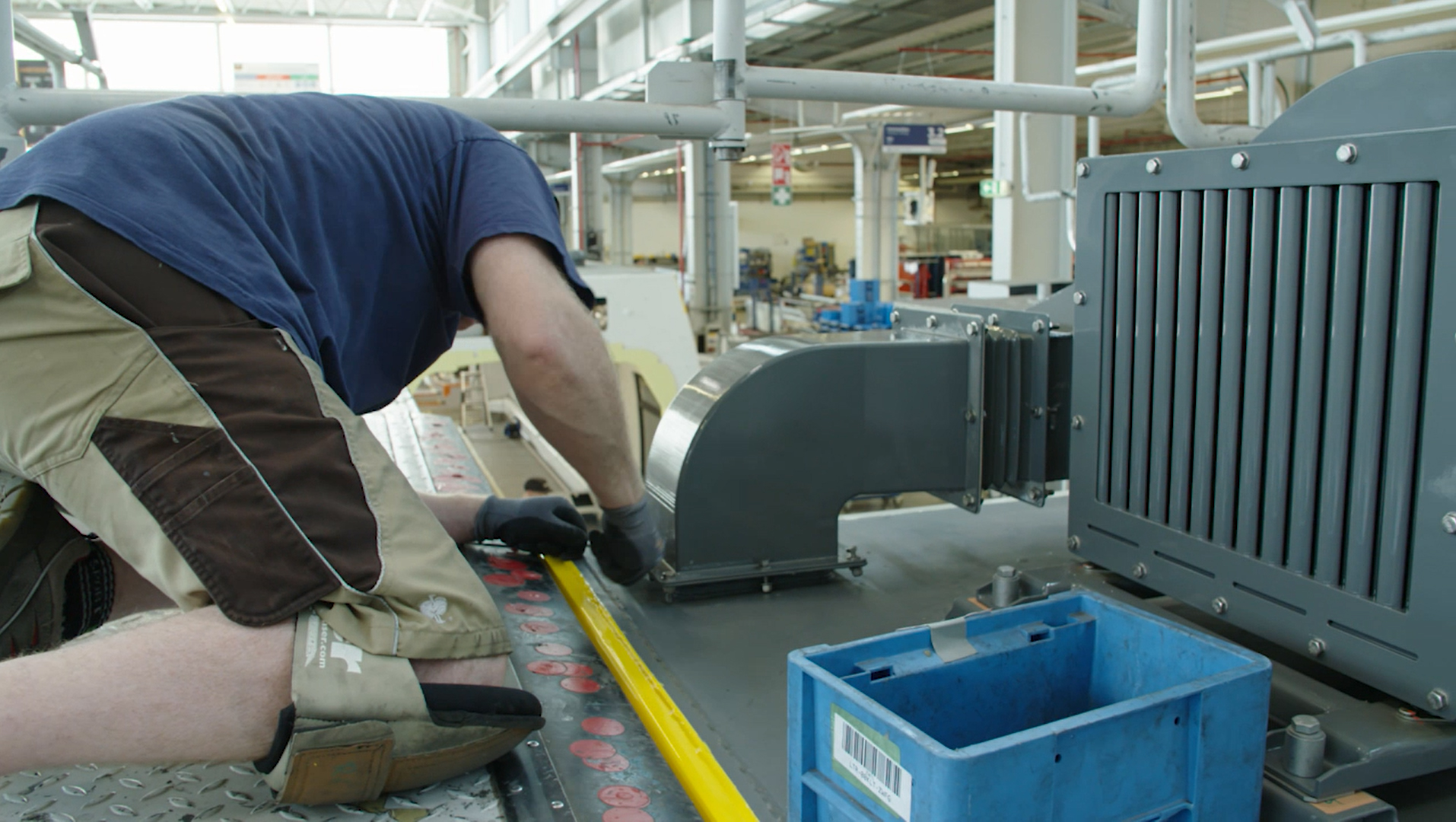
Customized 3D printed air vent system produced by Bombardier Transportation on Stratasys’ large-scale F900 3D Printer in ULTEM 9085 resin. Image courtesy of Stratasys.
Certification Becomes the Selling Point
For rail companies, speed and print quality are only part of the equation. They also need parts that can meet safety requirements and be produced consistently.
“Increasingly, yes. Print quality and productivity are the baseline in regulated industries such as rail. Certification, traceability, and documented repeatability often become the deciding factors for production adoption,” Kahlon said when asked whether certification was becoming more important than printer speed or print quality.
In June, Stratasys launched a new material designed for those kinds of production requirements. FDM PA6/66-GF30-FR is a flame-retardant polymer reinforced with 30% glass fiber. It is designed for the Fortus 450mc and F900 platforms and meets EN 45545-2 HL2 fire-safety requirements for rail applications, as well as FMVSS 302, a standard used in automotive applications.
Stratasys says the material is intended for functional and load-bearing components, including end-use and replacement parts. It is not the most dramatic kind of 3D printing announcement. But that is partly the point.
A certified material can make it easier to move a 3D printed part into production. Kahlon explains that “Yes, pre-qualified materials and documented testing can significantly shorten project timelines. They don’t eliminate application-specific qualification, but they reduce the amount of testing customers must perform themselves, helping projects advance more efficiently.”
Stratasys developed the material through its work with rail OEMs and service providers. Alstom and Siemens Mobility were both cited in the company’s announcement as users of additive manufacturing in rail.
Lorenzo Gasparoni, 3D Printing Program Manager at Alstom Group, said the new material supports “reliable, repeatable production of qualified spare parts,” while Siemens Mobility pointed to AM’s role in producing application-specific parts on demand.
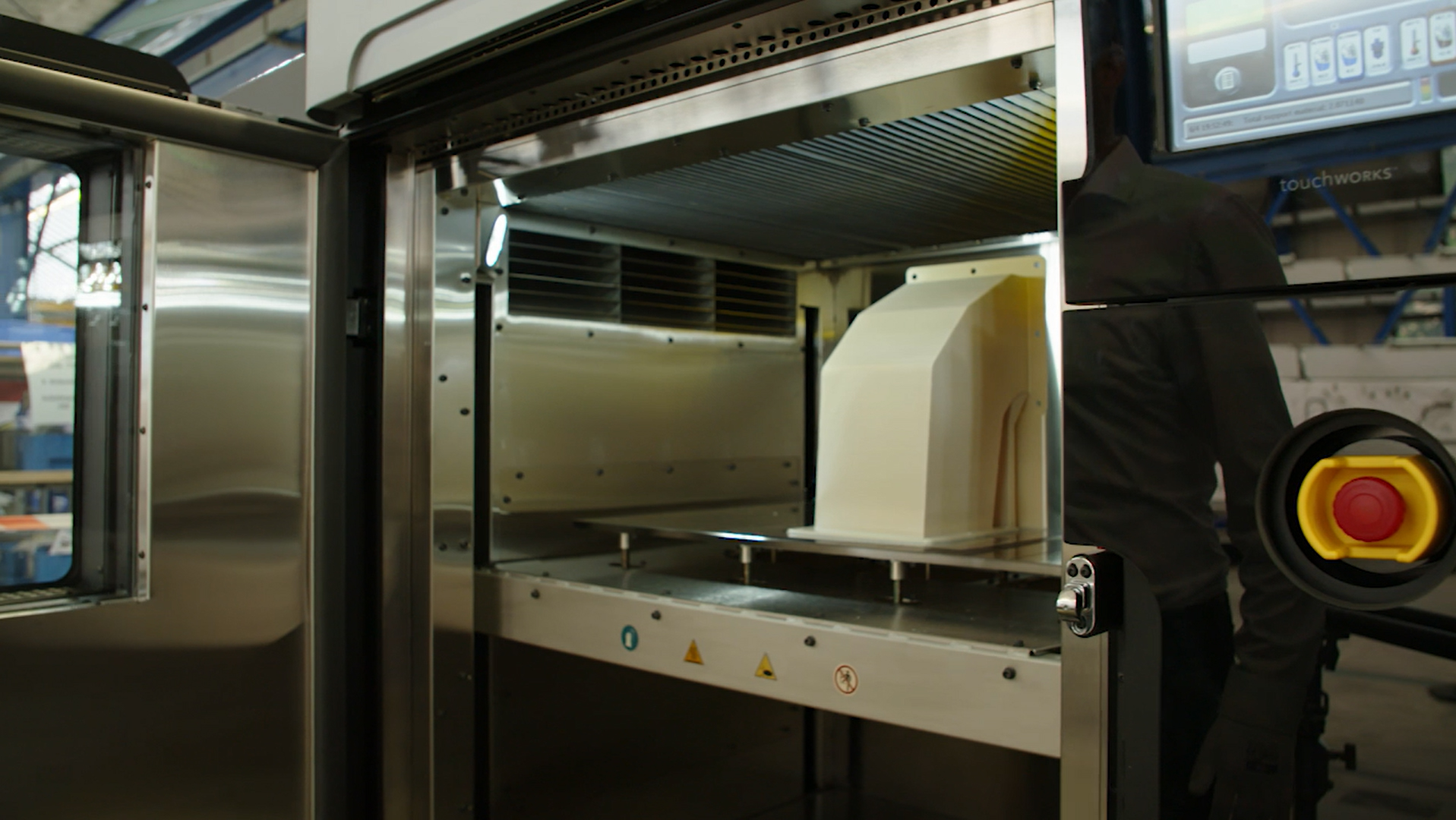
Bombardier Transportation is using the F900 3D printer to produce larger 3D printed vehicle components, such as this air vent system component. Image courtesy of Stratasys.
Why Rail Could Be a Particularly Good Fit
Rail is not necessarily looking to replace mass production with 3D printing. Spare parts may be a better fit. Trains can stay in service for decades, and some parts may no longer be available when they are needed. Keeping rarely used parts in storage is expensive, while making just a few new ones can take time and cost more. 3D printing offers another option: make the part when it is needed.
Stratasys says its rail customers are already focusing on tooling, inventories of spare parts and components used inside train cars, including footrests and handles. The company also sees digital inventory becoming a bigger part of the conversation. Instead of physically storing every possible replacement component, manufacturers can potentially maintain qualified digital files and produce some parts when needed.

3D printed grab handles installed on Chiltern Railways train. Image courtesy of Stratasys.
The idea of storing parts digitally and printing them when needed is not new. The harder part is making sure those parts meet the same standards every time. Companies still need to test the materials, check the finished parts, and make sure the process meets their quality requirements.
“The technology itself has advanced significantly, but many organizations are still building internal processes to qualify parts, document repeatability, and integrate additive manufacturing into existing quality management systems,” Kahlon pointed out.
From Printing a Part to Using It
The focus in rail is shifting from whether a part can be 3D printed to whether it can be used in production. That means meeting safety requirements, producing the same quality every time, and having a process that companies can approve and repeat.
For rail operators, this is especially important for replacement parts. Trains can stay in service for decades, and operators need to know that a part printed years from now will meet the same requirements as one printed today.
Stratasys sees similar needs outside rail. Kahlon pointed to automotive, heavy equipment, industrial machinery, and defense as other industries that could use the new glass-fiber-reinforced material. In rail, much of that work comes back to a simple problem: how to keep trains running when the parts they need are no longer readily available.
Subscribe to Our Email Newsletter
Stay up-to-date on all the latest news from the 3D printing industry and receive information and offers from third party vendors.
Print Services
Upload your 3D Models and get them printed quickly and efficiently.













You May Also Like
3D Printing News Briefs, October 10, 2026: Drones, WAAM, Ceramics, & More
We have a packed 3D Printing News Briefs for you this weekend! First, America Makes celebrated the recent National Manufacturing Day with 3D printed drones, and then it’s on to...
3D Printing News Briefs, October 3, 2026: Hypersonics, Hotends, & More
We’re starting off with defense in this weekend’s 3D Printing News Briefs, as Titomic was awarded a $5 million U.S. defense contract, and VulcanForms announced a partnership with Specter Aerospace...
The Part Is Only Half the Story: Why 3D Printing Needs a Digital Thread
A 3D printed part can generate a lot of information. The challenge is keeping track of it. Manufacturers need to know which design was used, what material went into the...
Advanced Manufacturing at IMTS 2026: 3D Printing and AI and Drones, Oh My!
Last week’s International Manufacturing Technology Snow (IMTS) in Chicago welcomed over 90,000 attendees to the jungle that is McCormick Place. With over 1.17 million square feet of exhibit space, and...