New Frontier Aerospace Wields Mjölnir, a 3D Printed Engine for Hypersonic Flight


In less than five years, startup New Frontier Aerospace (NFA) has successfully tested a new kind of rocket engine that could make spaceflight cleaner, faster, and more reusable.
In June 2025, the company announced it had successfully completed a series of hot-fire tests for its flagship Mjölnir rocket engine. Named after Thor’s legendary hammer from Norse mythology and the Marvel universe, Mjölnir is a compact, 3D printed powerhouse that combines next-generation design with sustainable fuel. According to the company, it’s not only the most advanced compact, pump-fed rocket engine ever built, but also one of the cleanest, running on liquid natural gas (LNG) that can be sourced from bio-waste, which makes it net carbon negative.
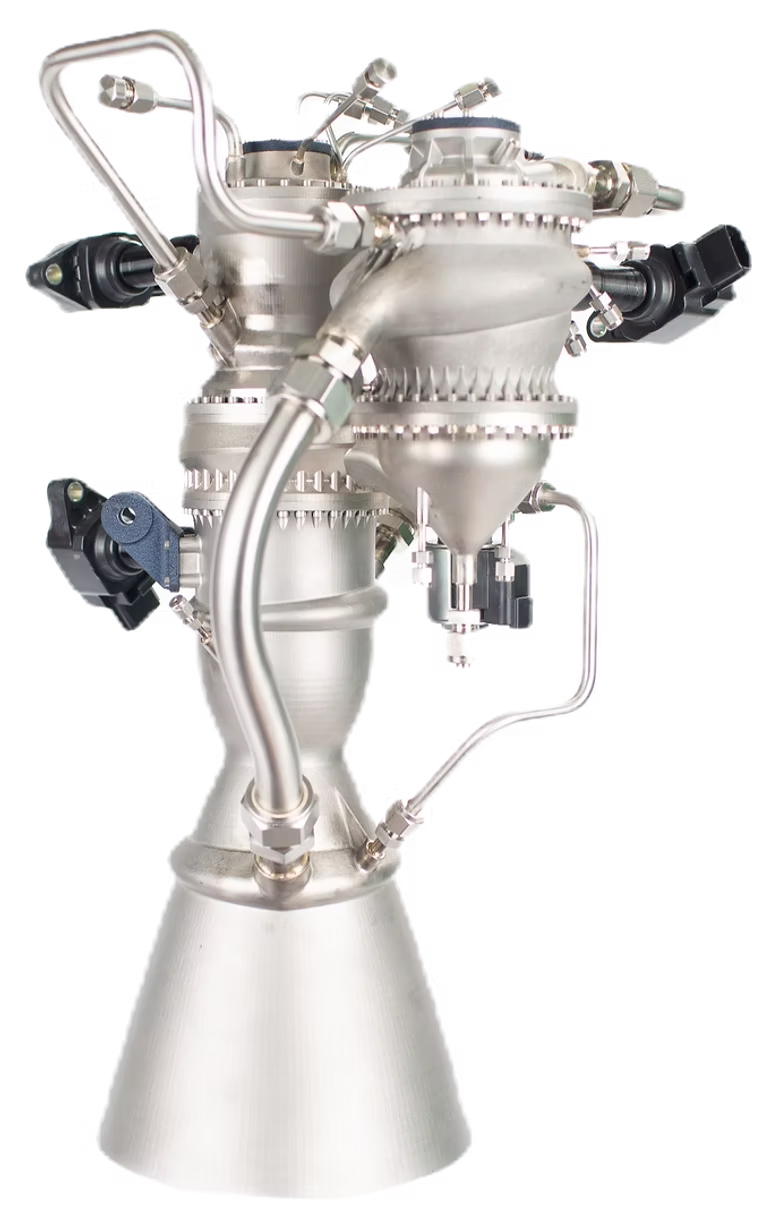
Mjölnir, 3D printed rocket engine. Image courtesy of NFA.
Mjölnir uses a specialized engine design that makes the most of its fuel by using all of it to cool and power the engine before it’s burned, which helps it run more efficiently. While this design has been explored by only a few major players (particularly SpaceX’s Raptor engine), NFA is now bringing it to market in a compact form.
The hot-fire tests showed that the engine works well and runs efficiently: “We are proud of the amazing team that built this program and thrilled with the engine’s performance during this series of hot fire tests. Mjölnir’s compact design, unmatched efficiency, and clean fuel make it a game-changer for hypersonic flight and space propulsion,” said NFA CEO Bill Bruner.
What’s It For?
Mjölnir is set to play a key role in NFA’s upcoming technologies. First, it will power the Pathfinder, a hypersonic unmanned aerial system (UAS) that can take off and land vertically, essentially a rocket drone. NFA expects Pathfinder’s first hovering test flight in early 2026.
The engine will also be used in the Bifröst, an orbital transfer spacecraft named after the mythical rainbow bridge connecting Earth and the realm of the gods in Norse mythology. It’s a great match for Mjölnir, and together the names show the company’s love for mythic references. It is actually similar to what SpaceX did with its sci-fi-inspired “Falcon” and “Dragon” spacecraft, names that pointed to big ambitions and a nod to pop culture.
Bifröst is scheduled to take flight in 2027. And beyond NFA’s fleet, Mjölnir is now available as a standalone product for customers building their high-performance rockets or hypersonic systems.

Rendering of lunar lander. Image courtesy of NFA.
Backed by Big Names
Developing a rocket engine from scratch is no small feat, and NFA didn’t do it alone. The early development of Mjölnir was made possible thanks to seed funding from the National Security Innovation Capital program, part of the U.S. Department of Defense (DoD)’s Defense Innovation Unit. What’s more, the most recent test series was backed by NASA, adding even more credibility to the project’s progress.

Rendering of military hypersonic VTOL. Image courtesy of NFA.
Compact, powerful, and environmentally responsible, Mjölnir is a great fit for today’s aerospace needs. As the space industry looks for reusable and fast-launching systems, there’s growing demand for engines that are both efficient and eco-friendly. NFA’s design, with its clean-burning fuel, matches the push to reduce carbon in space and defense technologies.
Plus, hypersonic vehicles that are capable of traveling at speeds greater than Mach 5 are viewed as critical for national security, global logistics, and even non-stop travel. An engine like Mjölnir could help make these types of vehicles more practical and widely available.
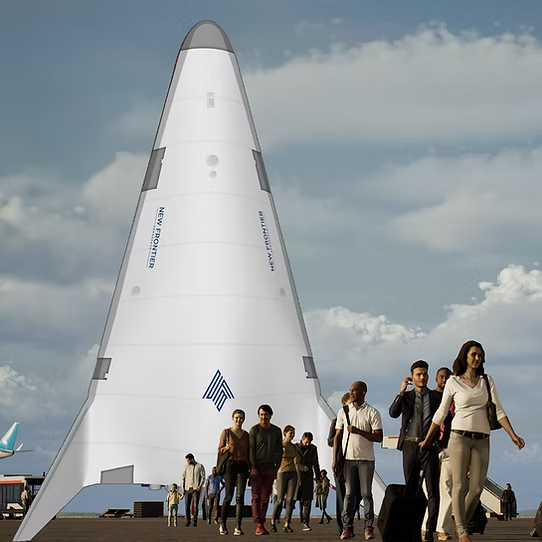
Rendering of civil hypersonic VTOL. Image courtesy of NFA.
With the first flights of Pathfinder and Bifröst on the horizon, and Mjölnir now available to other aerospace developers, NFA’s compact rocket engine could be a key enabler for the next wave of sustainable space and high-speed flight.
Subscribe to Our Email Newsletter
Stay up-to-date on all the latest news from the 3D printing industry and receive information and offers from third party vendors.
Print Services
Upload your 3D Models and get them printed quickly and efficiently.













You May Also Like
How One Artist Is Using 3D Printing to Tell Stories About the Ocean
Artist Kimberly Callas sees something different when she looks at a 3D printer. Where others see a machine for making parts, she sees a way to tell stories about the...
Bambu Lab Wants Home 3D Printing to Feel Less Like a Workshop with PLA Pure
As desktop 3D printers become increasingly common in homes, Bambu Lab is focusing attention on something beyond print speed and hardware features. This week, the company launched a new filament,...
AM Asia Watch: China Exported 2.46 Million 3D Printers in Four Months
China’s consumer 3D printer industry seems to be reaching a new level of global dominance. According to Chinese state media outlet China Global Television Network (CGTN), China exported 2.46 million...
Bambu Launches A2L: What the New Printer Reveals About Its Strategy
Bambu Lab continues its relentless march for 3D printing domination with the launch of the A2L. The 330 × 320 × 325 mm printer will have a nozzle temperature of...