D3House Uses Creality Technology to Make 11-Meter-Tall 3D Printed Jesus Sculpture


Digital technologies, like 3D scanning, 3D modeling, and 3D printing, have previously been used to create depictions of Jesus Christ and other important church figures. But at 11 meters tall, I think a recently 3D printed sculpture of Christ in Colombia may be the biggest one yet!
Comuna 13 is one of 16 communes in Medellín, Colombia, which is the country’s second largest city after Bogotá. Associated with bright colors, graffiti, and street art performance, the neighborhood is celebrated for its vibrant culture. It’s also a very popular tourist spot, and is home to D3House, a visionary team of designers supported by Creality.
Led by CEO Alejo, a mechatronics engineer, and his co-founder Juanes, a civil engineer and real estate developer, the diverse team at D3House is filled with visionaries in a variety of specialized roles. They work on many interesting projects, like a 3D printed sculpture of the mythical goddess Pachamama, who was worshipped by ancient Andean peoples; this 4.5 meter tall sculpture is also located in Comuna 13. The team used lessons they learned making the Pachamama sculpture to perfect modular 3D printing before tackling what D3House says is the largest 3D printed Christ sculpture in Colombia.

Pachamama sculpture in Comuna 13. Image via D3House.
15 Creality 3D printers were used to produce nearly 1,699 lightweight modules to build up the sculpture. Specifically, the K1 Max was chosen for its upgraded Unicorn nozzle, which helped prevent jams and increased print efficiency by 30%, while both the K1 and Ender-3 V3 offered high-speed printing with precision. The team selected PLA filament for its lighter weight, sustainability, and strength, plus its ability to achieve fine details, like textures and creases. A total of 245,637 grams of PLA were used, while fiberglass helped facilitate post-processing of the sculpture modules, which were like hollow puzzle pieces.

Christ sculpture in Comuna 13. Image via D3House.
Going with a puzzle-like design for the modules was important, because D3House was able to reduce the weight of the sculpture by 40% in comparison to traditional manufacturing methods. Plus, by breaking the sculpture up into these smaller pieces, the team could print simultaneously across multiple machines. To keep the 3D printed Jesus sculpture durable and rigid, they applied layers of fiberglass with epoxy resin to both the interior and exterior of the shells; this made the pieces resistant to rain, wind, and even erosion. Plus, it enabled the team to capture more intricated details, such as fabric folds and facial expression.
The team used a real-time dashboard system to track printer assignments, the exact amount of PLA consumption per unit, and the progress of each phase. This system helped them more efficiently reallocate resources, detect immediate deviations in the modules, and supposedly complete the sculpture with just 2% wasted material. The sculpture was completed in only six months, broken down into 3.2 months of active 3D printing and 2.8 months of post-processing and assembly, which included reinforcing the fiberglass, adding structural joints with internal steel, and surface finishing. So it was quite the coordinated effort!

Team D3House at Creality’s Headquarters
In the production center, print operations were overseen by Pedro García and Juan Galindo, who keep all 15 printers running smoothly. In charge of the technical and maintenance area, Daniel Bolívar worked to achieve uninterrupted print performance, while Santiago Saldarriaga refined the geometry of the 3D printed modules to enable a seamless assembly process. Finally, José Román handled all the post-processing and finishing.
It seemed like the project was in peril at one time, when all 15 of the Creality printers were working at capacity limits and several failed at once. Progress stalled at 40% for 72 hours, because the team didn’t have specialized tools for rapid repairs, or a full maintenance team to complete any repairs. This was a critical juncture, but D3House came through it with shining colors by redesigning their strategy on the fly. Operational printers were reassigned to priority modules, and preventive maintenance shifts took place every eight hours. To gain back some time, the team also adapted critical parts with strategic cuts. Because of this crisis, D3House will incorporate 30% redundant capacity in all future projects.
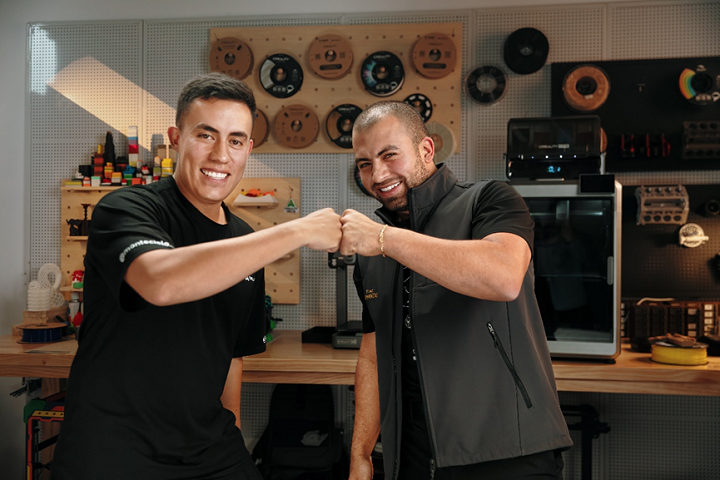
D3House CEO Alejo and Co-Founder Juanes at Creality Workshop
The Christ of Comuna 13 was successfully completed and installed, and has now become a cultural landmark and tourist attraction. Additionally, the government is now interested in the possibility of 3D printing for more public art, and even infrastructure. This 11-meter-tall “symbol of peace” is a great example of how 3D printing can speed up production, decrease material waste, and create appealing, sustainable public art.
D3House hopes to outdo itself soon by fabricating an 86-meter-tall Cristo del Peñol, which could be the tallest 3D printed statue in the world. Additionally, the project will feature an onsite 3D printing operations center, so the public can witness the sculpture being produced live.
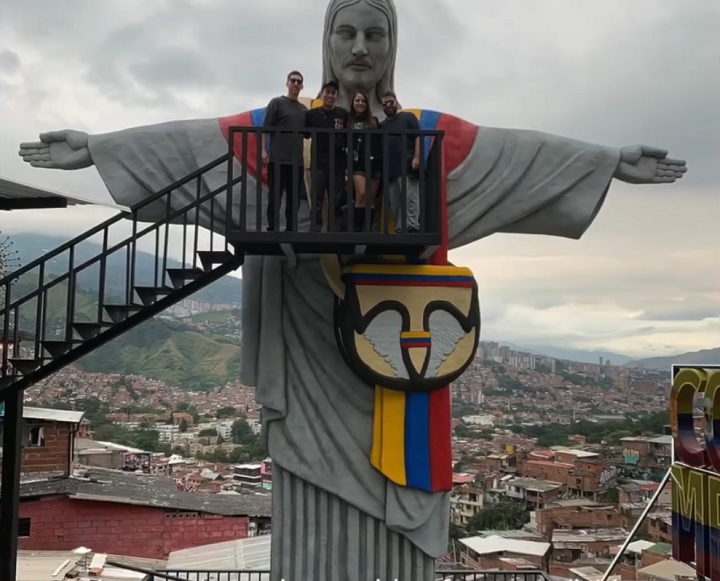
Screenshot from video via Creality’s Facebook
Subscribe to Our Email Newsletter
Stay up-to-date on all the latest news from the 3D printing industry and receive information and offers from third party vendors.
Print Services
Upload your 3D Models and get them printed quickly and efficiently.













You May Also Like
$51 Million Revenue VMP Wants to Become a Leading Additive Manufacturing Metal Powder Producer
Chinese powder producers have traditionally had little impact on the additive manufacturing market. Typically, they offer low-cost powders without much in the way of settings or application support. But China’s...
SprintRay Releases Midas Restore
SprintRay‘s new U.S. Food and Drug Administration (FDA)-cleared Midas Restore is a material for restorative dentistry. The ceramic-doped resin is meant for definitive inlays, crowns, and veneers. The resin has...
Alibaba Selling Fiber Optic Military Drones for $200
Ukraine was saved by Turkish-made Baykar Bayraktar drones and many brave soldiers in the first stages of the conflict. Then hobbyists and their DJI Mavics showed how drones could be spotters...
The Formlabs Shuffle
For the latest development on 8/31/26, please see an update at the end of this article. Formlabs is doing a management shuffle, pointing the firm even more surely towards an...