Phasio and AMIS Partner to Streamline 3D Printing Workflow


Phasio and AMIS will partner to join up both their software tools. Belgian firm AMIS has a build prep and workflow solution for binder jetting and powder bed, while Phasio is a digital shop, client communications, quoting, and workflow tool for machine shops. The pair hopes to offer an integrated solution that will make life easier for digital manufacturing services. The idea is that Phasio handles the quote, files are sent to AMIS, which generates the nesting and build, while files are then stored in Phasio.
Phasio CEO Conor Lucas said that,
“We are thrilled to join forces with AMIS. This collaboration is a natural extension of our commitment to enhancing user experience. Our integrated solution not only accelerates processes but also improves overall accuracy, ultimately reducing manual errors and freeing up valuable resources for more strategic tasks.”
AMIS Managing Director Kris Binon meanwhile said,
“Our collaboration with Phasio represents a significant step forward in providing our clients with a seamless digital ecosystem. The combined strengths of our software platforms deliver a comprehensive solution that meets the evolving needs of today’s AM print service providers and production companies alike.”
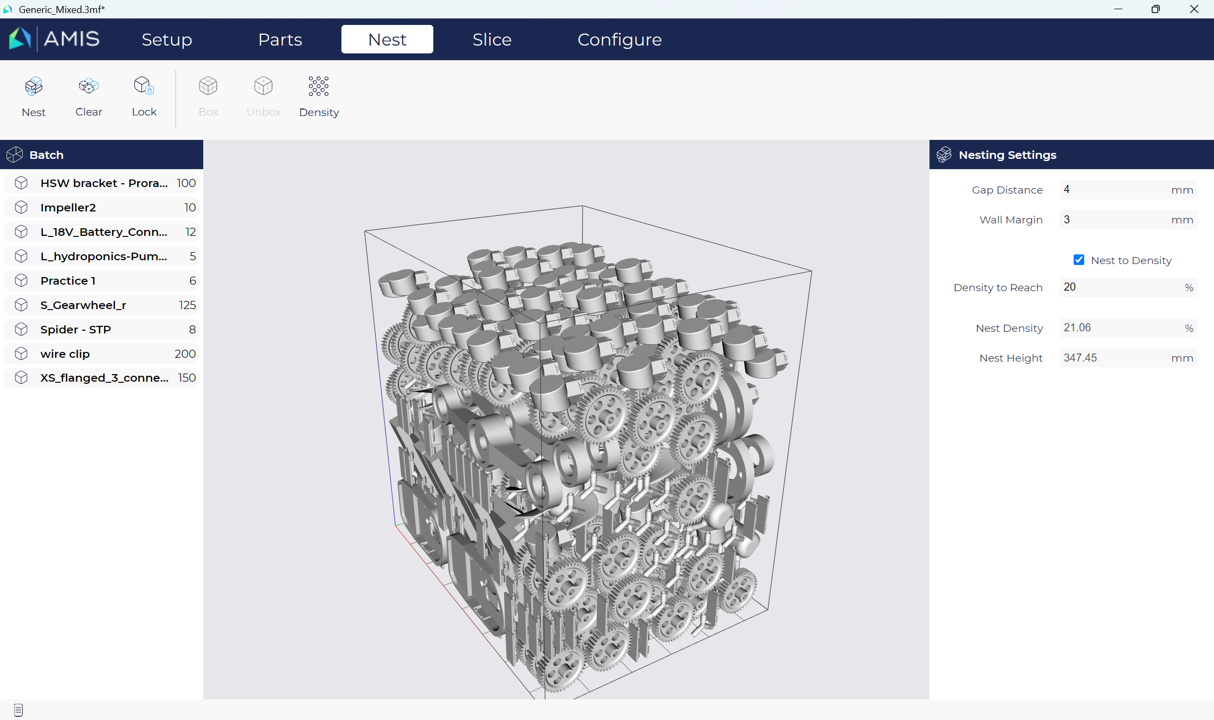
The two hope that the combined solution will speed up quoting and file checking by users while reducing manual errors. AMIS is an automated nesting tool that can detect part overlap. You could use the tool to analyze and build single files or entire builds. The tool can repair parts and automatically resurface parts as well.
Materialise has been the dominant software player in Additive for many decades now. Focusing on build prep, the company has a host of tools that deal with your files and workflow. Over the past five years, a gaggle of 3D Printing and digital manufacturing startups has emerged. Usually, these tools focus on a small part of the entire Additive Manufacturing workflow or operation. Precisely focused and usually subscription-based, these startups want to deliver value and grow with comparatively small teams. They don’t aim to replace Materialise but rather become a standard part of the daily workflow. And then, of course, with this as a base, some may set their sights on the crown.
To counter this, Materialise has a COAM strategy to get these companies to sign up for its platform. Offsetting marketing and sales costs could very well be beneficial. But, another trend is emerging, that of these relative minnows joining forces. Just recently Synera and PanX joined forces as well to extend Synera’s marketplace. Everybody wants to be Salesforce, just not in the same way.
With these smaller firms, it is often difficult to see who delivers value to whom. But the general idea is that together, they are stronger. For clients, one single sign-in and one environment is the thing that makes the most sense. As long as they have all the requisite tools and can access them easily, they can care less about who makes them. There is, therefore, a lot of value in cobbling together the entire value chain. I’d expect more M&A activity as players such as Hexagon build and buy the whole value chain.
Meanwhile, other players new to the industry may adopt a similar approach. For companies like Siemens or Autodesk, these tasty little morsels can also extend their tools and increase their subscription revenue. It would be great if, aside from this, we also see a kind of Voltron come forth out of these smaller firms. A combined solution seamlessly weaving together smaller solutions could become a credible opponent to the big guys.
Subscribe to Our Email Newsletter
Stay up-to-date on all the latest news from the 3D printing industry and receive information and offers from third party vendors.
Print Services
Upload your 3D Models and get them printed quickly and efficiently.













You May Also Like
Metal 3D Printers for the Desktop Are Finally Starting to Feel Like Desktop Products
FDM 3D printing is becoming increasingly accessible, yet metal 3D printers designed for everyday desktop use remain rare on an ordinary workbench. The real challenge is not making a metal...
What 3D2GO Says About 3D Printing’s Growth in Southeast Asia
The Philippines offers an interesting case study in how 3D printing can develop in Southeast Asia, and Manila-based 3D2GO helps illustrate it. 3D printing in Southeast Asia doesn’t have to...
The Frankenservice Part 2: Have Your Cake and Eat it Too
This series of articles delves into a thought experiment. What if we let go of using a few machines very optimally, but instead use lots of different machines to meet...
Silencer Market Set to Test Metal Additive’s Readiness for Production Prime Time With Enormous Market Expansion
Throughout the history of additive manufacturing (AM) technologies, there are only a couple of really interesting case studies in which we see a market significantly disrupted and revolutionized by AM....