The Importance of Services in 3D Printing: Steady Growth and Promising Potential

Additive manufacturing services are often underestimated in our industry, with the spotlight focusing on hardware, software, and the products they enable. Industry coverage and public perception frequently center on major hardware manufacturers’ achievements (or downfalls).
However, a deeper analysis of market data reveals a different trend: the services sector is steadily growing and gaining importance, demonstrating resilience to the volatility of hardware markets.
Services are a Growing Market Segment
A December 2024 report by Additive Manufacturing Research underlines the robust and consistent growth of AM services.
The sector totaled $1.9 billion in Q3 2024, reflecting an impressive 14% year-over-year increase, with an annual volume of AM services now exceeding $7 billion. In comparison, the overall market – which encompasses hardware, software, and materials – registered a 9% year-over-year growth, while hardware sales show signs of deceleration.
Also, industry experts surveyed by All3DP Pro on the 2025 trends seconded a clear shift toward applications and services in the AM landscape. AM companies increasingly move beyond selling standalone technology to offering comprehensive solutions for manufacturing challenges. This transition reflects a growing focus on delivering applications and value-added services rather than just selling equipment.
Services are an Important Pillar of the AM Ecosystem
Services are integral to the additive manufacturing ecosystem, particularly in an economy that thrives on specialization and adaptability. Businesses can outsource the technology and expertise required for production, leveraging external service providers for preliminary and finished products.
The benefits are clear.
- Cost efficiency and timeliness: Parts and components are produced on demand, in the required quantities, with specific material properties, and at competitive prices.
- Flexibility: Aggregated service platforms, such as marketplaces, provide access to diverse manufacturing processes, materials, and finishes, ensuring almost endless customer possibilities.
- Cross-industry applications: Service platforms are not confined to vertical markets, making them suitable for all customers across all industries.
The rise of professional service platforms and marketplaces, which combine multiple manufacturing capabilities, transforms how customers think about the production and procurement of parts. They now have access to comprehensive manufacturing ecosystems beyond AM, providing flexibility and cost-effective solutions locally and globally.
Although 3D printing often gets attention for its high-tech applications in industries such as aerospace and automotive, its real, untapped potential of services lies in addressing low- and medium-complexity manufacturing across a range of sectors. AM services facilitate access to global supply chains, enabling efficient parts sourcing for more than industrial applications. Adoption often starts on the shop floor and even at home. Utilizing the power of services, professionals and private people get access to technologies beyond their financial scope, allowing them to quickly test and try without considerable investment and bring AM closer to their everyday use.
Success Factors for Service Platforms
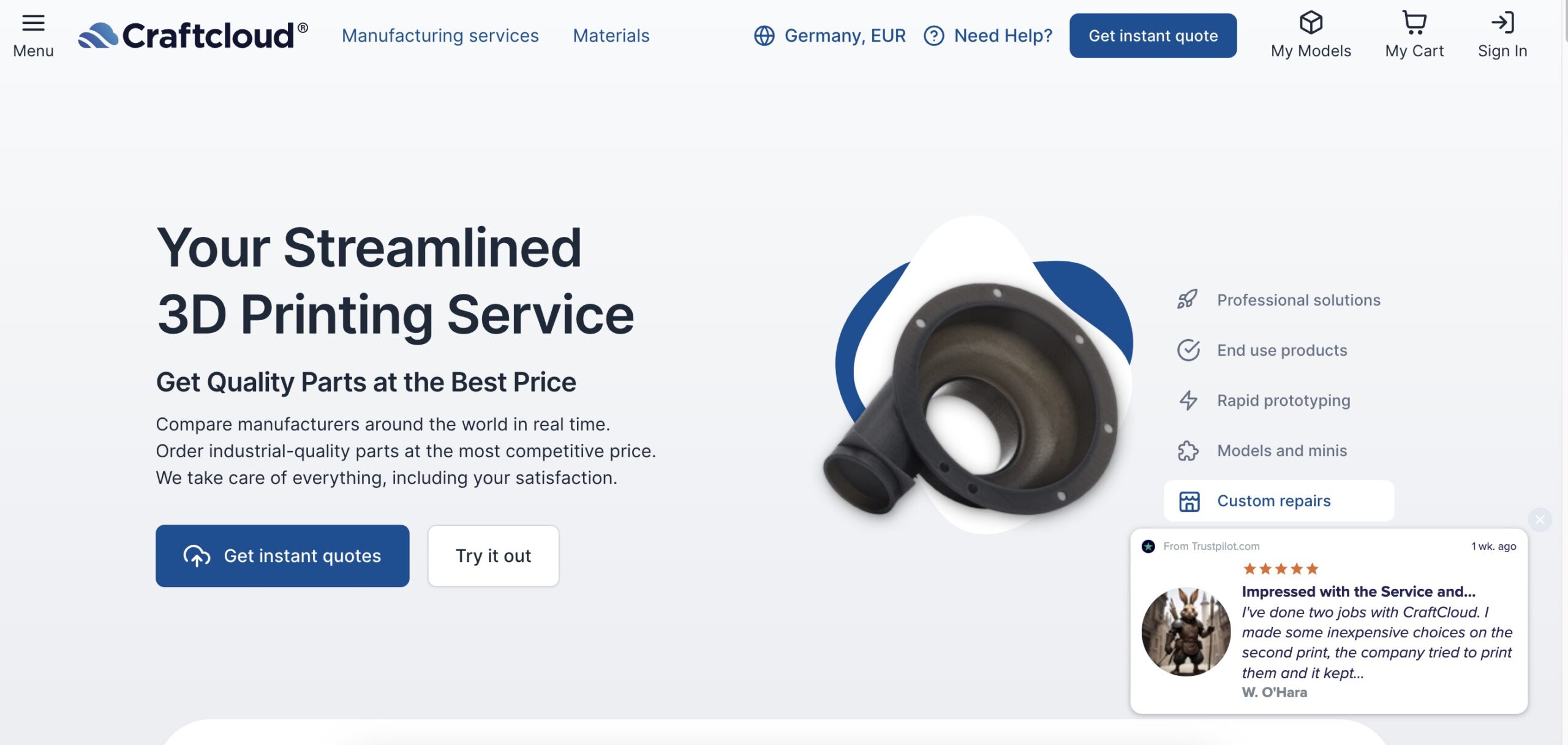
Craftcloud is a fast-growing marketplace for 3D printing services. Image courtesy of All3DP.
Platforms like All3DP’s Craftcloud exemplify the success of 3D printing services. With a network of over 200 AM service bureaus – ranging from large-scale manufacturers to smaller, specialized service bureaus – Craftcloud enables highly flexible order management across various technologies, materials, and locations. Other notable platforms include Xometry and the re-emerging Shapeways.
The integration of complementary technologies, such as CNC machining and injection molding, further enhances these platforms’ value propositions, positioning them as one-stop solutions for the modern manufacturing customer. Their ability to dynamically balance priorities such as cost, delivery speed, and production quality ensures high customer satisfaction and repeat engagement.
Services matter. They are a reliable factor for stable growth in an AM environment that is otherwise characterized by volatility in these days.
 About the Author

Mathias Plica is the CEO and Co-Founder of All3DP GmbH, a Munich-based company that operates Craftcloud, a marketplace for 3D printing services and All3DP.com, the world’s leading 3D printing magazine. With over three decades of experience in digital publishing and entrepreneurship, Mathias holds an economics degree from Ludwig-Maximilians-Universität München. He previously co-founded and led CHIP Online and has been at the forefront of innovation in the digital space.
Mathias Plica will participate at Additive Manufacturing Strategies, Feb 4-6 in New York City.
Subscribe to Our Email Newsletter
Stay up-to-date on all the latest news from the 3D printing industry and receive information and offers from third party vendors.
Print Services
Upload your 3D Models and get them printed quickly and efficiently.













You May Also Like
Solukon Goes Big with New SFM-AT850 Depowdering System
Solukon has released the SFM-AT850 depowdering system. The German depowdering specialist has updated its product line, and this machine replaces the SFM-AT800-S and SFM-AT1000-S. Rather than many small parts, this...
The Hidden Economics of Powder Bed 3D Printing: Closing the Loop in Powder Management
Automation is a very topical thing in additive manufacturing at the moment. With renewed scale, some clients are fervently looking to automate production. Other business cases only make sense with...
Oerlikon Adds ATLIX’s xBUILD 5000, Plans More for 2027
Oerlikon has installed a new ATLIX xBUILD 5000 metal 3D printer at its facility in Huntersville, North Carolina, marking the first production deployment of the system worldwide. The machine will...
The Science Lab You Can 3D Print
Researchers at Sweden’s Umeå University have shown how desktop 3D printers can be used to make lab equipment, giving scientists a cheaper way to build tools for their research. The...