
Chinese Researchers 3D Printing Lotus Root Scaffolds for Bone Implants

Over the years, we’ve seen numerous examples of 3D printing used to make scaffolds for bone regeneration, but this is the first time I’ve heard of this type of material being used for it: lotus root. The perennial, aquatic lotus plant mainly grows in Asia and Australia, and its subterranean stem, or root, is often used as an ingredient in many Asian dishes, including soups and salads. But for the last ten years, researchers at Wuhan Polytechnic University’s School of Food Science and Engineering have been extracting fibers from lotus roots for a very different reason.
One of the main researchers working on the project, Professor Jiang Xueyu, says that lotus roots are very rich in fiber, which is one of the reasons why they’ve chosen to use this unique material. According to a news outlet in Hubei, China, the team is using the lotus root fibers to make 3D printed, customized bone scaffolds for supporting cell regeneration in bones. If their work is able to be adapted for clinical use, the technology could majorly improve patient recovery, as well as significantly lower treatment costs.
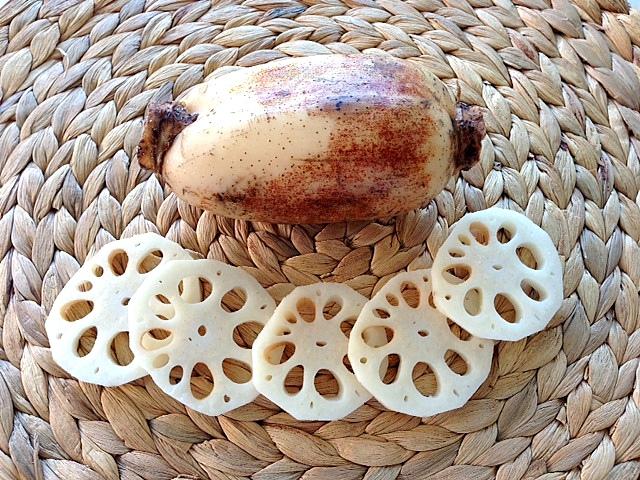
Lotus root. Photo by Heather Teoh via the Food Literacy Center
Bone implants are medical devices that are surgically inserted into the body to augment, or even replace, bone tissue. Steel implants are not always compatible, and larger surgical incisions are often needed to insert them, which can increase a patient’s recovery time. While bone itself can have self-healing abilities, grafts are necessary to restore the tissue, which come with their own complications. That’s why there’s been plenty of research on substitute bone materials, like 3D printed ceramics, coral, and now lotus root.
The 3D printed lotus fiber scaffolds are tailored to specific bone defects, and the researchers say they integrate naturally with the body (as opposed to traditional steel implants), encouraging bone cell growth along the structure. This will majorly speed up the patient’s healing process. Additionally, a second surgery is likely not needed to remove these implants because they are said to degrade at a rate that matches the formation of new bone. The research team’s work is currently undergoing animal trials.

3D printed materials from lotus root fibers.
However, according to Professor Yi Yang, who’s leading this research team, “their innovations extend beyond medical applications.” Yang claims that their work has actually changed how lotus root is processed as a food ingredient. Normally, lotus root starch production methods produce a lot of unnecessary wastewater, and get rid of some important nutrients. So Professor Yang’s team developed “whole lotus root powder,” which not only improves the flavor and versatility of the plant, but also preserves all of its nutrients.
The team also learned that if you gelatinize lotus root powder, it has some unique gelling and rheological properties. This makes it great for 3D printing foods, and their lotus root breakthrough has actually inspired a number of new edible products, such as lotus root-infused fish cakes, instant beverages, and even probiotic-enhanced snacks.
Subscribe to Our Email Newsletter
Stay up-to-date on all the latest news from the 3D printing industry and receive information and offers from third party vendors.
Print Services
Upload your 3D Models and get them printed quickly and efficiently.













You May Also Like
Metal 3D Printers for the Desktop Are Finally Starting to Feel Like Desktop Products
FDM 3D printing is becoming increasingly accessible, yet metal 3D printers designed for everyday desktop use remain rare on an ordinary workbench. The real challenge is not making a metal...
3D Printing Financials: 6K Additive Sales Rise as Aerospace and Defense Demand Grows
6K Additive (ASX: 6KA) grew rapidly in the first half of 2026 as demand for its metal powders increased, particularly from aerospace and defense customers. The newly public company also...
When Data Becomes the Differentiator: Qualified Material Data is Changing the Future of Structural Additive Manufacturing
For years, additive manufacturing has promised engineers greater design freedom. The challenge wasn’t printing the part—it was proving the part belonged on an aircraft. Designing a lightweight bracket or consolidating...
Amaero Builds U.S. Metal Powder Capacity for Additive Manufacturing
For metal additive manufacturing (AM) to grow in the United States, companies need more than printers. They also need a reliable supply of the powders that go into those machines....























































