LOOP 3D Reveals 3D Printer Designed for Industrial Uptime

LOOP 3D has released the LOOP PRO X+ TURBO Gen2. This version has been improved to meet the needs of manufacturing clients. The printer is meant to be a production unit that can scale from single parts to higher volume print jobs. Upgrades have also been made specifically for CF- and GF-type materials. The printer is open but has optimized settings for the company’s own Dynamide material family. The LOOP 3D Cloud software works in the browser. The tool tracks builds and settings, you can remotely monitor prints and subdivide files and settings per project or client. The tool includes a remote access option for tech support.
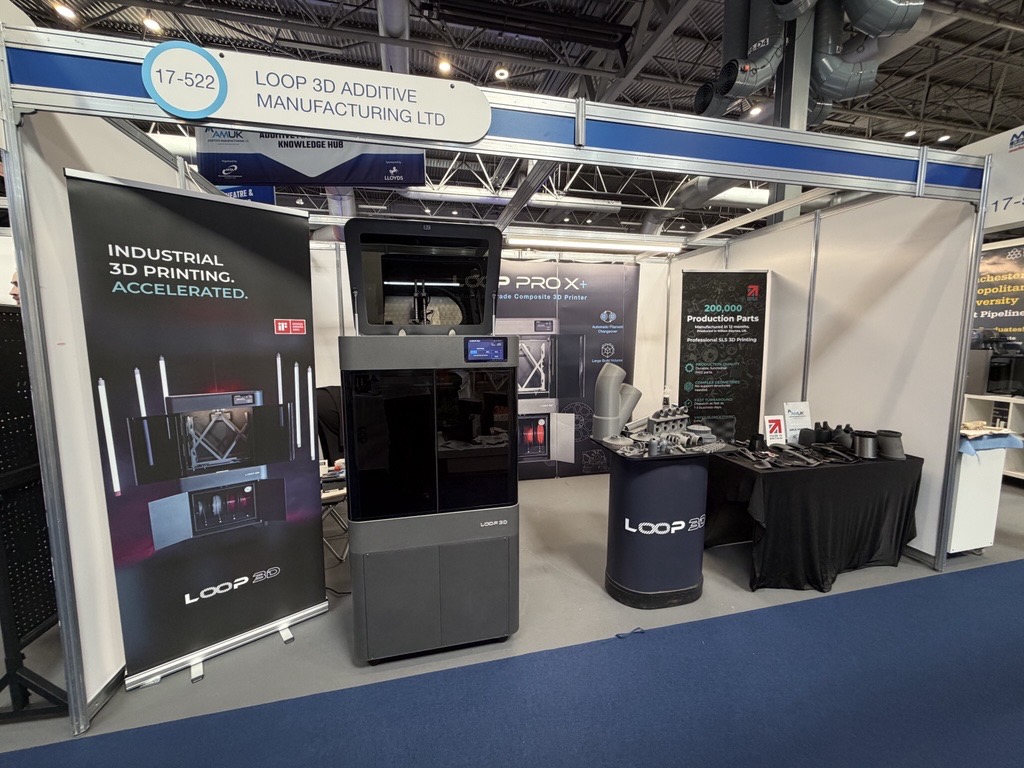
LOOP 3D booth at the MACH 2026 trade show in Birmingham, UK. Image courtesy of LOOP 3D.
The 500 x 350 x 500 mm printer is made from a milled aluminum chassis and comes with a flexible spring-based build platform with PEI (polyetherimide) build sheets. The printer has a modular architecture, and the idea is that it will be easier for users to replace components. One module consists of the controller board and motor drivers; another consists of all the UI (user interface) and communications. The two high-flow printheads are swappable, and it comes with HEPA (high-efficiency particulate air) and carbon filters. A unique feature is automated sliding doors, which could be very cool. There’s an automated filament changeover in case of runout as well, while a material bay can hold four filaments. Motion comes from servos and linear rails.
-
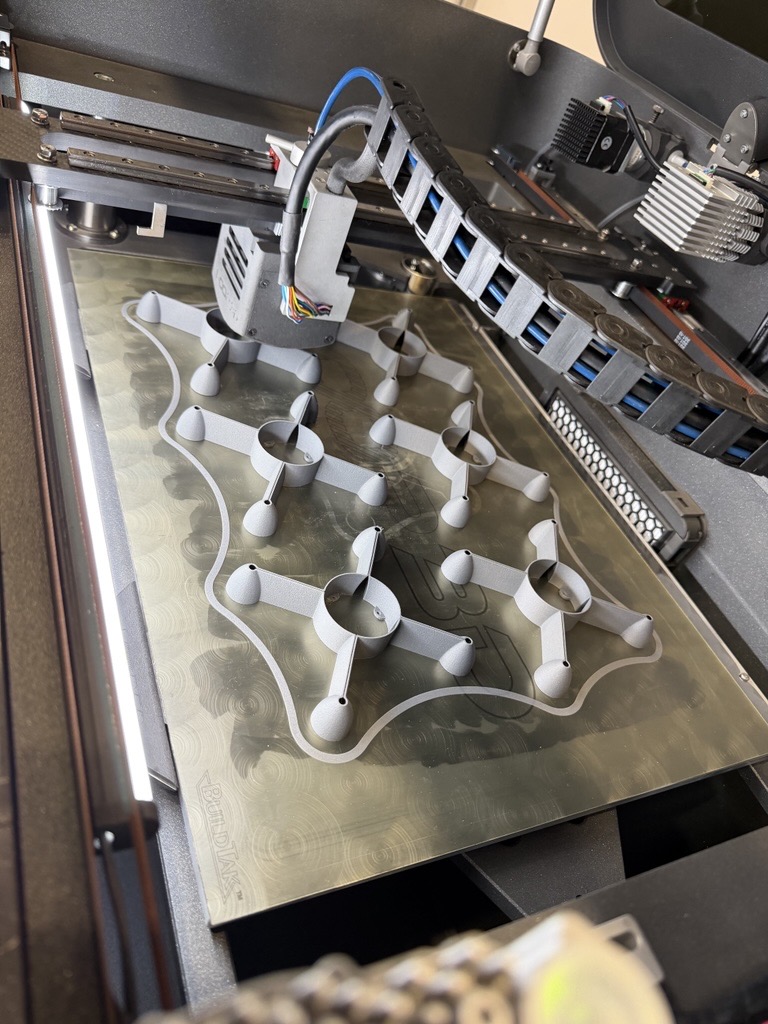
- A mini interceptor drone body is produced approximately every 30 minutes at the LOOP 3D booth at MACH 2026 trade show in Birmingham, UK. Image courtesy of LOOP 3D.
-
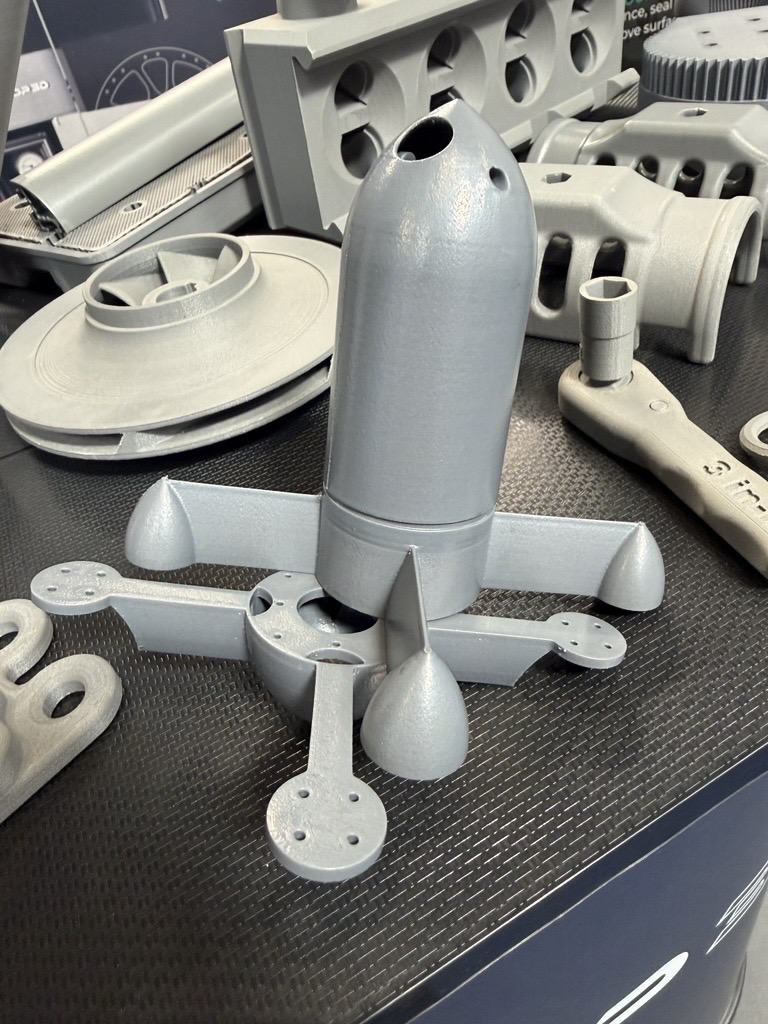
- A mini interceptor drone body is produced approximately every 30 minutes at the LOOP 3D booth at MACH 2026 trade show in Birmingham, UK. Image courtesy of LOOP 3D.
The overall architecture is H-Bot, with H-Bot one belt loops around the gantry in the form of an H. This belt can move very quickly but may cause racking, making the gantry lopsided or out of spec when pulled in one direction. LOOP solves this by having a durable, massive aluminum chassis that weighs 170 kilos. That also helps mitigate vibration, leading to more stable prints. Core XY printers use multiple belts working simultaneously, pulling from both ends. Core XY printers can therefore be fast and cheaper because the chassis doesn’t have to be as durable or heavy. That’s one of the keys to Bambu Lab‘s success, making something quick that doesn’t have a ton of metal in it. With shorter belts, less jumping about with crossed belts H bot architectures can be much more stable, quick, reliable and repeatable. Racking, meanwhile, can be reduced through the linear rails and heavy chassis elements. Bambu tries to get around the errors and vagaries of Core XY through software compensation, while the LOOP has a more industrial, reliable architecture and frame. The two approaches are fundamentally different: Bambu bets it can be a better software company than anyone else, while companies like LOOP aim to engineer a well-functioning device primarily through mechanical engineering.

The new system has improved kinematics and a renewed motion system. I really like the design and philosophy behind LOOP. These systems are solid. I like the modular architecture as well. This would really make sense in areas such as hospitals, the military, or oil platforms, where you want high uptime and easy, local paths to mitigating errors.
CEO Erkan Ustaoglu said,
“The Gen2 is built for one purpose: production. Every subsystem has been engineered to push speed, reliability, and consistency to the next level. This is where additive manufacturing stops prototyping—and starts delivering at scale.”
Against the onslaught of Bambu & Co, LOOP has a real uphill struggle. But reliable, long-lasting, and easy-to-maintain systems will be in high demand across many industries. Especially in strict regulatory environments or where many people need to use common printers, the LOOPL architecture and offering make a lot of sense. Their ease of use and quick maintenance fixes are paramount. Yes, something else can be cheaper, but it needs to work on the day. If LOOP offers complete solutions for specific industries, working with partners and users to deliver the exact performance, certifications, and value proposition they need can be highly successful. Industry-specific solutions that work even when knocked about, with gloved hands, or in dusty environments remain an unmet need for many users. And for these kinds of applications, this really seems like a good option.
Subscribe to Our Email Newsletter
Stay up-to-date on all the latest news from the 3D printing industry and receive information and offers from third party vendors.
Print Services
Upload your 3D Models and get them printed quickly and efficiently.













You May Also Like
The Manufacturing Race Behind the Drone Revolution
We are in the middle of a major manufacturing shift focused on the production speed and payload capacity of uncrewed aerial systems (UAS), or drones. A recent Manufacturing Dive article...
ADDMAN to Buy Up to $10.8M in Nickel 718 Powder from 6K Additive Over 30 Months
After years of buildup, we’re finally starting to see what the US metal additive manufacturing (AM) market could look like at scale. To be sure, it’s still not quite there,...
Metal AM in a Multipolar World, Part 2: How PBF and DED Could Change by 2035
The first decades of PBF development were heavily shaped by machine capability: more power, more lasers, larger build volumes, better recoating, and improved process monitoring. These developments will continue, but...
Advanced Manufacturing at IMTS 2026: 3D Printing and AI and Drones, Oh My!
Last week’s International Manufacturing Technology Snow (IMTS) in Chicago welcomed over 90,000 attendees to the jungle that is McCormick Place. With over 1.17 million square feet of exhibit space, and...