Backflip Launches AI for 3D Scan-to-STL

Trinckle has attempted something similar for fixtures, as have other companies striving to make CAD more accessible and user-friendly. Now, Backflip aims to use the so-called magic sauce of AI to tackle this problem. AI—the universal mayonnaise for investment hype and future promises—could either accelerate market growth significantly or fuel yet another wave of optimism around an immature technology.
Backflip is launching a SOLIDWORKS plugin and a web app designed to help firms create engineering parts more easily. While text-to-STL has proven effective for generating fun and creative files, producing parts with precise dimensions that can properly mate with other components has remained a challenge.
The SOLIDWORKS plugin aims to convert 3D scan data directly into native SOLIDWORKS files with a feature history, while the app transforms scans into parametric CAD models that can be easily modified. This approach eliminates the need for manual measuring and recreating parts from scratch, significantly reducing downtime. While 3D scan repair software like Geomagic has been around for some time, and simpler 3D scanning solutions like Comb exist for orthopedics, Backflip’s AI is designed for broad industrial applications, making it a potentially transformative tool.
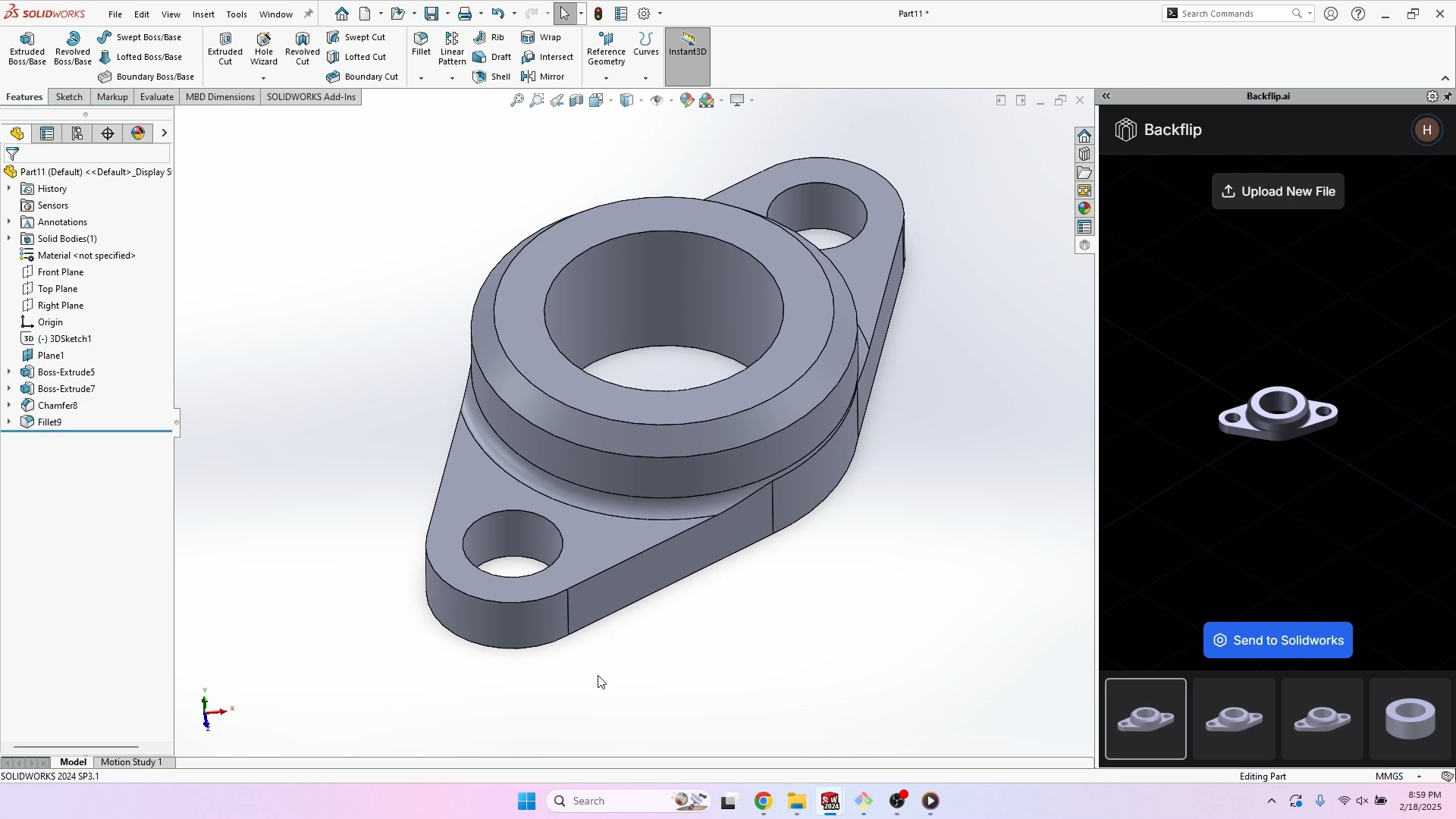
A bearing mount block automatically reconstructed from a 3D scan with native SOLIDWORKS features using the Backflip plugin
In general, resurfacing a file is easy to do—badly. However, resurfacing point clouds and other scan data with precision, so they can be effectively used for technical parts, has been a challenge. This process typically requires human intervention to ensure accuracy and usability
“3D scanners map the surface of an object with incredible precision, quickly generating millions of data points, but they produce micro surface textures that can’t be manufactured with traditional tools. Our technology automatically converts these intricate surfaces into clean geometries designed for existing 3D CAD and manufacturing software,” said Greg Mark, Backflip CEO and Cofounder.
“These new developments are the result of Backflip’s continued R&D investments in neural representation of 3D data. We’ve paired state-of-the-art AI/ML techniques with the team’s deep background in manufacturing to create a really powerful technology foundation. Our additional focus on resource-efficiency enables us to advance rapidly, and yields 60x more efficient training, 10x faster inference, and 100x the spatial resolution of existing leading methods,” said Backflip’s Head of AI, Logan Ford.
Plugin
The plugin aims to show users how a part has been created while providing even beginners with options to easily adapt the model. It also generates a native feature history, which allows engineers to tweak the design as needed and helps newer users learn how CAD parts are structured. By breaking down the process step-by-step, Backflip is not just automating CAD but also making it easier for more people to enter the field.
The underlying model has been trained on the “world’s largest” synthetic dataset of over 100 million unique 3D geometries, though the company has yet to disclose an official release date.
For decades, converting scans into functional 3D-printable files has been a significant challenge. While progress has been made, and automated workflows exist for specific applications—including medical ones—a universal scan-to-STL workflow for all types of scans and working parts remains an incredibly difficult problem to solve.
The key challenges lie in adapting data, stitching, and resurfacing scans without introducing unwanted changes—tasks that seem nearly impossible to fully automate. If the team has truly solved these issues, it would mark a major advancement for the industry. However, it remains unclear whether the system can process mobile phone scan data or which types of scanners it supports.
A broad range of users could benefit from this technology if it works well with simple scanners. If it can reliably produce engineering parts, it will be a major advantage. However, any tedious, time-consuming failure—where a part turns out unusable after hours of processing—will quickly discourage adoption.
I’ve been using Backflip extensively and am impressed with the variety of parts it can generate. If it truly enables seamless creation of engineering and technical components, I’ll be more than impressed.
Subscribe to Our Email Newsletter
Stay up-to-date on all the latest news from the 3D printing industry and receive information and offers from third party vendors.
Print Services
Upload your 3D Models and get them printed quickly and efficiently.











You May Also Like
Velo3D Becomes First Qualified AM Vendor for US Army’s Ground Vehicles Program
One indicator that I’ve used to help me track the additive manufacturing (AM) industry’s progress in terms of its technical maturity is the relative progress that each U.S. military branch...
Lululemon SoHo Store Installs Large-Format 3D Printed Benches
Shoppers visiting the new Lululemon flagship store in SoHo might notice something new and original when they sit down. Several of the seating elements inside the space were not carved...
3D Printing News Briefs, February 5, 2026: Advisory Board, Virtual Twins, & More
We’re starting with business in today’s 3D Printing News Briefs, including a new website launched by Metamorphic AM. Massivit appointed two senior leaders to its advisory board, and Dassault Systèmes...
Printerior Launches Circdal to Build a Sustainable Architectural Ecosystem with 3D Printing
Robotic arm systems gradually gained traction for years in the large-format additive manufacturing (AM) space, before experiencing a legitimate breakout year in 2025. Pellet extrusion has been the clear winner...