6K Additive Lands Long-Term Nickel-Alloy Powders Supply Agreement with Siemens Energy

We’ve still got a month left in Q1, but I’ve already come back to the theme of the role of additive manufacturing (AM) in the ‘sustainability-as-security’ thesis — a topic that I’ve been focused on for years — more than once in 2026. This is very welcome news for anyone who believes in AM’s growth potential.
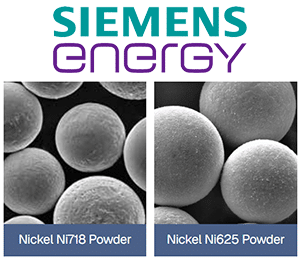
6K Additive exemplifies the sustainability-as-security case about as well as any other company, and the metals supplier just reinforced its position by announcing a long-term deal with Siemens Energy to source nickel-based alloy powders from the cleantech giant. 6K Additive will process nickel-based revert powder — scrap from in-house production — from Siemens Energy into new feedstock, supporting 6K Additive’s goal to build a circular economy for metal AM.
6K Additive notes that it has already processed nearly 20 tons of such powder from Siemens Energy, which the former subsequently supplied to the AM market. Siemens Energy has historically been one of the world’s largest metal AM users, giving 6K an ideal pipeline for high-quality scrap.
Siemens Energy, meanwhile, has been massively ramping up its investments into the US market, focusing on supporting the AI boom with grid infrastructure and gas turbine equipment, among other applications. According to the company, its latest investment of $1 billion will create over 1,500 skilled jobs in the US.
In a press release about 6K Additive’s long-term deal with Siemens Energy to source nickel superalloy scrap, the CEO of 6K Additive, Frank Roberts, said, “Siemens Energy is a strong example of an industrial partner committed to advancing circularity. Their consistent and high-quality feedstock enables us to produce premium nickel alloy powders using our UniMelt process, delivering meaningful reductions in energy use and carbon emissions while supporting the growing demand for sustainable AM materials.”
The Head of Finance for AM at Siemens Energy, Steve Sarcander, said, “At Siemens Energy, sustainability and responsible resource use are integral to how we approach advanced manufacturing. By supplying our revert material into 6K Additive’s production process, we are supporting circular material flows while helping to reduce waste and emissions associated with metal powder production. Partnerships like this play an important role in strengthening the overall [AM] value chain.”
Given the sustainability-as-security context, and the fact that this particular story involves a deal between a US company and a European one, I think it makes the most sense to view the agreement through the lens of US-EU trade relations. On the surface, while the relationship between the US and its European allies has rarely looked rockier, there are nonetheless reasons to believe that the trade dynamics could emerge on the other side of the turmoil in stronger shape than ever.
For one thing, even after President Trump imposed new, harsher tariffs on trading partners, including the EU, following the Supreme Court’s rejection of the tariffs that Trump has imposed since retaking office last year, the EU’s trade chief stated that he’s confident that the US will “ease” tariffs on metal products coming from the EU in the weeks ahead. Since metals in general, and critical minerals in particular, have become so central to the ongoing trade negotiations between the US and the EU, that statement suggests that a major breakthrough could be on the horizon for the monumental deal the US and the EU struck in the summer of 2025.
For another thing, speaking of that same trade deal — it hinges on energy flows from the US to Europe, and European nations have few options aside from the US when it comes to replacing baseload power supplies from Russia. This means that a deal between the EU and the US is in everyone’s interests regardless of what happens with tariffs, and the EU is simply now in a better bargaining position than it was prior to the Supreme Court ruling.
Assuming some version of the deal goes through, the outcome could result in many more business agreements that look like the one between 6K Additive and Siemens Energy. The West appears to be trending towards a scenario where North America and Europe become more interdependent on critical infrastructure supply chains, and one side provides the raw materials while the other provides the finished goods.
Interestingly, the nature of this dynamic that’s currently in discussion suggests that the relationship will most often work the other way around from the 6K/Siemens Energy arrangement, with the US supplying critical minerals and the EU providing the parts. But if true circular economy for AM can actually be cultivated, it will open up any number of possibilities for rearranging the elements within the overall trade framework.
Image courtesy of 6K
Subscribe to Our Email Newsletter
Stay up-to-date on all the latest news from the 3D printing industry and receive information and offers from third party vendors.
Print Services
Upload your 3D Models and get them printed quickly and efficiently.













You May Also Like
How Drone Proliferation Is Forcing a Rethink of Defense Manufacturing
The rapid proliferation of low-cost drones is forcing manufacturers to rethink their approach to design, production, quality, and scale. For defense manufacturing teams, the challenge is both how quickly a...
What 3D2GO Says About 3D Printing’s Growth in Southeast Asia
The Philippines offers an interesting case study in how 3D printing can develop in Southeast Asia, and Manila-based 3D2GO helps illustrate it. 3D printing in Southeast Asia doesn’t have to...
3D Printing News Briefs, September 12, 2026: Rebranding, Cybersecurity, Project Call, & More
We’ve got a lot of business news from ATLIX to start off this weekend’s 3D Printing News Briefs, with a new identify for its additive manufacturing (AM) portfolio and some...
Silencer Market Set to Test Metal Additive’s Readiness for Production Prime Time With Enormous Market Expansion
Throughout the history of additive manufacturing (AM) technologies, there are only a couple of really interesting case studies in which we see a market significantly disrupted and revolutionized by AM....