UpNano Lands €7M to Advance 2PP 3D Printing


Known for its hardware that can 3D print microscopic structures, UpNano has become an ally for industries like biomedicine and electronics. Now, the Austrian startup has landed a capital boost of €7 million, led by a group of investors. This financial injection is set to fuel UpNano’s next phase of innovation and growth, expanding its technology’s use in areas such as photonics and even bioprinting.
UpNano’s 3D printers can make microscale to nanoscale polymer parts with sub-micron precision, producing structures smaller than a human hair while maintaining exceptional detail. Thanks to its two-photon polymerization (2PP) 3D printing, UpNano’s technology stands out in the industry for its speed and accuracy. Founded in 2018 as a spin-off from the Vienna University of Technology (TU Wien), UpNano has grown rapidly, delivering cutting-edge solutions for high-precision manufacturing.
While UpNano isn’t the only player in the 2PP space—other companies like Nanoscribe also operate in this niche—UpNano has carved out a competitive edge with its proprietary 2PP process, which allows for both high precision and scalability.

UpNano 3D printed structures on its 2PP printing tech. Image courtesy of UpNano.
Backing this vision is a group of heavy hitters: Austrian venture capital fund aws Gründungsfonds, Italian investment group NovaCapital, the startup investment branch of IGO Industries known as IGO Innovation GmbH, and existing investor ILUM Tec.
“Our portfolio consists of well over 30 technology companies that we support with money and expertise,” explains NovaCapital Managing Director Carlo Germano Ravina. “We are entrepreneurs and managers with extensive experience and connections in technology-driven industries. With this mindset, we believe that UpNano can be the turning point of the 2PP 3D printing sector, being able to finally bridge the gap towards industrial, series production.”
For UpNano, this new funding is more than just a financial win—it’s a vote of confidence. According to the company’s CEO, Bernhard Küenburg, this backing will not only enable UpNano to fast-track the development of its next-gen 2PP printers but also strengthen its foothold in the global market 2PP 3D printing market. With the €7 million injection, the company is now set to launch even more advanced printers, as well as expand on its already high-performing NanoOne series of printers to international markets.
“We are delighted that our existing technology, IP position, and marketing strategy have been externally evaluated by experienced investors and that they agree on the great potential of our company,” says Küenburg. “The new investment of EUR 7 million, as well as the extensive experience of our investors in supporting young and successful companies on their growth path, are great assets for UpNano.”

UpNano’s management team. Image courtesy of UpNano.
Unlike typical 3D printing, 2PP allows for the creation of incredibly precise structures, down to sizes smaller than a single micron. This is a huge deal for industries that rely on creating tiny, complex parts, such as microelectronics, optical devices, or bioprinting.
UpNano’s NanoOne 3D printers are known for combining ultra-high resolution with speed, something that has historically been tough to balance. With 2PP, UpNano has found a way to produce highly detailed, intricate parts that can vary in size from the nano to centimeter scale. These machines have the potential to help fields like tissue engineering, drug delivery, and medical implants. UpNano’s 3D printers are already used in labs and factories around the world, and this new funding is only going to accelerate that growth.
With this new funding, UpNano plans to take its technology even further, setting new standards in the world of high-precision 3D printing. The company is already planning to unveil its next big innovation at the Formnext 2024 event in Frankfurt this November. UpNano recently showcased its portfolio of printers, materials, and services at the µTAS (MicroTAS) conference in Montreal, Canada, in mid-October 2024, an event focused on microfluidics, nanotechnology, and lab-on-a-chip systems.
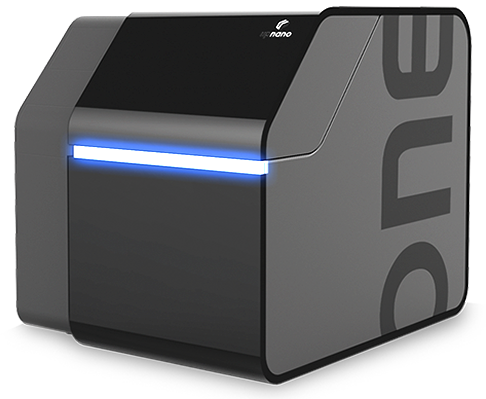
NanoOne printer. Image courtesy of UpNano.
This investment comes at a time when more industries are realizing the potential of 2PP technology. For example, in biomedicine, the ability to create detailed scaffolds for tissue engineering could change how medical professionals approach everything from implants to drug delivery. Similarly, the electronics industry is turning to 2PP 3D printing to develop smaller, more complex devices that could power the next wave of tech innovation.
In all of these fields, UpNano offers a unique combination of high resolution, fast printing speeds, and a wide range of material options; whether it’s to create a tiny part for an optical device or printing a scaffold for growing human cells, UpNano says its printers are built to handle it all. With a fresh €7 million in its pocket and backing from investors with deep expertise in technology-driven industries, the company is positioned to lead the next wave of 2PP 3D printing innovation.
Subscribe to Our Email Newsletter
Stay up-to-date on all the latest news from the 3D printing industry and receive information and offers from third party vendors.
Print Services
Upload your 3D Models and get them printed quickly and efficiently.













You May Also Like
Advanced Manufacturing at IMTS 2026: 3D Printing and AI and Drones, Oh My!
Last week’s International Manufacturing Technology Snow (IMTS) in Chicago welcomed over 90,000 attendees to the jungle that is McCormick Place. With over 1.17 million square feet of exhibit space, and...
Caracol to Build Large-Format 3D Printing Hub in Milan With Designtech & LAMÁQUINA
In the 1990 classic in economic strategy, The Competitive Advantage of Nations, business theorist Michael Porter wrote, “Most commentators on the Italian economy have persistently underestimated Italy, because they have...
ETH Students 3D Print Experimental Rocket Engine
Students at the Swiss University ETH have built a Rotating Detonation Rocket Engine (RDRE). An RDRE burns propellant in a ring-shaped combustion chamber where a continuous supersonic wave detonation is...
Printing Money Episode 35: Notable VC and M&A Deals, with Arno Held and Alex Kingsbury
Welcome to Printing Money Episode 35 and let us be the last to wish you a happy new year. For this episode Danny is joined by Arno Held (Managing Partner,...