Veeco Buys NXG XII 600 Metal 3D Printer for Semiconductor Applications

Veeco, a US-based semiconductor equipment supplier with $583 million in revenue, has acquired a 12-laser NXG XII 600 powder bed fusion 3D printer from Nikon SLM Solutions for semiconductor applications. The company, which produces PVD machines, ALD machines, and other equipment for the currently cash-rich semiconductor industry, plans to use this large-scale machine for manufacturing “gas delivery systems, manifolds, and heat exchangers.”
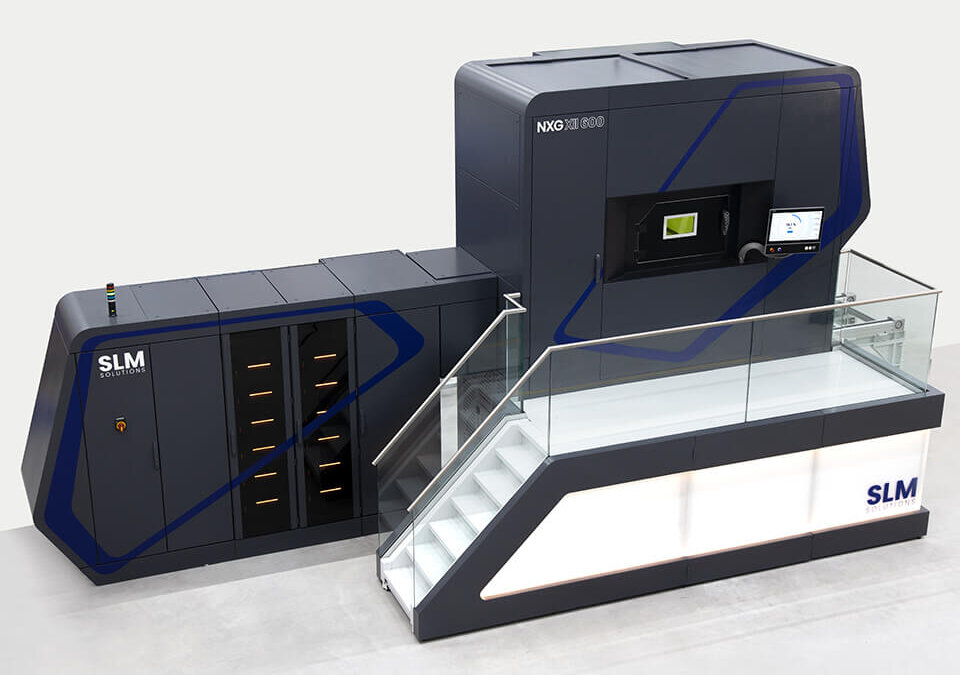
“We are proud to partner with Veeco and to have provided them with the NXG XII 600, Veeco’s success with their initial application demonstrates the immense potential of additive manufacturing for the semiconductor industry. We look forward to seeing how they continue to innovate and expand the use of AM in their operations,” said Charlie Grace, CCO at Nikon SLM Solutions.
“Additive manufacturing plays a pivotal role in driving innovation and productivity for advanced process equipment in semiconductor and compound semiconductor manufacturing. This technology not only accelerates time-to-market but also enhances the precision and efficiency of manufacturing processes. By leveraging the capabilities of the NXG XII 600, Veeco will push the boundaries of what is possible in semiconductor manufacturing, paving the way for new advancements and applications in the industry. This collaboration with Nikon SLM Solutions represents a significant step forward in our mission of innovation and commitment to long-term customer success,” said Ahmed El Desouky, Director of Additive Manufacturing at Veeco.

Image: courtesy of 3DPrint.com/Sarah Saunders.
It’s uncertain exactly how Veeco plans to use its NXG XII 600, as traditionally, large multi-laser systems like this have been employed for applications in defense and new space industries. The appeal of these systems has often been their ability to produce singularly large, integrated components. For example, a rocket propulsion unit printed as a single piece could offer significant benefits in terms of reduced assembly costs, lower mass, enhanced performance, and the ability to integrate more functionality while reducing the overall part count. These advantages have been particularly valuable in the new space industry, where there are few alternatives for producing such complex parts, and time constraints are critical due to the need to meet contracts and launch schedules. At the time, cash-rich companies were willing to invest in these capabilities.
The semiconductor industry shares some similarities, as it is currently experiencing a cash-rich phase, though a downturn may be on the horizon. However, the specific component-level logic behind Veeco’s purchase of the NXG remains unclear. While the semiconductor industry is expected to invest around $1.4 billion in additive manufacturing by 2032, according to the “3D Printing for Semiconductors: Market Opportunity Brief” from Additive Manufacturing Research, it’s not entirely obvious what precise applications Veeco envisions for the machine. In the past we’ve seen semiconductor showers, probes, and EUV components, among other parts. The CHIPS Act has indeed spurred U.S. companies to ramp up domestic production of chip components, potentially creating production constraints that justify such an investment.
Heat exchangers, one of the applications Veeco mentioned, are typically smaller components. For this reason, using a large machine like the NXG XII 600 can seem counterintuitive; generally, smaller machines are more cost-effective, offering more redundancy and flexibility. However, there may be specific cases where exceptionally large heat exchangers for specialized semiconductor equipment are needed, justifying the use of a larger system.
Overall, the semiconductor industry is proving to be an important growth driver for additive manufacturing, especially as more firms look to localize production and invest in new technologies to maintain their competitive edge. The factors influencing Veeco’s decision likely reflect broader industry trends and specific needs in high-precision and complex component manufacturing.
Subscribe to Our Email Newsletter
Stay up-to-date on all the latest news from the 3D printing industry and receive information and offers from third party vendors.
Print Services
Upload your 3D Models and get them printed quickly and efficiently.













You May Also Like
How Should Businesses Build New Business? Dirk Simon Weighs In — Part 1
Dirk Simon had deep experience in materials and chemistry before joining the 3D printing industry. Instrumental in BASF and Farsoon’s market introduction, Dirk has spent a lot of time thinking...
The Frankenservice Part 2: Have Your Cake and Eat it Too
This series of articles delves into a thought experiment. What if we let go of using a few machines very optimally, but instead use lots of different machines to meet...
The Additive Chicken Coop, Part IV: Lemmings
If we look at our past, we can see how making custom machines, incessantly watching ourselves, and our inability to rescope shaped our industry. We have also looked at the...
The Additive Chicken Coop, Part III: Bananas
A friend of mine, Ed Davis, once pointed out the level of strategic replication in additive. I wasn’t aware of it before and haven’t been able to unsee it since....