Formnext 2023 Day Two: A Barely Audible Hum

At Formnext, a persistent, barely audible hum permeates the show floor, created by the murmurs and movements of thousands circulating through the expansive hall. This ambient noise, occasionally broken by laughter or mechanical whirs, is a constant presence. On the second day, the show was bustling yet not uncomfortably so. While there’s always a wish for higher attendance, the quality of the discussions stood out; they were meaningful and purposeful. Many visitors, well-versed in 3D printing, sought out specific solutions, updates, or news.
There’s a perception of softening machine demand, yet transactions are occurring, particularly within the more affordable industrial sector. With the general expectation that capital expenditures are being slashed due to the costly nature of investment, opportunities for deals are abundant—not just among the small companies facing insolvency but also in the machinery sector.
A cautious optimism is taking root, driven by a slight uptick in participation, but concerns linger that the underperformance of some publicly traded firms could cast a shadow over the wider, more diverse ecosystem. In the midst of these challenging times, genuine manufacturing flourishes—real transactions for real components with tangible profits. Many attendees are intent on refining processes, elevating efficiency, and cutting costs on parts. While some report an unprecedented number of leads, others find progress slower, revealing a divide where the successful continue to thrive and the struggling falter more decisively.
Many of the new offerings at the event were incremental advancements. For instance, there was the automated post-processing solution for Formlabs’ powder bed fusion technology that streamline depowdering, resurfacing, and powder recycling for the Fuse system. Markforged unveiled the FX10, a new addition to their machine lineup, amid a broader trend of collaboration within the industry.
Axtra3D and 3D Systems have teamed up to provide a dental solution that integrates Oqton’s capabilities, while Nikon SLM Solutions is joining forces with Materialise to advance software development. HP and Materialise are also partnering, integrating Multi Jet Fusion technology into the CO-AM platform. A consortium including Siemens, HP, BASF, EOS, and Dye Mansion has created the AM Navigator tool, a new resource for the industry.
Farsoon, Hyperganic, and BASF have brought forth a lattice engine, an innovation that particularly piqued my interest. A remarkable development involves Hittech Group, a Dutch company specializing in semiconductor and high-end manufacturing, which is entering a joint venture with 3T Additive Manufacturing, part of BEAMIT and thereby a subsidiary of Sandvik. This exemplifies a significant value shift—from selling raw materials like iron ore to sophisticated semiconductor equipment.
What’s evident is an uptick in strategic partnerships, with numerous firms joining forces. While there are public collaborations aimed at collectively industrializing certain aspects of 3D printing, in private, alignments are becoming even more pronounced. We’re observing alliances forming not just among large industrial firms and select 3D printing suppliers in their networks but also among 3D printing companies themselves, all aiming to serve larger clients. This dynamic is poised to create an uneven playing field, potentially amplifying successes for some while exacerbating losses for others.
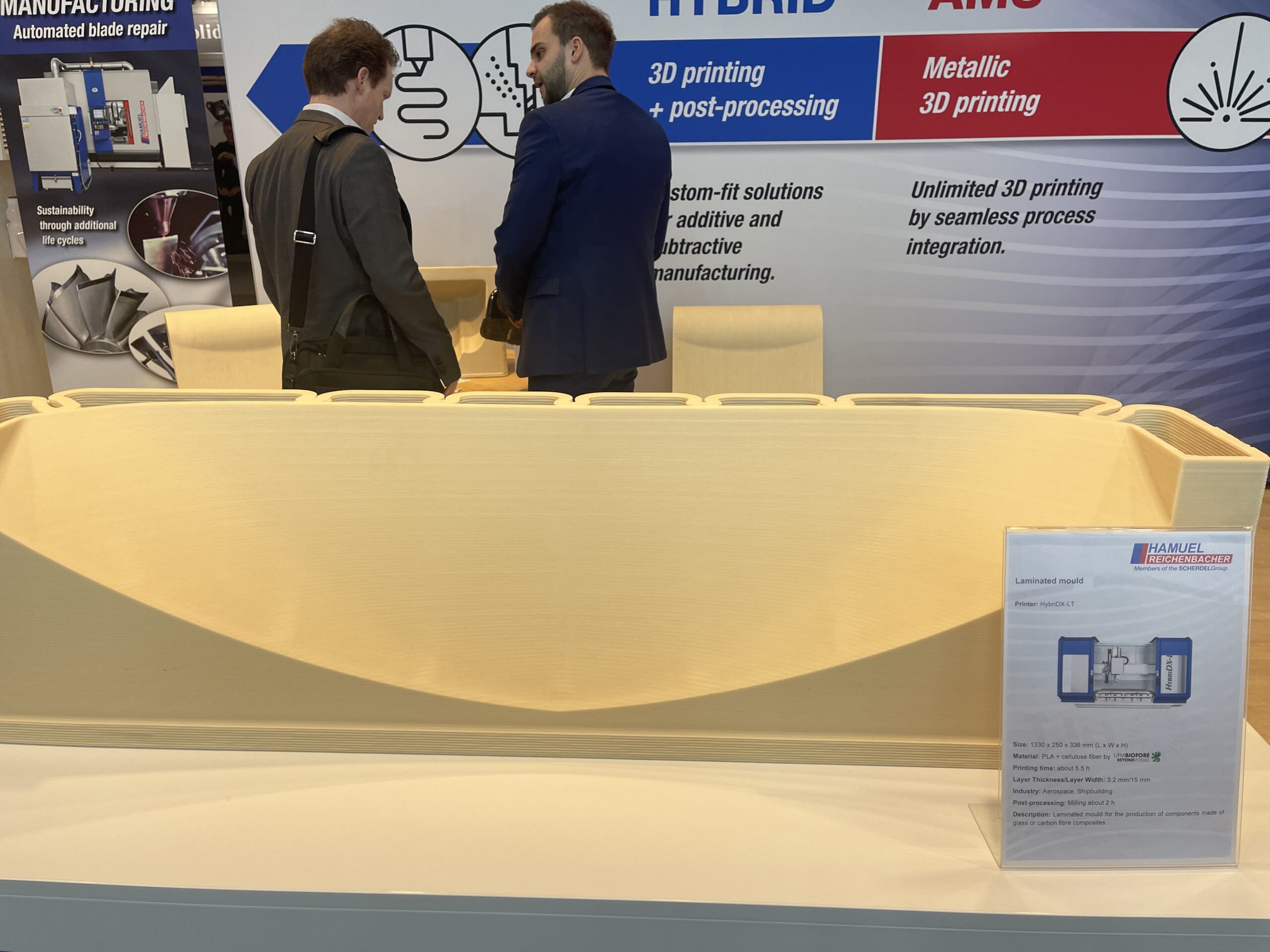
There were numerous subtle innovations that caught my eye at the event. Reichenbacher Hamuel, for instance, showcased a hybrid 3D printing machine that caters to molds and large-scale parts. Notably, the company demonstrated a laminated mold made from a bio-based material, which was remarkably smooth to the touch. This advancement has the potential to be a sustainable game-changer for many companies, especially considering that the combined printing and machining time for such a tool is less than eight hours, outpacing many alternatives.
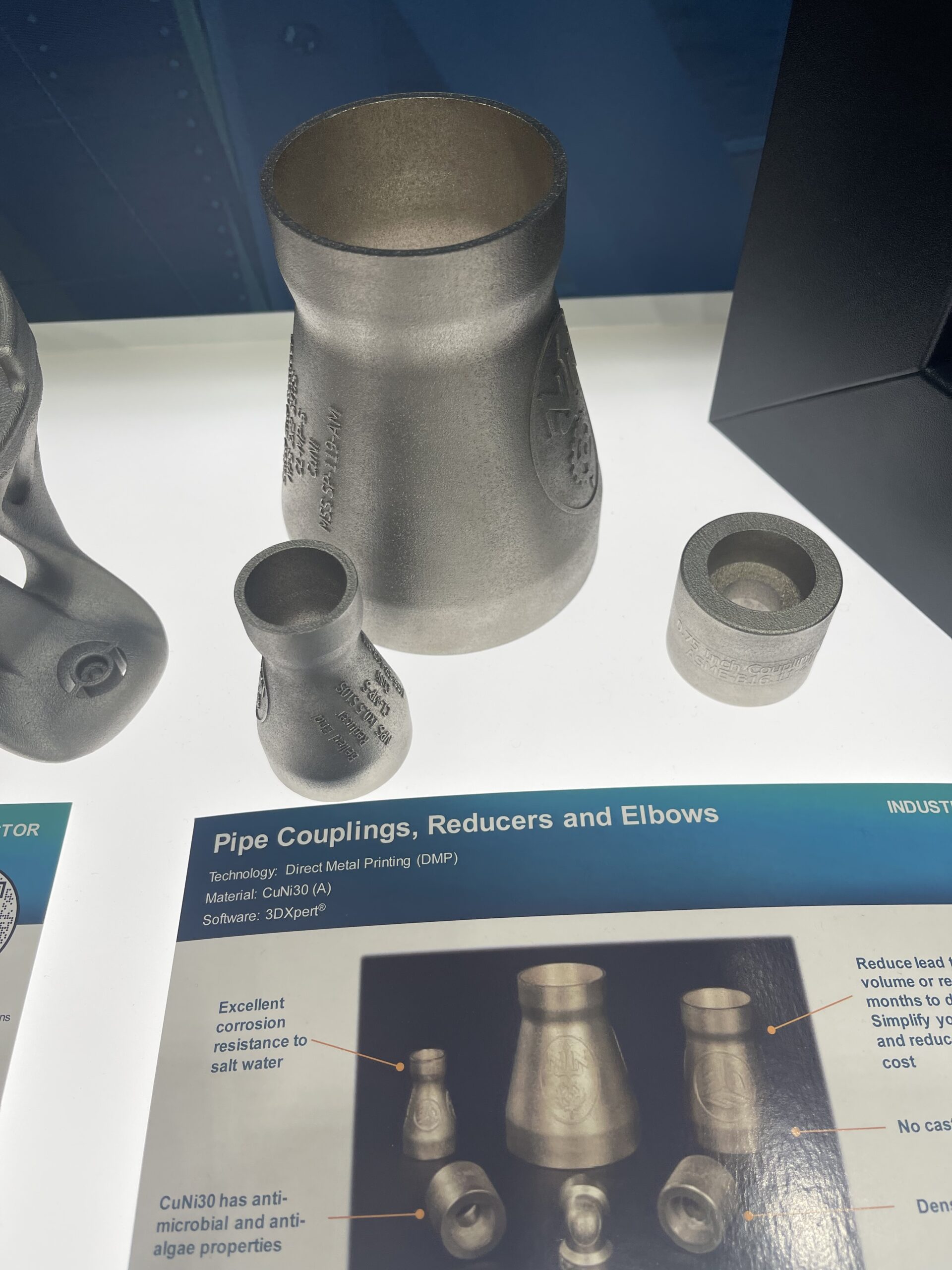
The seemingly mundane elements also left an impression on me. Pipe couplings, reducers, and elbows might not scream innovation, but considering the volumes produced and their use in critical, high-end applications, their potential impact is significant. At the 3D Systems display, the powder bed fusion material CuNi30a was presented—its resistance to saltwater opens up applications in maritime, oil, and similar industries.
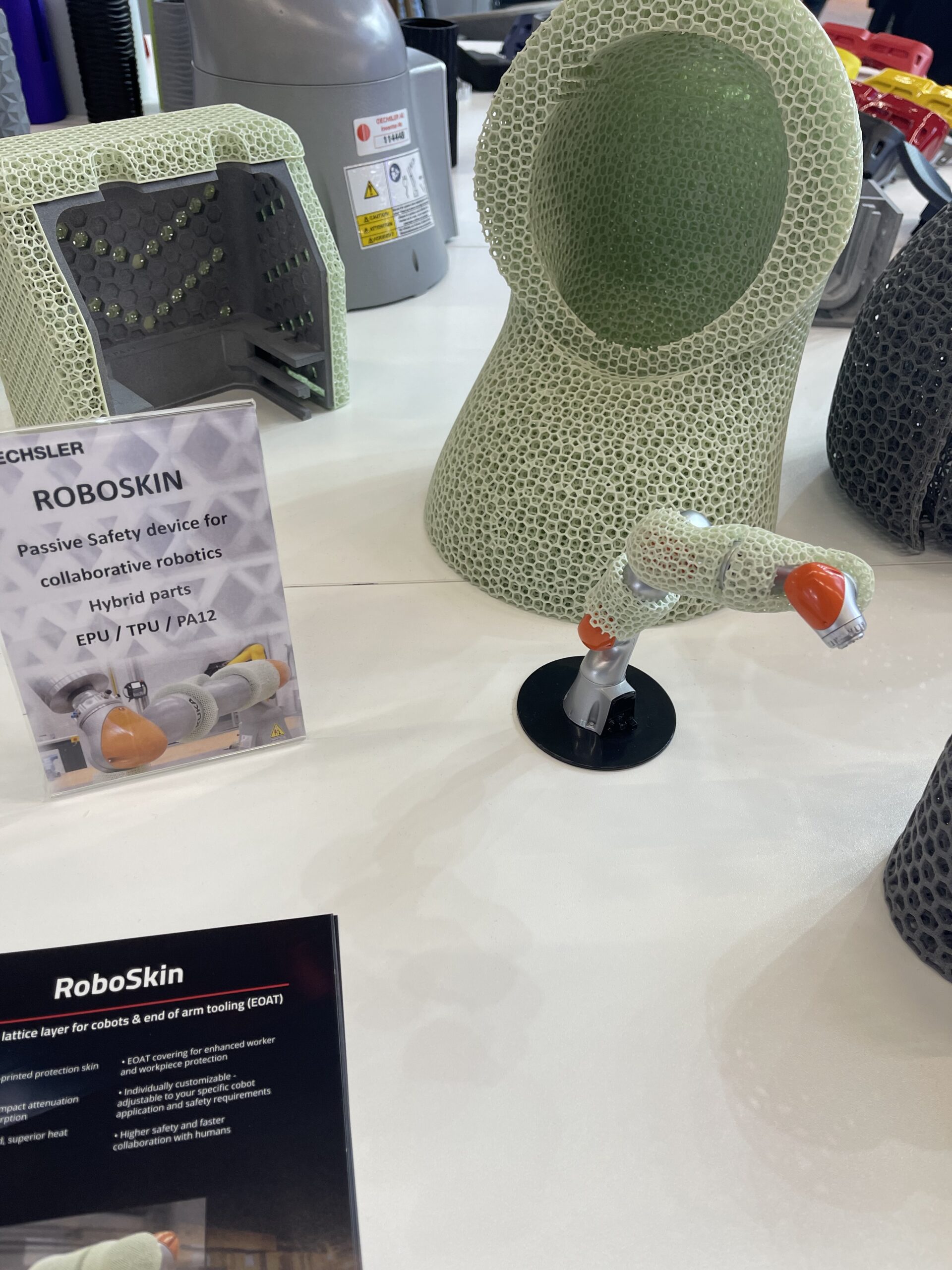
I was equally enchanted by RoboSkin from Oechsler, featuring Carbon’s elastomeric coverings designed for industrial robots and collaborative robots (cobots). This material not only serves as protection for the robots but also creates a safer interaction point for humans working alongside them. The covering could even make people feel more at ease around cobots.
Witnessing dozens of real-life applications and solutions was exhilarating. It was a testament to an industry maturing to address global needs. The physical exhaustion from traversing the event couldn’t dampen the elation I felt—it was as if I was walking on air.
Subscribe to Our Email Newsletter
Stay up-to-date on all the latest news from the 3D printing industry and receive information and offers from third party vendors.
Print Services
Upload your 3D Models and get them printed quickly and efficiently.











You May Also Like
3D Printing News Briefs, May 28, 2026: Continuous Fiber Reinforcement, Bioprinted Trachea, & More
In today’s 3D Printing News Briefs, America Makes announced the winners of its JAQS-SQ Project Call. Axtra3D is partnering with Keystone Industries to expand its dental material ecosystem, while BigRep...
3D Printing News Briefs, May 23, 2026: Inserts, Racing, Cultural Heritage, & More
In this weekend’s 3D Printing News Briefs, 3D People has integrated threaded inserts into its online quoting tool, AM Solutions has introduced a more compact solution for automated cleaning and...
3D Printing News Briefs, May 20, 2026: Distribution, Fracture Mechanics, & More
We’re starting with business in today’s 3D Printing News Briefs. ATLIX announced a strategic distribution partnership with Excelencia Tech Group, and Timeplast raised $5 million in an oversubscribed campaign, powered...
Ceramic 3D Printing Applications on Display at Ceramics Expo USA
There’s a lot of crossover between ceramics and additive manufacturing (AM). Now, we just need to get the two industries to talk to each other more. It was nice to...