Fuji Introduces Electronics 3D Printer to J.A.M.E.S. Consortium

While the rest of the additive manufacturing (AM) industry is focused on the potential merger between Stratasys (Nasdaq: SSYS) and Desktop Metal (NYSE: DM), the exciting world of electronics 3D printing is making steady progress toward becoming one of the most revolutionary areas for the sector. This is demonstrated in part by the evolution of the additively manufactured electronics (AME) consortium J.A.M.E.S. GmbH. The group, which aims to advance AME through mutual collaboration between members, recently signed its newest member, Fuji Corporation, which released an electronics 3D printer in 2021.
Not to be confused with Fujifilm, which has mostly danced on the outskirts of the 3D printing industry, Fuji Corporation is a Japanese machine tool and robotics manufacturer. The company makes a wide variety of manufacturing systems, ranging from lathes to automated, multi-faceted modular equipment for complex machining with up to 70 different tools. It also manufactures machines for electronics assembly, including pick-and-place and other surface mount technologies.
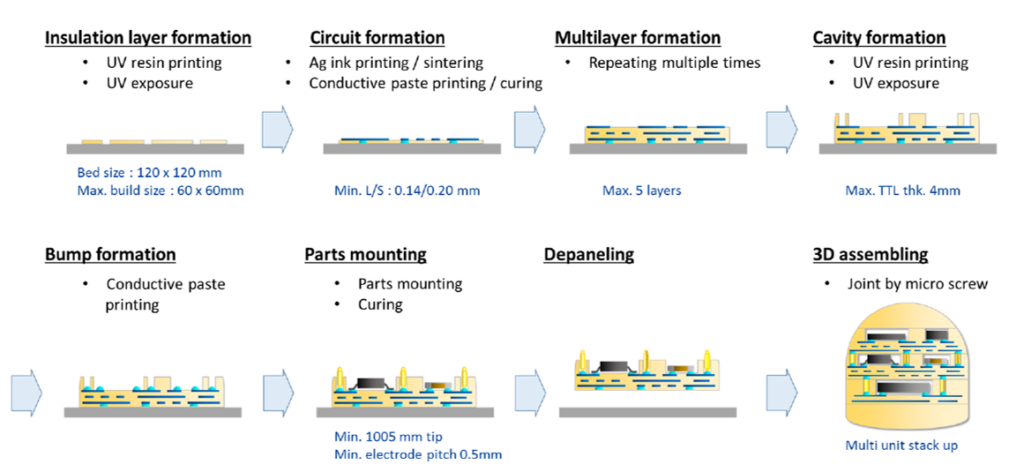
With these business areas in mind, it’s not entirely surprising that the company has its own electronics 3D printer, the FPM-Trinity. The system works by depositing and curing photopolymer resin before applying and sintering silver ink and placing additional electronic components. While it is capable of creating entire functioning circuit boards in a single job, it is not yet at the level of then automatically assembling them into multi-layered boards.
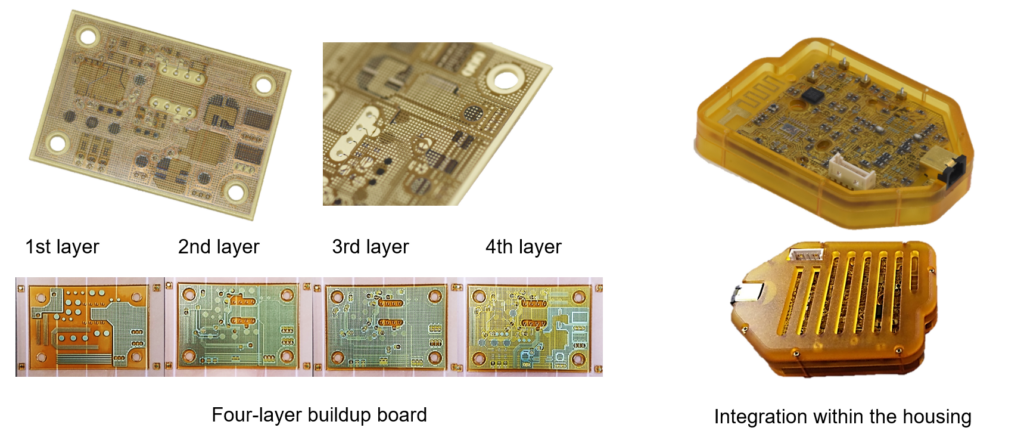
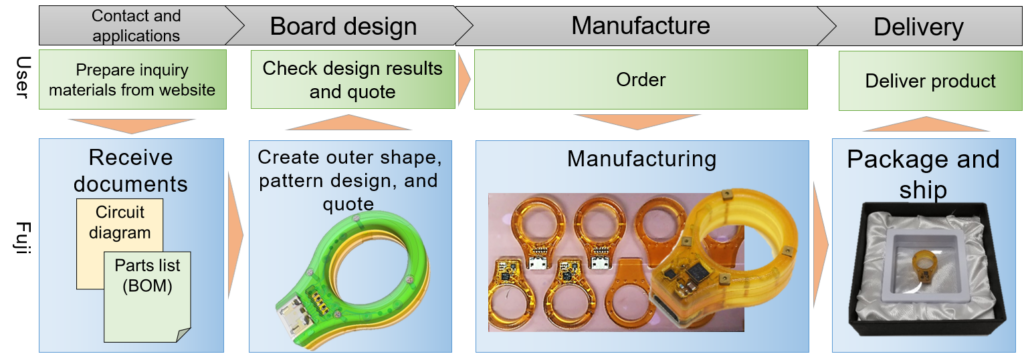
Like most electronics 3D printer manufacturers, the technology is currently marketed for prototyping and low-volume production. The printer is still under development, but Fuji offers electronics 3D printing as a service. As the system is made market-ready, Fuji aims to fully commercialize it as a product itself.
For its part, J.A.M.E.S. has established an online community for manufacturers and users to communicate in real-time as a means of advancing AME more quickly. By joining the consortium, Fuji will be able to promote the use of FPM-Trinity while obtaining feedback from users.
The electronics 3D printing industry is still quite nascent, but there are inklings that its use may be more widespread than is made public. Optomec’s Aerosol Jet technology has been used to 3D print antennas onto millions of mobile devices. Customers include Apple, Google, Meta, and Samsung, who have likely acquired electronics 3D printers from nearly every other manufacturer, such as Voltera, nScrypt, Nano Dimension, and Neotech.
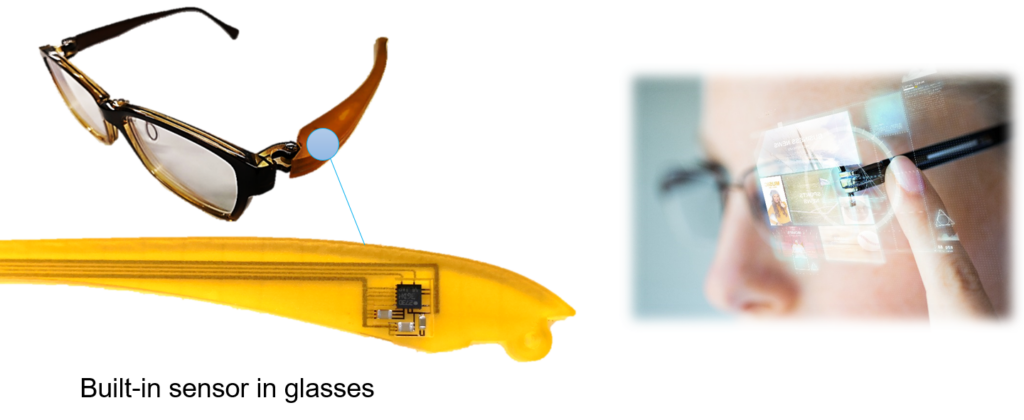
Back when it was Facebook, Meta purchased a startup devoted to 3D printing electronics and brought Luxexcel into the fold at the end of last year, ostensibly to produce prescription smart glasses or mixed reality headsets. Apple will be unveiling its first mixed reality headset next week. For a company like Apple to release what has previously been a cumbersome, niche technology, surely it has had to reduce the form factor and weight of the device. The best way to do something like that would be to incorporate electronics directly into the unique geometries of the headset—i.e., use 3D printing. So, while Fuji and J.A.M.E.S. are only now beginning to accelerate the adoption of AME, it may be that, after this year, the once-small sector will explode.
Images courtesy of Fuji Corporation.
Subscribe to Our Email Newsletter
Stay up-to-date on all the latest news from the 3D printing industry and receive information and offers from third party vendors.
Print Services
Upload your 3D Models and get them printed quickly and efficiently.












You May Also Like
Making 3D Printing Personal: How Faraz Faruqi Is Rethinking Digital Design at MIT CSAIL
What if your 3D printer could think more like an intelligent assistant, able to reason through a design idea, ask questions, and deliver something that works exactly the way the...
Reinventing Reindustrialization: Why NAVWAR Project Manager Spencer Koroly Invented a Made-in-America 3D Printer
It has become virtually impossible to regularly follow additive manufacturing (AM) industry news and not stumble across the term “defense industrial base” (DIB), a concept encompassing all the many diverse...
Heating Up: 3D Systems’ Scott Green Discusses 3D Printing’s Potential in the Data Center Industry
The relentless rise of NVIDIA, the steadily increasing pledges of major private and public investments in national infrastructure projects around the world, and the general cultural obsession with AI have...
Formlabs Teams Up with DMG MORI in Japan
In late June, Nick Graham, Chief Revenue Officer at Formlabs, announced on LinkedIn that the company had partnered with DMG MORI, one of the world’s leading machine tool companies, to...