3D Printed Sensors Developed to Aid Lupus Patients

Researchers from the University of Minnesota are one step closer to helping millions of Lupus patients worldwide. A small team of dedicated scientists and doctors have created a 3D printed light sensing device that will be able to correlate light sensitivity to a patient’s Lupus symptoms. From the work, scientists could glean new insights into the disease and help doctors better treat Lupus all over the world.
Light and Lupus: A Complex Relationship
Lupus affects roughly five million people worldwide, and can cause rashes, joint pain, and fatigue. This can be debilitating to the person, and research has shown their symptoms worsen when exposed to sunlight or artificial sunlight. Although they have known there was a correlation between the two, doctors have found it challenging to predict how each individual will be affected by the light.
David Pearson, a dermatologist at the University of Minnesota’s Medical School, wanted to tackle this issue head on after working with many Lupus patients during his time in Minnesota. Seeking to better understand the correlation between light and Lupus symptoms, Pearson sought out Michael McAlpine, a professor from the university who has developed wearable medical devices in the past.
3D Printed Light Detector
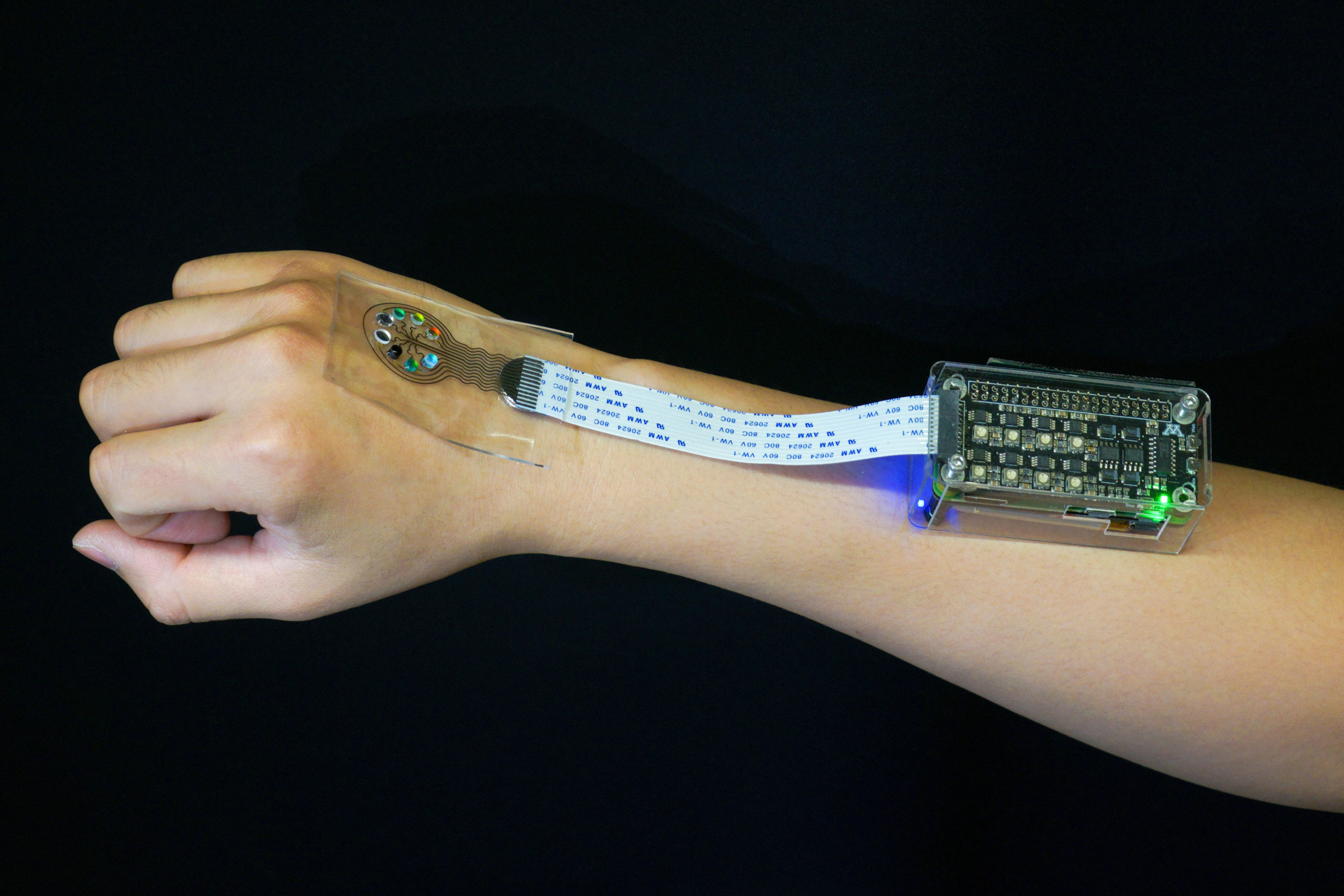
Together, Pearson and McAlpine created a 3D printed UV-visible light detector that could be placed on the skin and worn continuously throughout the day. The device is able to monitor UV-Vis exposure and correlate that exposure to a patient’s symptoms. Built using previous work from McAlpine’s group, the team was successfully able to modify a 3D printed light emitting device and convert it into a light receiving device, seen below.
The device will soon start clinical trials after its recent approval for human subject testing, and hopefully the studies give doctors insights into Lupus never before understood. The project joins a long list of others in which 3D printing is used to help better understand health and medicine. Feasibly, such devices could be printed in doctor’s offices worldwide. We can imagine a patient sitting down and, within the duration of the appointment, their doctor determining the impact of different wavelengths’ affect before printing a device personalized to them. More work will need to be done before that dream becomes a reality. However, if the University of Minnesota continues to progress like it has, we will get there.
Subscribe to Our Email Newsletter
Stay up-to-date on all the latest news from the 3D printing industry and receive information and offers from third party vendors.
Print Services
Upload your 3D Models and get them printed quickly and efficiently.











You May Also Like
AUKUS Installs Metal Part 3D Printed on a Deployed Submarine Tender
In a project showcasing virtually every major theme that has been driving military interest in additive manufacturing (AM) over the last decade, sailors on the U.S. Navy’s Emory S. Land-class...
3D Printing News Briefs, November 27, 2025: Awards, Sand Binder Jetting, Tabletop Gaming, & More
To all those who celebrate, happy Thanksgiving! In today’s holiday 3D Printing News Briefs, we’re starting off with some exciting news: the winners of this year’s Formnext Awards! Then, we’ll...
Trident Warrior 2025 Becomes a Massive Showcase for 3D Printing — With 11 AM Companies in the Field
Every year, the U.S. Navy runs an exercise called Trident Warrior to test new technologies under real operating conditions. In 2025, the biggest surprise was how central 3D printing became....
Formnext 2025: New Metal PBF 3D Printer, Serial Production Applications, & More
It’s Day 2 of Formnext 2025, where over 800 exhibitors from around the world have converged in Frankfurt for Europe’s premier additive manufacturing (AM) trade show. From exciting new printers...