
US Army Awards Contract to Phillips Federal for Containerized WAAM Factories

Everything that the U.S. Army has been doing with additive manufacturing (AM) over the last year or so suggests that the branch is getting serious about deployable production systems. One of the most recent examples of this trend was announced on January 2, when Phillips Corporation’s Federal Division revealed that the Army had granted a contract to the company to develop containerized Wire Arc Additive Manufacturing (WAAM) systems that include Haas CNC machines for post-processing.
The contract is part of the Army’s Metal Working Machine Shop Set (MWMSS) program, which has been in place for over a decade now. Phillips Federal’s contract is a five-year, Indefinite Delivery, Indefinite Quantity (IDIQ) deal, which gives the Army flexibility in terms of assessing its order requirements as the situation evolves and demand signals clarify.
Each of the systems, called Wire Arc Hybrid Manufacturing (WAHM) units, includes a Fronius iWave 400i welder, in addition to the Haas CNC machine, plus the associated software, with all components integrated into shipping container housing. The success of companies like Firestorm Labs has reinforced the plausibility of the containerized production system concept, in an environment in which the Army sees the ability to manufacture equipment at the frontlines as an urgent priority.
According to Phillips Federal, Naval Surface Warfare Center Carderock Division (NSWCCD) will manage the IDIQ contract through NSWCCD’s Additive Manufacturing Project Office. Phillips Federal has worked extensively with the U.S. Navy on AM development in recent years, including work on the first permanent installation of a hybrid metal AM system aboard a deployed Navy warship at the end of 2022.
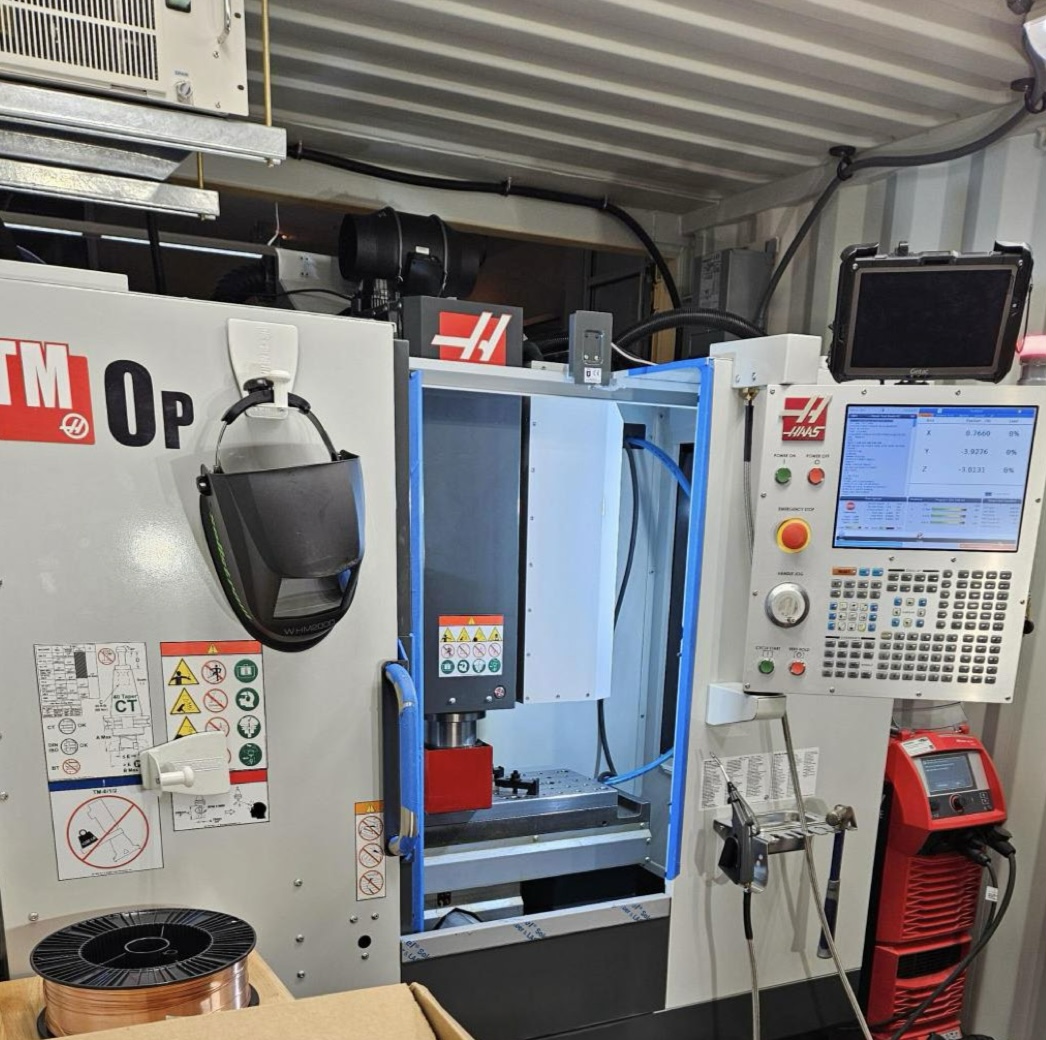
In a press release about the U.S. Army’s award of an IDIQ contract to Phillips Federal for containerized hybrid WAAM systems, the President of Phillips Federal, Tim McClanahan, said, “I’ve been personally involved with the MWMSS program since its inception, and it’s been incredibly rewarding to see how these systems have evolved from concept to fielded capability. What began as a focused effort to extend expeditionary metalworking has naturally matured into a far more capable hybrid manufacturing solution.
“The integration of [WAAM] with CNC machining in a containerized format delivers more capability to the warfighter than ever before by enabling faster repair, increased self-sufficiency, and true manufacturing at the point of need. This award reflects years of collaboration with the Army and our partners to turn operational requirements into real, deployable capability.”
While expeditionary manufacturing with genuinely deployable production cells represents only a fraction of how the U.S. military and the defense sector are currently leveraging AM, the growth of this market segment is also arguably the most heavily dependent of any area of the AM-defense nexus on technical maturity. With that in mind, if the Army currently sees enough demand to warrant a five-year contract, it’s likely only a matter of time before other customers follow the branch’s lead.
Assuming that happens, containerized expeditionary AM systems could rather quickly increase their share of the overall market. Although the underlying tech has taken a disproportionate amount of time to evolve, its adoption rate could be asymmetrically rapid, now that the systems have gone “from concept to fielded capability,” in the words of Phillips Federal’s president.
The interesting angle there is that the success of containerized systems would likely be one of those developments where a victory for one area of the AM market wouldn’t be at the expense of other AM market segments, but would, instead, help grow the entire pie for everyone. A successful containerized system, in addition to the production capacity it represents, is also a showcase for all the advantages of AM more broadly. And there’s increased justification for printing a piece of military hardware if you know that the component can be reliably reproduced in the field.
Another interesting opportunity hinted at here is the potential it opens up for cross-branch cooperation on AM activities. The U.S. Navy and U.S. Coast Guard recently announced an example where Coast Guard sent files for a replacement bracket to a nearby U.S. Navy submarine, which printed the part and then hand-delivered it to the Coast Guard for installation. The more expeditionary systems there are in the field, the more this sort of thing will become routine.
Images courtesy of Phillips Federal
Subscribe to Our Email Newsletter
Stay up-to-date on all the latest news from the 3D printing industry and receive information and offers from third party vendors.
Print Services
Upload your 3D Models and get them printed quickly and efficiently.













You May Also Like
3D Printing News Briefs, August 22, 2026: Polymers for CubeSats, Animal Mobility Devices, & More
We’re starting with defense news in this weekend’s 3D Printing News Briefs, before moving on to polymers for CubeSats and 3D printed prosthetics. We’ll end with a story about engineering...
Pusan National University & ORNL Develop Elastomeric Liquid Crystal Actuators
Researchers from Korea’s Pusan National University and Oak Ridge National Laboratory (ORNL) have developed 3D printed elastomeric actuators. In a paper published in Nature, the team used elastomeric liquid crystal...
Scientists Use BMF to 3D Print Seal Whiskers That Track Prey Long After It’s Gone
Seals use their whiskers to hunt. Not Navy Seals, although they may in some way also, but this article is about lowercase seals. Not Seal the musician either; as far...
Harvard’s Jennifer Lewis Lab Is 3D Printing Artificial Muscles That Twist and Bend on Demand
Researchers at Harvard John A. Paulson School of Engineering and Applied Sciences (SEAS) have developed a new way to 3D print materials that can move on their own, bending, twisting,...























































